



















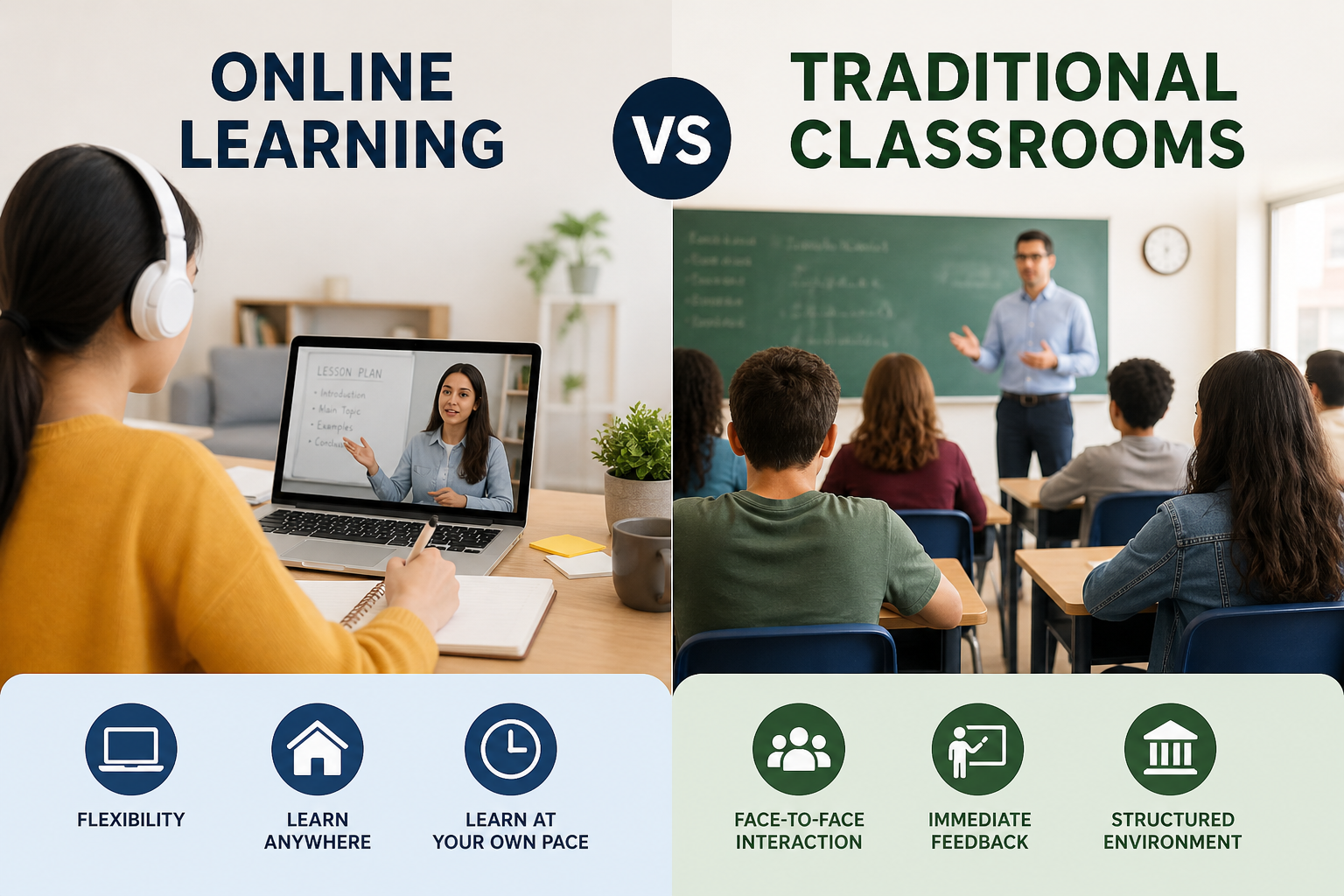
The argument over whether online education “works” was settled, in a research sense, more than a decade ago. The evidence has only accumulated since. The honest summary is more nuanced than either the marketing claims or the cultural skepticism suggest: well-designed online instruction produces outcomes comparable to — and in some specific contexts, better than — traditional in-person instruction. Poorly designed online instruction does not. The variable is design, not modality.
The foundational evidence is the U.S. Department of Education’s meta-analysis of online and blended learning research, which examined dozens of studies and found that, on average, students in online conditions performed modestly better than students in face-to-face conditions on identical assessments. The effect was strongest for blended formats — courses that combined online and in-person elements — and held across a range of subjects and student populations.
Several follow-on studies have refined the picture. Three findings are worth holding in mind.
The “engagement gap” is a design problem, not a modality problem. The widely cited concern that online students are less engaged tends to dissolve when researchers control course design. Online courses that include structured discussion, active-learning prompts, and regular feedback produce engagement metrics indistinguishable from in-person courses. Online courses built around recorded lectures and multiple-choice quizzes produce engagement gaps. The pattern holds regardless of student age or prior experience.
Outcomes for working adults are particularly strong online. This is the population for whom online formats were designed, and it shows. Working adults completing online programs show higher completion rates than working adults attempting traditional evening classes — primarily because the format eliminates a long list of friction points (commute, fixed class times, family-coverage conflicts) that drive attrition in evening programs.
Synchronous components close most remaining gaps. The online courses that consistently match in-person outcomes include some live elements — a weekly seminar, a project-team meeting, a faculty office hour — even when most of the work is asynchronous. Pure asynchronous design works for self-directed learners but produces wider performance variance than blended designs. The implication for program design is straightforward: hybrid pacing, with mostly-asynchronous content and a regular synchronous touchpoint, is the most reliably effective structure.
The mistake the research warns against is treating “online” and “in-person” as if they are uniform categories. The variation within each format is far larger than the variation between them. A poorly run in-person lecture course produces worse outcomes than a well-designed online course. A well-designed in-person seminar produces better outcomes than a hastily ported online version of the same content. Buyers of education — students, employers, and policymakers — should be asking design questions, not modality questions.
What this means for prospective students is a shift in which questions matter. The question “is this online?” is less useful than the question “how is this online program designed?” Specifically: how often do students hear from faculty? Are there synchronous components, and how often? What’s the structure of the assessment — projects, exams, papers, or some mix? How are students grouped, if at all? What does student work actually look like at the end of the program?
A growing body of evidence-based online degree programs is designed around these answers, with regular faculty interaction, structured discussion, and applied assessments rather than passive content delivery. These are the programs the research supports — and they are increasingly difficult to distinguish, on outcomes, from their on-campus counterparts.
For employers, the implication is similar. The screening question “is the candidate’s degree online?” is less informative than “what did the candidate actually do in their program?” The programs that produce strong graduates produce strong online graduates and strong in-person graduates, because the design — not the modality — does the work.