






















Wildfire behavior has changed. The fires of the past two decades in the American West, in Australia, in southern Europe, and across other fire-prone regions have broken historical records for size, speed, and destructiveness with enough regularity that the broken records are no longer news. The convergence of drought, heat, decades of fire suppression that has accumulated fuel loads, and expanding development at the wildland-urban interface has created a fire environment where communities that were not historically at significant risk now face genuine threats, and communities that were always at risk now face threats of greater severity and speed than previous generations experienced.
This changed risk environment demands updated preparedness thinking. Strategies that worked when fires moved at speeds that allowed hours of warning time are less adequate when fires can travel a mile in minutes under certain wind and fuel conditions. This guide addresses wildfire preparedness systematically, from home hardening through evacuation planning to the immediate actions that determine outcomes when a fire approaches.
Understanding Wildfire Behavior
Effective wildfire preparedness requires understanding what drives fire behavior. The fire triangle applies: fuel, heat, and oxygen. In the wildland context, fuel is vegetation in all its forms, from dry grass to brush to mature timber. Heat is the ambient temperature and the radiant heat from the fire itself. Oxygen delivery is driven primarily by wind, which is the most powerful and least predictable variable in wildfire behavior.
Wind drives fire in two ways: it supplies oxygen that intensifies combustion, and it pushes the fire front in the wind direction while potentially throwing embers miles ahead of the main fire through a process called spotting. Spot fires started by wind-carried embers landing in unburned fuels are one of the most dangerous aspects of severe wildfire events and one of the reasons fires can move so much faster than their visible front would suggest. A home can ignite from an ember landing on a wooden deck or entering a roof vent while the main fire front is still miles away.
Home Hardening Against Wildfire
The most durable wildfire protection is built into the structure and landscaping before any fire occurs. Home hardening addresses the vulnerability points that allow ignition from ember cast, radiant heat, and direct flame contact.
Roofing and Vents
The roof is the most vulnerable component of a home in a wildfire because it presents the largest surface area for ember deposition. Class A fire-rated roofing materials, including metal, tile, and Class A asphalt shingles, provide the highest resistance to ignition from ember exposure. Vents, including attic vents, soffit vents, and foundation vents, are entry points for embers and need to be fitted with 1/8-inch or finer metal mesh screens that prevent ember entry while maintaining airflow.
Defensible Space
Defensible space is the cleared and managed vegetation buffer around a structure that reduces fuel available to an approaching fire and provides room for firefighters to work safely. California fire code requires Zone 1 (0 to 30 feet from the structure) to be maintained with non-combustible or low-fuel-volume plants spaced to avoid continuous fuel beds, and Zone 2 (30 to 100 feet) to have reduced fuel density with vertical and horizontal separation between plants. Even where not legally required, this framework reflects sound fire behavior principles applicable anywhere.
Creating Your Wildfire Evacuation Plan
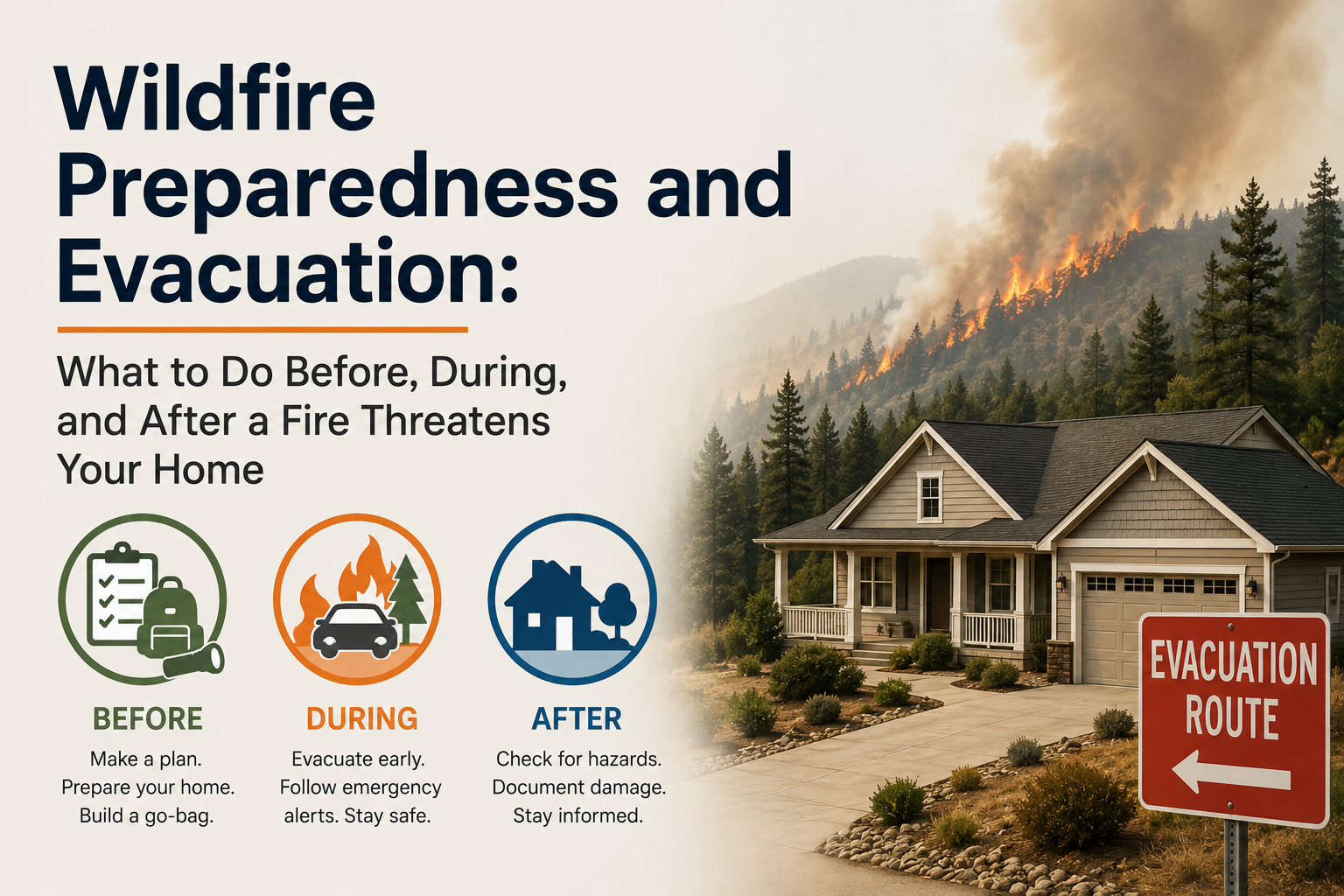
Wildfire evacuation plans need to account for the speed at which conditions can change. The time between a voluntary evacuation advisory and a mandatory evacuation order can be minutes in fast-moving fire conditions. The time between a mandatory order and impassable roads can be shorter still. Planning that assumes you will have hours to prepare and depart may be dangerously optimistic.
The practical implication is that your threshold for beginning evacuation preparations should be earlier than the official order in many cases. When a fire is in your general region and conditions are favorable for rapid spread, pre-loading your vehicle with essential supplies and documents, knowing your routes, and being mentally prepared to leave on short notice is more appropriate than waiting for official guidance that may come too late.
The Go Bag for Wildfire Evacuations
Speed of departure is a critical variable in wildfire evacuation in a way it is not for most other emergency types. A well-prepared bug out bag pre-packed and stored near the exit of your home allows you to be in your vehicle and moving in minutes rather than scrambling to gather belongings under time pressure and psychological stress. For wildfire scenarios specifically, this pack should include N95 respirators for smoke exposure, copies of insurance documents and irreplaceable personal records, medications for at least a week, phone chargers and a portable battery bank, and cash. The standard 72-hour supply kit forms the core, with these fire-specific additions layered on top.
Keep a secondary set of your most irreplaceable documents, insurance policies, property records, identification, financial account information, in a fireproof document bag or offsite in a bank safe deposit box or secure cloud storage. A fire that destroys your home and your records simultaneously creates a recovery burden far more severe than loss of the physical structure alone.
During an Active Wildfire Threat
If you have not evacuated and fire approaches, the decision calculus changes rapidly. Attempting to evacuate through an active fire front on a road that may be burning or blocked is extremely dangerous and has killed people in multiple documented incidents. If you have missed the window for safe road evacuation, shelter in place in a cleared area or structure may be the survival option. A building that is properly hardened and has defensible space can survive a fire front passing over it while the occupants shelter inside with all openings sealed.
The actions to take if sheltering in place during fire passage: close all windows and doors but do not lock them. Fill sinks, bathtubs, and any available containers with water. Remove flammable window treatments. Move furniture away from windows. Seal gaps under doors with wet towels. Turn on all interior lights so the structure is visible to firefighters in smoke. Stay in an interior room away from windows on the side facing the fire. Monitor the fire’s approach and be prepared to move to different areas of the structure as conditions change.
After the Fire: Return and Recovery
Returning to a property after a wildfire passes carries hazards that are not immediately obvious. Structural damage may not be visible from the exterior. Hot spots can remain active for days, and disturbing ash can re-ignite smoldering material. Ash from burned structures contains toxic compounds including heavy metals, asbestos from older building materials, and combustion byproducts that are harmful through both inhalation and skin contact. N95 respirators and gloves are minimum protective equipment for any work in fire-affected areas.
Document all damage photographically before any cleanup begins. Contact your insurance company before removing debris, as insurers often require the opportunity to assess damage before it is disturbed. Be aware that post-fire landscapes are vulnerable to flash flooding and debris flows, particularly on slopes where vegetation that previously absorbed rainfall has been removed. Significant rain on a recently burned watershed can produce debris flows that move faster and are more destructive than the original fire.