























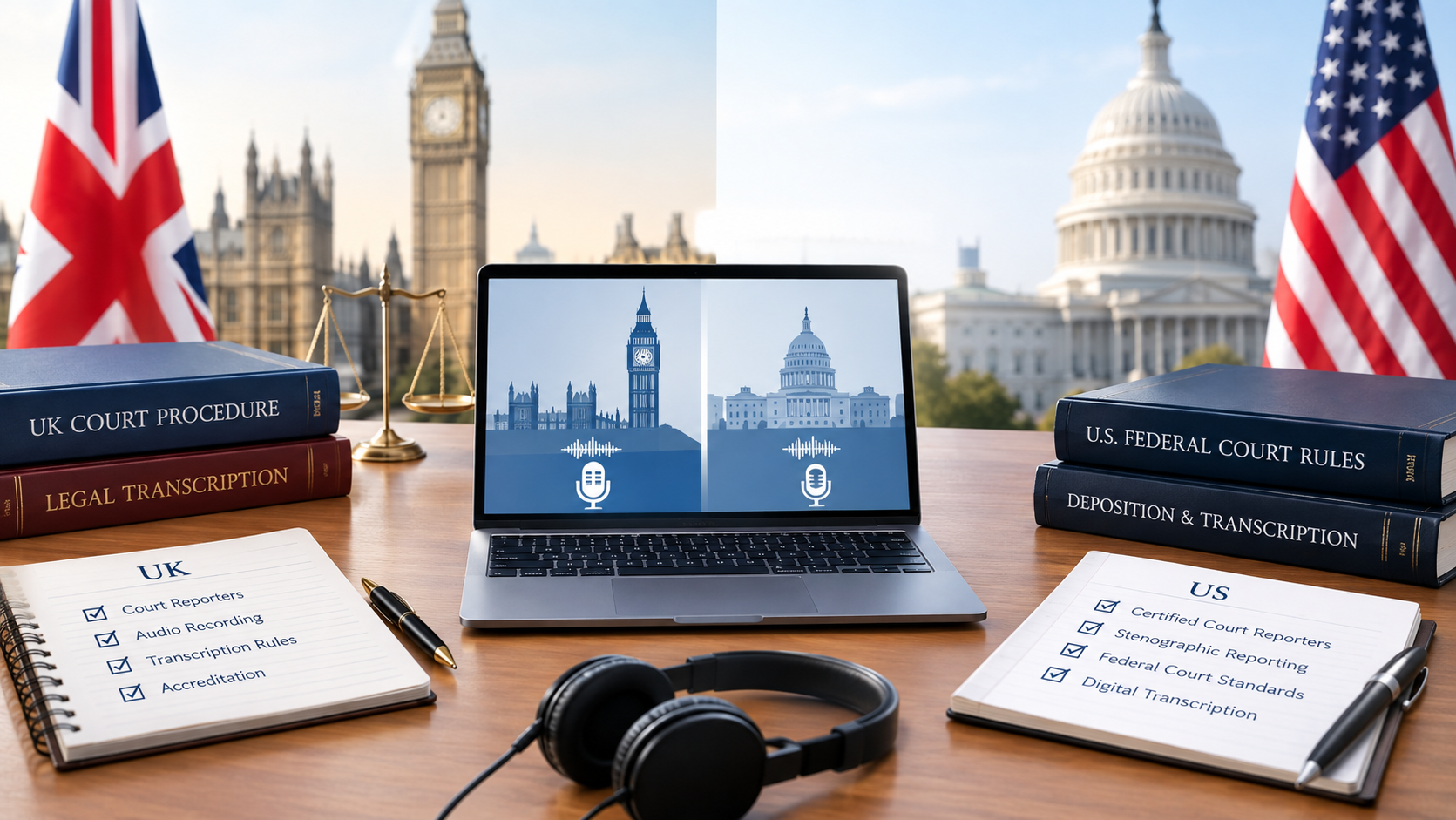
The UK and US share deep common-law traditions, but the United Kingdom comprises distinct legal jurisdictions, with England and Wales following a different legal and procedural framework from Scotland and Northern Ireland. For legal teams working between the US and England and Wales, these differences can shape how proceedings are recorded, transcripts are obtained, and depositions are arranged. They can, in turn, affect trial preparation, turnaround times, and the management of evidence in cross-border litigation. Understanding these procedural differences can help legal teams plan cross-border matters with fewer unexpected issues.
What Is the Main Difference?
In England and Wales, hearings are generally taped or digitally recorded, with transcripts available on request. In the US, stenographic reporting and realtime services are widely used, particularly in federal court proceedings and depositions, although electronic recording is also used. The practical differences in court reporting become important when a case involves overseas witnesses or urgent transcripts. The exact arrangement depends on the court, proceedings, and service required.
How Proceedings Are Recorded England and Wales
In England and Wales, many court hearings are recorded electronically, although recording arrangements vary by court and type of proceeding. This approach is central to UK court transcription, particularly when a formal written record is required after a hearing. Where a written transcript is required, it can be requested from the court or tribunal.
United States
The federal judiciary permits several authorised methods to capture the record, including shorthand, stenotype, stenomask, or electronic sound recording, depending on the district judge’s direction. The US court reporters may use stenographic methods to create a realtime text feed, giving counsel immediate access to a draft transcript while the proceeding is underway.
Realtime Transcript Availability
The availability of live text feeds varies considerably between the two systems. In the US, attorneys can arrange realtime court reporting for eligible proceedings, including trials and depositions. The US federal judiciary treats these live outputs as draft, unedited transcripts rather than final certified records. A final transcript may require subsequent review and processing.
In England and Wales, real-time reporting is not the standard recording method for ordinary court hearings. It may be separately arranged for proceedings where parties require immediate access to a transcript, such as complex commercial litigation, public inquiries, or arbitrations. Live drafts may then be reviewed for terminology, speaker identification, formatting, and accuracy before final delivery.
Depositions and Overseas Witnesses
Depositions form an important part of pre-trial discovery in US civil litigation, allowing testimony to be obtained before trial. Conversely, domestic litigation in England and Wales rarely utilises pre-trial depositions, relying instead on the exchange of witness statements and subsequent cross-examination in open court.
Where evidence is required from a witness in another jurisdiction, the appropriate procedure depends on the circumstances of the case and the countries involved. Under the Civil Procedure Rules, a Letter of Request may be used where a proposed deponent is outside the jurisdiction. A special examiner may also be appointed in circumstances permitted by the rules. A Letter of Request is therefore a possible route, not an automatic requirement for every overseas witness. International teams arranging court reporting for overseas proceedings should confirm the applicable rules before scheduling witnesses, as establishing the correct legal channel early prevents the accidental invalidation of testimony.
Transcript Access and Turnaround
The administrative workflows required to secure final documentation diverge sharply between the two countries:
- England and Wales: Written records require a formal application process. Legal teams must submit an official transcript request through Form EX107 to the relevant court or tribunal. Fees and delivery times vary according to factors including transcript size and whether it is a new transcript or a copy.
- United States: US federal courts have established transcript delivery categories ranging from standard to expedited and realtime services, with applicable fees set under federal judiciary rules. State courts can follow entirely different rules, so legal teams should confirm the applicable requirements when arranging US court reporting.
A professional legal transcription service can help manage formatting, speaker identification, timestamps, and turnaround requirements, while the legal team confirms any certification or filing deadlines applicable to the proceeding.
Public Access and Reporting Restrictions
The principle of open justice governs both legal systems, yet neither guarantees unrestricted public access to every word spoken in a private hearing. In England and Wales, public availability depends heavily on whether the matter was heard in open court or in private. Civil Procedure Rules place clear restrictions on transcript distribution, stating that a non-party seeking a transcript of a hearing held in private requires a court order.
In the US federal system, transcripts are generally subject to an initial 90-day restriction period after filing. During this period, access is limited while counsel have an opportunity to request required redactions. State court procedures can differ, and remote public access remains subject to applicable redactions and restrictions after the initial limitation period expires.
Checklist for International Legal Teams
- Confirm the Recording System: Identify whether the venue utilises digital audio logging or an active stenographer.
- Evaluate Real-Time Needs: Determine if the complexity of the testimony requires an immediate live text feed.
- Confirm Oath Requirements: Establish who is responsible for administering the oath and what the relevant jurisdiction requires.
- Review Overseas Evidence Protocols: Confirm whether a Letter of Request or a voluntary deposition framework is appropriate.
- Establish Delivery Deadlines: Align the choice of standard or expedited turnaround with your upcoming filing deadlines.
- Check Confidentiality and Redaction Rules: Assess local restrictions regarding private hearings and mandatory data redaction.
- Secure Language Support: Arrange for certified interpreters if any witness or participant requires multilingual support.
How LingArch Supports Cross-Border Proceedings
Cross-border proceedings can involve court reporting, deposition coordination, transcription, and interpretation, when witnesses or legal teams are in different locations. LingArch provides court reporting services including onsite and remote court reporting, realtime reporting, daily rough drafts, and expedited transcript options.
Its deposition services include coordination for remote and in-person proceedings, court reporting, interpretation, and related transcription support. LingArch also provides legal transcription for hearings, depositions, interviews, and other legal content, with formatting, timestamps, speaker identification, and review built into its workflow.
Conclusion
UK and US court reporting practices diverge enough that assuming one system’s rules apply in the other can cost a legal team real time and budget. Confirming the recording method, transcript request process, and overseas witness protocol before scheduling is what prevents that.
Need support with court reporting, depositions or legal transcription for a cross-border matter? Contact LingArch to discuss your requirements.
Note: This article provides general information and does not constitute legal advice. Recording, deposition and transcript requirements should be confirmed with qualified counsel and the relevant court or tribunal.