




















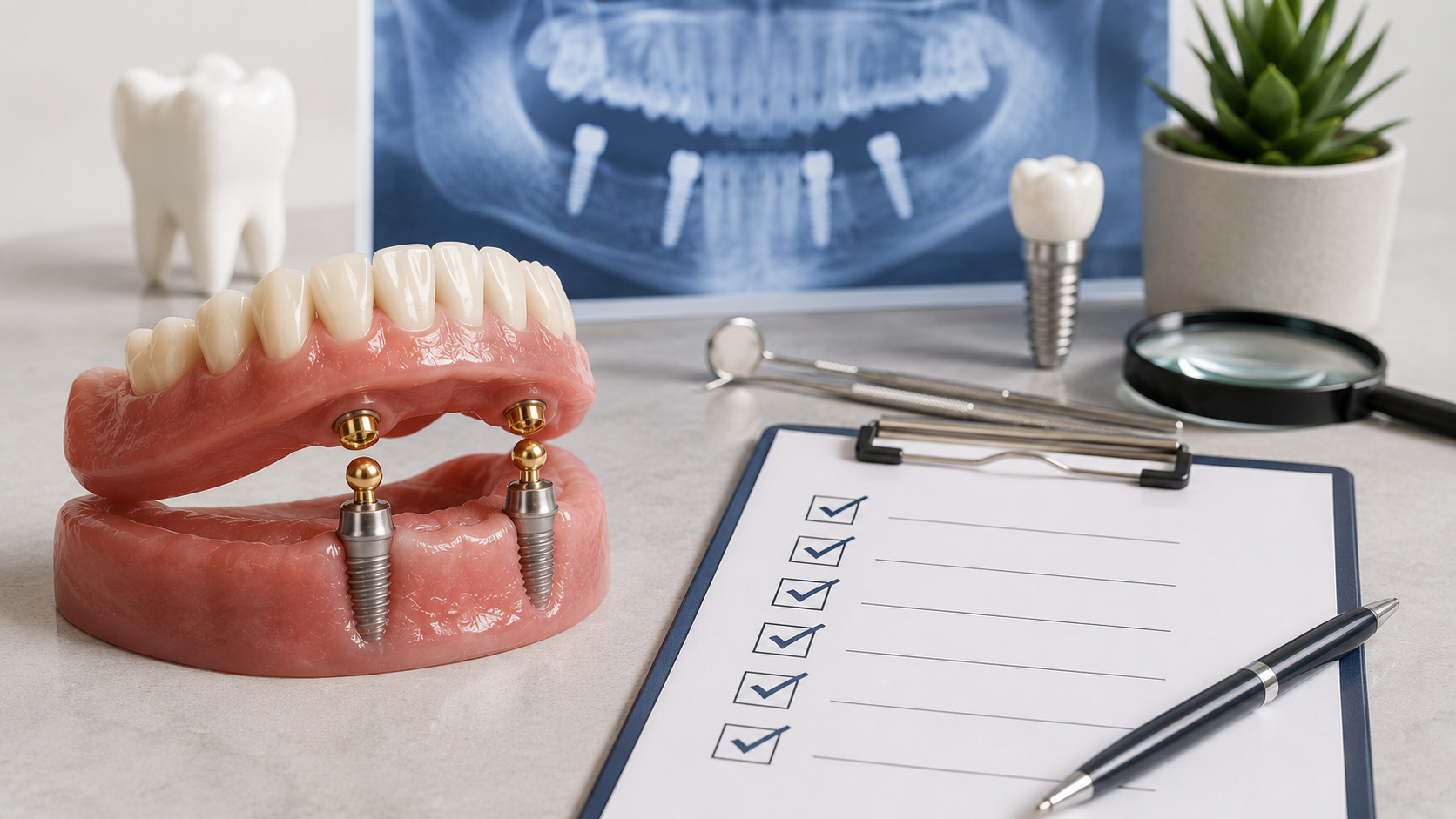
A ball-retained overdenture should be reviewed as a complete prosthetic system. Changes in retention may involve the attachment, matrix, denture base, implant position, tissue condition, occlusion, or the patient’s insertion and removal technique.
A structured recall appointment helps the clinician identify the source of a problem before replacing a component. The following seven checks provide a practical framework.
1. Record the Patient’s Experience
Begin by asking what has changed since the previous appointment.
The patient may report:
- Reduced retention
- Uneven retention
- Movement during function
- Difficulty inserting or removing the denture
- Food accumulation
- Tissue soreness
- Clicking or unusual sounds
- Damage to the prosthesis
- Changes in cleaning ability
Determine when the issue began and whether it followed a fall, repair, reline, attachment replacement, or change in oral condition.
Do not assume that every complaint of looseness requires a new matrix. The underlying cause should be identified first.
2. Evaluate the Peri-Implant Tissues
Remove the overdenture and inspect the tissues around each implant and attachment.
Assess:
- Plaque and deposits
- Bleeding
- Swelling
- Suppuration
- Tissue overgrowth
- Recession
- Discomfort
- Hygiene access
Complete any additional clinical or radiographic assessment indicated by the patient’s history and findings.
Inflamed tissue or accumulated deposits may affect comfort and seating. Address biological concerns according to the clinician’s diagnosis rather than masking the problem with increased retention.
3. Examine the Denture Base and Occlusion
Inspect the prosthesis outside and inside the mouth.
Check for:
- Fractures
- Worn teeth
- Damaged housings
- Base distortion
- Loss of tissue support
- Pressure areas
- Occlusal discrepancies
- Insufficient space around attachments
- Evidence of recent repair
A denture that no longer seats completely may place uneven force on the attachments or create the impression that retention has failed.
Evaluate whether adjustment, repair, reline, or replacement requires consideration before changing the attachment components.
4. Identify the Exact Attachment System
For a ball abutment overdenture case, clinicians should confirm the implant connection, platform, abutment dimensions, ball diameter, housing, matrix, required instruments, and product references before ordering replacements.
Similar-looking ball attachments may differ in connection, thread, height, or retentive-component design. Do not select a replacement from appearance alone.
Use the patient record, original labels, manufacturer documentation, laboratory information, and appropriate imaging when necessary to establish the system.
5. Inspect the Abutments, Housings, and Matrices
Clean the components according to the clinical situation and inspect them under adequate lighting and magnification when helpful.
Look for:
- Surface wear
- Damaged matrices
- Loose housings
- Debris
- Corrosion
- Distortion
- Fractured components
- Uneven engagement
- Loss of retention
Check each attachment independently. One side may behave differently from the other because of wear, alignment, tissue support, or damage.
Replace components only with verified compatible parts and follow the applicable seating and tightening instructions.
6. Review Insertion, Removal, and Hygiene
Ask the patient to demonstrate how the overdenture is inserted and removed. An incorrect path may increase wear or make one attachment engage before the other.
Review cleaning around:
- Ball abutments
- Peri-implant tissues
- Denture housings
- Intaglio surface
- Retentive inserts
Recommend tools and methods suitable for the individual patient’s dexterity, prosthesis, tissue condition, and manufacturer instructions.
Confirm that the patient can recognize changes that require an earlier clinical review, such as persistent discomfort, swelling, component movement, or prosthesis damage.
7. Document the Maintenance Performed
Record:
- Clinical findings
- Attachment system
- Component references
- Parts replaced
- Abutment condition
- Retention after treatment
- Occlusal findings
- Hygiene instructions
- Follow-up interval
- Unresolved concerns
If a component is tightened or replaced, document the instrument, applicable protocol, and product information.
Clear records prevent future appointments from depending on visual estimation and help another clinician or laboratory identify the exact system.
Treat Retention as One Part of the Review
Restoring retention without examining tissue health, prosthesis seating, occlusion, attachment wear, and patient technique may leave the actual problem unresolved.
A complete recall process helps the clinician decide whether maintenance involves cleaning, adjustment, reline, component replacement, prosthesis repair, or further implant evaluation.