























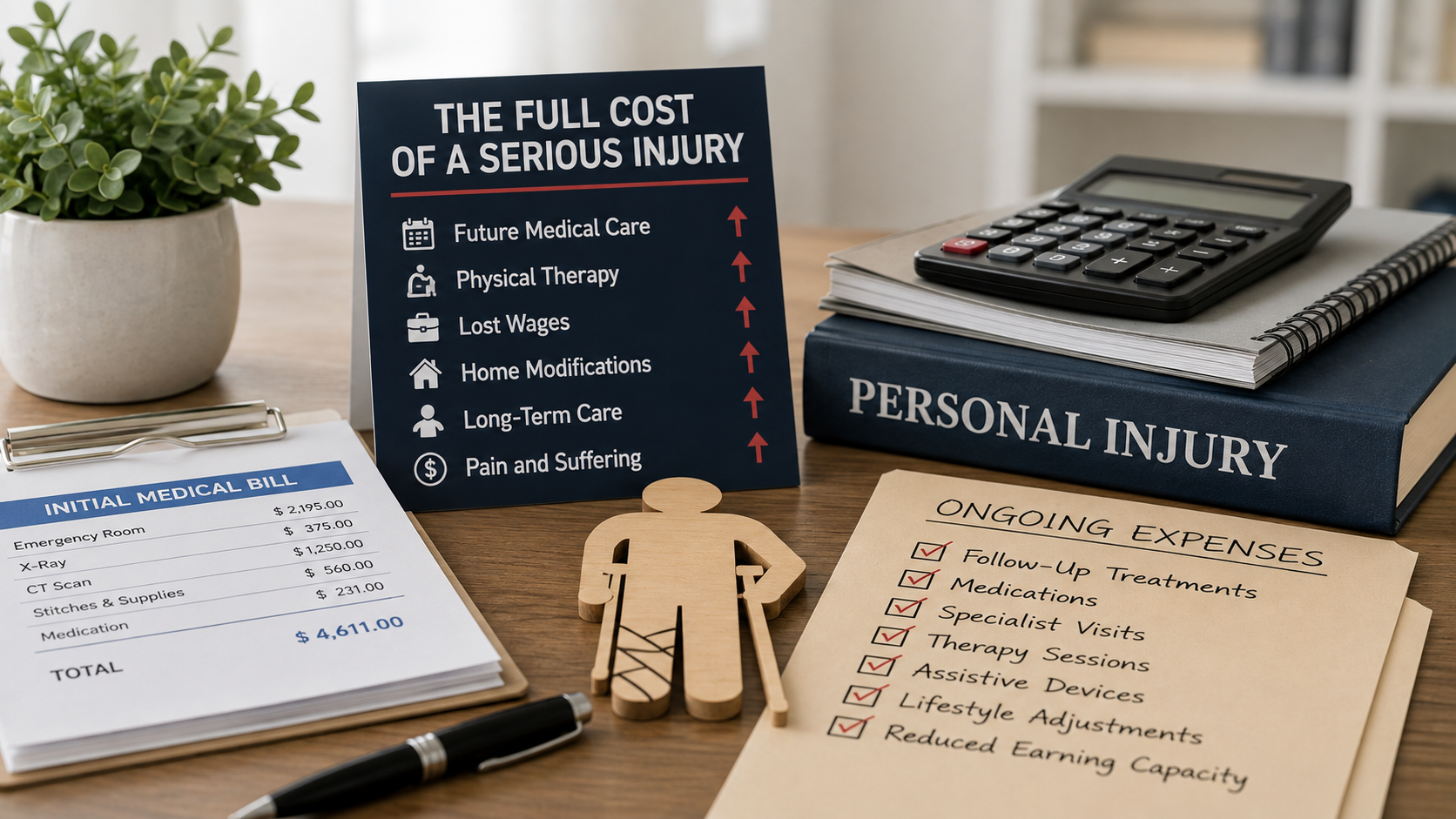
After a serious accident, one of the first financial concerns is often the medical bill.
An emergency room visit, ambulance ride, diagnostic imaging, surgery, or hospitalization can create substantial expenses almost immediately. But for many injury victims, those initial bills represent only part of the financial impact of an accident.
A serious injury can affect a person’s finances for weeks, months, or even years. Follow-up medical care, rehabilitation, time away from work, reduced earning ability, transportation expenses, and other consequences can continue long after the accident itself.
Understanding the potential long-term impact of an injury is important before assuming that the first medical bills tell the whole story.
The Initial Medical Bills May Be Only the Beginning
Immediately after an accident, medical treatment may include:
- Ambulance transportation
- Emergency room care
- Hospitalization
- X-rays
- CT scans
- MRIs
- Physician examinations
- Medication
- Initial surgery or other procedures
These expenses can add up quickly.
However, some injuries cannot be fully evaluated based only on the treatment received during the first few days after an accident.
A person may leave the emergency room and later require months of additional treatment. Other injuries may improve initially but continue causing pain, weakness, limited mobility, or other symptoms.
That’s why evaluating the financial impact of a serious injury can require looking beyond the initial hospital bill.
Follow-Up Medical Treatment Can Continue for Months
Depending on the injury, ongoing treatment may include:
- Specialist appointments
- Physical therapy
- Occupational therapy
- Chiropractic treatment
- Pain management
- Diagnostic testing
- Prescription medications
- Injections
- Follow-up surgery
- Rehabilitation
Someone with a broken bone, for example, may require more than the initial treatment needed to stabilize the injury.
A person with a back, neck, knee, shoulder, or head injury may need ongoing medical evaluation to determine whether symptoms will resolve or become a longer-term problem.
These additional appointments and procedures can increase the overall financial impact considerably.
Some Injuries Require Future Medical Care
One of the more difficult issues following a serious injury is determining what medical treatment may be necessary in the future.
Future care could potentially include:
- Surgery
- Physical therapy
- Rehabilitation
- Medication
- Follow-up imaging
- Specialist care
- Medical equipment
- Assistive devices
- Home modifications
- Long-term medical monitoring
The need for future care depends on the nature and severity of the injury.
For someone who has suffered a permanent or catastrophic injury, medical needs may extend years into the future.
This is one reason why resolving an injury claim before the long-term medical picture is understood can create problems. An early settlement may appear substantial when compared with the bills that have already arrived but may not account for treatment that could be necessary later.
Time Away From Work Can Create Another Financial Burden
Medical expenses aren’t the only financial consequence of a serious accident.
An injury may prevent someone from returning to work temporarily.
A person recovering from surgery, a fracture, a spinal injury, or another significant condition may be physically unable to perform their normal job duties.
Lost income can become especially difficult when medical expenses are arriving at the same time.
The effect can be even greater for people who:
- Work hourly jobs
- Depend on overtime
- Earn commissions
- Own a small business
- Are self-employed
- Work in physically demanding occupations
- Have limited paid leave available
A few days away from work may be manageable for some families.
Several weeks or months can create a very different financial situation.
A Serious Injury Can Affect Future Earning Ability
Some injuries don’t just cause temporary missed work.
They can change what someone is physically capable of doing in the future.
Imagine someone whose occupation requires lifting, standing, driving, climbing, construction work, or other physical activity. A permanent back, knee, shoulder, or spinal injury could potentially prevent that person from returning to the same position.
The individual might need to:
- Reduce working hours
- Change job responsibilities
- Move into a lower-paying position
- Retrain for another occupation
- Leave a physically demanding career entirely
In these circumstances, the financial impact isn’t limited to wages missed during recovery.
There may also be a longer-term difference between what the person was capable of earning before the accident and what they can reasonably earn afterward.
Everyday Expenses Can Increase After an Injury
Serious injuries can create expenses that aren’t necessarily obvious immediately after an accident.
For example, an injured person may temporarily need help with:
- Transportation to medical appointments
- Childcare
- Household tasks
- Yard maintenance
- Mobility
- Personal care
- Meal preparation
- Home accessibility
Someone who cannot drive may need rides to work or medical appointments.
A person recovering from surgery may need assistance with household responsibilities they previously handled independently.
Individually, some of these expenses may appear relatively small. Over several months, however, they can become significant.
Keeping receipts and records related to accident-related expenses can help document the broader financial impact of an injury.
Serious Injuries Can Affect More Than Finances
Not every consequence of an injury appears on an invoice.
A serious accident can affect someone’s ability to participate in activities they previously enjoyed, care for their family, exercise, sleep comfortably, travel, or perform normal daily tasks.
Pain can also continue long after visible injuries have healed.
Depending on the circumstances of a personal injury case, these effects may become relevant when evaluating the overall impact of an injury.
That is why an injury claim should not necessarily be viewed simply as a calculation of hospital bills.
A San Diego personal injury lawyer can evaluate the broader circumstances surrounding an injury, including medical treatment, financial losses, potential future needs, and other effects of the accident.
Car Accidents Can Create Multiple Types of Financial Loss
Motor vehicle collisions provide a good example of how quickly accident-related costs can extend beyond medical treatment.
After a serious car accident, someone might face:
- Emergency medical treatment
- Follow-up physician appointments
- Physical therapy
- Lost income
- Vehicle repairs
- Rental-car expenses
- Transportation costs
- Future medical treatment
- Reduced ability to work
A person may also be dealing with an insurance company while simultaneously trying to recover physically and return to normal life.
When a collision results in significant injuries, getting legal help after a car accident in San Diego can help an injured person understand what types of losses may be relevant to a claim.
Why Early Settlement Offers Deserve Careful Consideration
After an accident, an insurance company may make a settlement offer relatively early in the process.
Receiving money quickly can sound appealing, particularly when someone is already dealing with medical expenses and lost income.
But timing matters.
If the extent of an injury is not yet known, it may be difficult to understand the full financial consequences.
Questions that may still be unanswered include:
- Will additional medical treatment be necessary?
- Will surgery be recommended?
- How long will physical therapy continue?
- When can the person return to work?
- Will there be permanent work restrictions?
- Will the injury cause long-term pain or limitations?
- Will future medical care be necessary?
An early settlement based primarily on existing bills may not reflect losses that become apparent later.
This doesn’t mean every early settlement offer is necessarily inadequate. It means the offer should be evaluated in light of the individual circumstances and available information rather than simply compared with the medical bills received so far.
Documentation Can Become Extremely Important
Determining the financial impact of an injury requires documentation.
Useful records may include:
- Medical bills
- Medical records
- Prescription receipts
- Physical therapy records
- Wage statements
- Pay stubs
- Tax or business records when relevant
- Employer documentation
- Receipts for accident-related expenses
- Records of missed work
- Medical recommendations for future treatment
Keeping these materials organized can make it easier to understand how an accident has affected someone financially.
Documentation can also become important when an insurance company disputes the extent of an injury or questions whether particular losses resulted from the accident.
Why Future Costs Matter When Evaluating an Injury Claim
One of the biggest mistakes an injured person can make is thinking only about what an accident has already cost.
A more complete evaluation asks two separate questions:
What has this injury cost so far?
and
What is this injury reasonably expected to cost in the future?
Those are not always the same number.
Someone who has recovered completely after several weeks may have relatively limited future losses.
Someone facing another surgery, permanent physical limitations, ongoing treatment, or reduced earning ability may have a very different situation.
The severity of the injury and its expected long-term effects matter.
Every Personal Injury Case Is Different
There is no standard amount that every injured person should expect to recover.
Two people involved in similar accidents may experience completely different medical and financial consequences.
Factors that can affect an injury claim may include:
- The type and severity of the injury
- Medical treatment received
- Future treatment needs
- Time missed from work
- Long-term work restrictions
- Whether the injury is permanent
- Available insurance coverage
- Strength of the evidence
- Who was responsible for the accident
- Whether responsibility is disputed
- How the injury affects everyday life
For this reason, evaluating a serious injury generally requires looking at the individual circumstances rather than relying on an average settlement amount.
The Bottom Line
The first medical bills after an accident can be substantial, but they may not tell the full story.
A serious injury can lead to months of follow-up treatment, rehabilitation, lost income, reduced earning ability, additional everyday expenses, and potentially years of future medical care.
Before resolving an injury claim, it is important to understand not only what the accident has already cost but also how the injury may affect the person’s health, work, finances, and daily life in the future.
Accident Law Center (Andy Van Le & Associates, PC) represents people injured in accidents throughout San Diego County.
Call (619) 525-0001 for a free consultation.
No attorney fee unless compensation is recovered.
Website:
https://www.accidentlawctr.com/
Andy Van Le is a San Diego attorney and managing attorney of Accident Law Center (Andy Van Le & Associates, PC), representing people injured in car accidents and other personal injury matters throughout San Diego County.