





















Many teams understand that their database deserves attention, but very few have a dependable process for deciding what kind of attention matters most. Engineers may notice that some SQL is difficult to maintain, that a few joins are doing more work than they should, or that a table has started carrying too many responsibilities. Product managers may notice that data-related work is getting harder to estimate. Support teams may notice that some questions require too much manual interpretation. Everyone can feel the drag, but without a review habit the database remains a source of background discomfort instead of a clearly managed project area.
That gap is where systems become reactive. Postgres issues are often addressed only when a release gets risky, a migration becomes complicated, or reporting starts producing answers that nobody fully trusts. By that stage, the team is already paying for earlier inattention. It is not only dealing with technical problems. It is dealing with delayed decision-making.
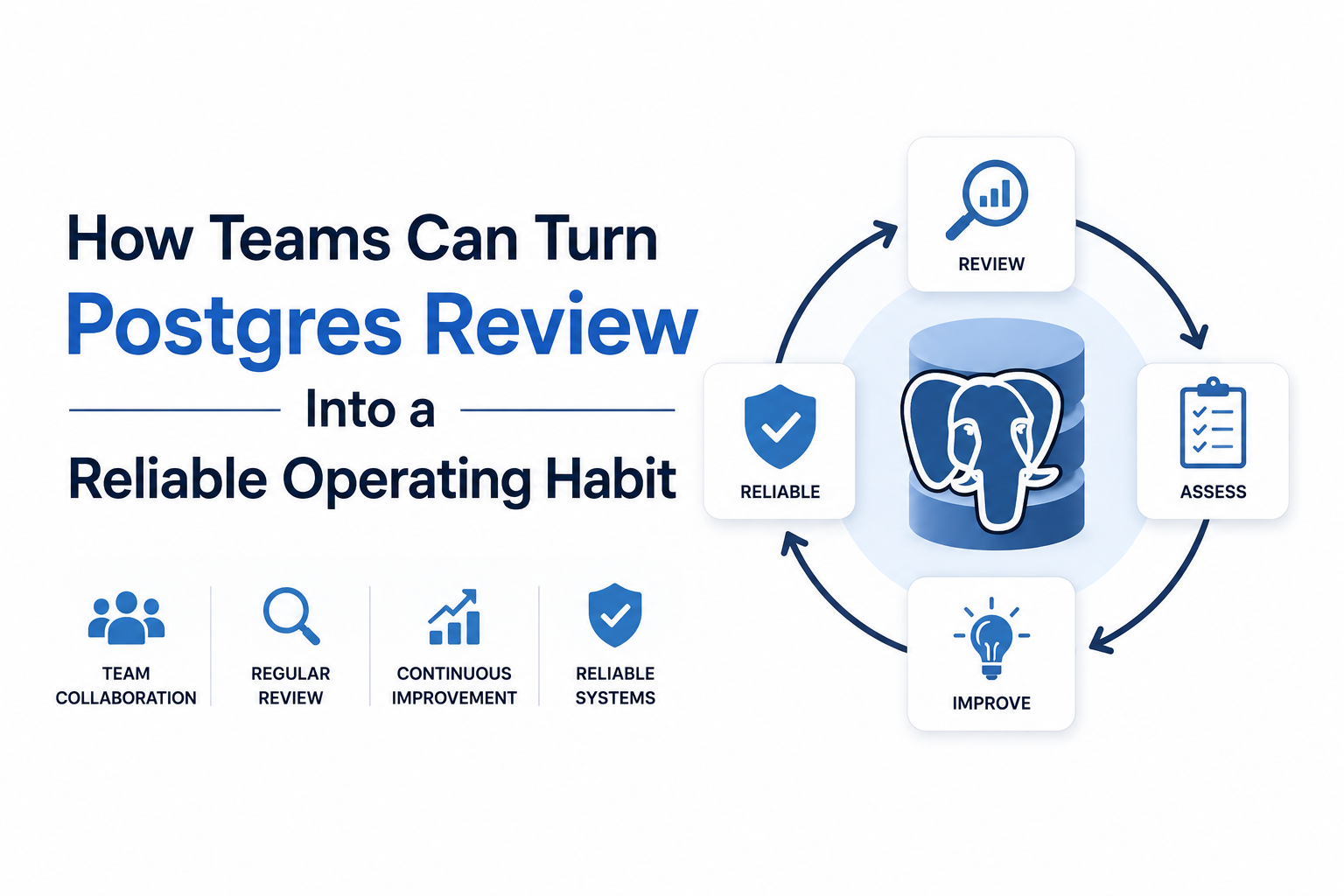
A healthier model is to make database review a normal operating habit. The goal is not to create a heavy ceremony. The goal is to build a repeatable way to inspect structure, interpret SQL behavior, and decide what should be improved next. Once that habit exists, teams stop treating Postgres as something they revisit only under pressure.
A useful review usually starts with the schema itself. Teams should be able to explain what the most important entities are, how they relate to each other, where historical records matter, and which parts of the model are expected to stay stable. If those answers are unclear, every downstream change becomes harder because engineers are modifying structure without shared certainty.
The next layer is SQL behavior. Query patterns reveal what the application truly depends on. Slow or awkward queries often point to a deeper mismatch between schema design and actual product workflows. Reviewing SQL is valuable not because every query must be perfect, but because query behavior shows where structural decisions are creating repeated friction. Sometimes the answer is an index. Sometimes it is a naming fix. Sometimes it is a more meaningful schema adjustment that prevents the same problem from reappearing.
The third layer is prioritization. Not every finding deserves urgent action. Good review habits separate inconvenience from strategic risk. A confusing but rarely used query may be acceptable for a while. A structural issue that complicates every new feature or every major migration deserves attention much sooner. Teams that can make this distinction avoid wasting energy on low-value cleanup while still protecting themselves from long-term drift.
This process also improves communication across roles. A review that ends with clear findings and next actions is much easier to discuss with product, support, and operations stakeholders. Instead of hearing that “the database needs cleanup,” they can understand that a specific table, relationship, or query pattern is increasing delivery risk or reducing reporting confidence. That changes the conversation from abstract technical debt to concrete operational impact.
A Postgres SQL review workflow helps turn these observations into something actionable. It allows teams to move from “something feels off” to “these are the next changes that will improve reliability, maintainability, and delivery speed.” That structure matters because the hardest part of database improvement is usually not spotting a problem. It is organizing the work well enough that the right fix is made at the right time.
Database Optimization Tool supports this style of work by helping teams review schemas, assess SQL decisions, and identify prioritized improvements. That gives teams a more reliable way to work with Postgres as the product grows.
The longer a product runs, the more valuable this operating habit becomes. A strong review process does not remove complexity from a system that is growing. It prevents that complexity from becoming unmanaged. Over time, that is what keeps the database understandable, adaptable, and aligned with the product it serves.
Teams that review their database regularly are not being cautious for its own sake. They are protecting the speed and confidence of future delivery. When Postgres review becomes habitual, technical clarity stops being a rescue mission and starts becoming part of how the product is built.
A practical review session usually begins with a very small set of checkpoints. The team looks at the tables touched by the most important workflows, the queries used most often, and the assumptions hidden inside migrations or reporting jobs. That review does not have to solve everything in a single pass. Its purpose is to create a shared map of what is stable, what is risky, and what should be improved first.
It also helps to define the cost of inaction clearly. If an issue is left alone for another quarter, what becomes harder? Does reporting stay confusing? Do feature estimates remain inflated because engineers do not trust the current structure? Does every migration require more manual caution than it should? These questions make the tradeoffs visible and help teams treat database work with the same seriousness as any other product constraint.
Another useful habit is to connect structural review to upcoming roadmap decisions. If a team already knows a product area will expand, that is the right time to check whether the current schema is ready for it. Making a focused adjustment early is usually cheaper than building a second layer of workarounds later. In practice, this is how teams keep Postgres aligned with growth instead of forcing growth to move around old design choices.
Good database work is rarely about chasing perfection. It is about reducing avoidable friction. When teams review structure, SQL behavior, and migration risk in a repeatable way, they protect delivery speed and make future changes easier to understand.
One more reason this matters is that database complexity is cumulative. A schema that is only slightly awkward today may feel dramatically more expensive after six more features, three more reports, and a few emergency fixes. That is why delayed database work has a hidden multiplier. The longer important structural decisions remain unreviewed, the more surrounding code and process grows around them. By the time a team decides to intervene, it is not correcting one issue. It is unraveling everything that adapted to that issue.
A steady review habit avoids that trap. It gives teams a way to make improvements while the system is still understandable enough to change with confidence. That is the real payoff of good planning: not theoretical elegance, but lower risk, clearer communication, and faster decisions when the product inevitably evolves again.
Consider a common product scenario. A team launches with one clean workflow, then adds subscriptions, support tooling, analytics exports, and admin permissions over time. At first the original schema seems flexible enough. Later, every new requirement depends on exceptions. A report needs special joins. A migration needs temporary backfills. An internal tool depends on fields that were never meant to be authoritative. None of this looks catastrophic in isolation, but together it slows delivery and makes the database harder to trust.
This is exactly why teams benefit from reviewing structure before pain becomes visible to every stakeholder. A short, structured review can reveal whether a schema still matches the product, whether SQL is doing unnecessary work, and whether a migration should happen sooner while the blast radius is still manageable. Once those findings are written down and prioritized, the team has a much better chance of improving the database without interrupting product momentum.
In practice, the strongest database teams are not the ones that never make tradeoffs. They are the ones that revisit important tradeoffs before they harden into permanent drag. That is what makes planning valuable. It gives the team permission to improve structure in stages, with a clearer idea of why each stage matters and what outcome it supports.
Consider a common product scenario. A team launches with one clean workflow, then adds subscriptions, support tooling, analytics exports, and admin permissions over time. At first the original schema seems flexible enough. Later, every new requirement depends on exceptions. A report needs special joins. A migration needs temporary backfills. An internal tool depends on fields that were never meant to be authoritative. None of this looks catastrophic in isolation, but together it slows delivery and makes the database harder to trust.
This is exactly why teams benefit from reviewing structure before pain becomes visible to every stakeholder. A short, structured review can reveal whether a schema still matches the product, whether SQL is doing unnecessary work, and whether a migration should happen sooner while the blast radius is still manageable. Once those findings are written down and prioritized, the team has a much better chance of improving the database without interrupting product momentum.
In practice, the strongest database teams are not the ones that never make tradeoffs. They are the ones that revisit important tradeoffs before they harden into permanent drag. That is what makes planning valuable. It gives the team permission to improve structure in stages, with a clearer idea of why each stage matters and what outcome it supports.
A simple way to start is to review one product area at a time. Look at the schema behind the workflow, check the main queries, list the assumptions that seem fragile, and define one or two changes that would make future work easier. Repeating that process every release cycle is often enough to keep a growing Postgres system from becoming harder to change than the product itself.
A simple way to start is to review one product area at a time. Look at the schema behind the workflow, check the main queries, list the assumptions that seem fragile, and define one or two changes that would make future work easier. Repeating that process every release cycle is often enough to keep a growing Postgres system from becoming harder to change than the product itself.
A simple way to start is to review one product area at a time. Look at the schema behind the workflow, check the main queries, list the assumptions that seem fragile, and define one or two changes that would make future work easier. Repeating that process every release cycle is often enough to keep a growing Postgres system from becoming harder to change than the product itself.
A simple way to start is to review one product area at a time. Look at the schema behind the workflow, check the main queries, list the assumptions that seem fragile, and define one or two changes that would make future work easier. Repeating that process every release cycle is often enough to keep a growing Postgres system from becoming harder to change than the product itself.
Teams can also use a short checklist when reviewing any database-backed feature. What data is created? What data is updated? What data must remain historically accurate? Which reports or dashboards depend on it? Which queries will become more frequent after launch? Which parts of the schema are carrying assumptions that no longer match the product? Answering these questions in plain language often reveals structural issues before they appear in production metrics. It also makes technical review easier to explain to non-engineers, because the conversation stays attached to product behavior instead of abstract theory.
Another practical benefit of structured review is better sequencing. Some database improvements should happen before a new feature ships. Some can happen immediately after launch while context is fresh. Some can be documented for a later cycle because they do not yet create real drag. Once teams work this way consistently, database improvements stop competing with roadmap work in an unproductive way. They become part of how the roadmap is made realistic.
Over time, this discipline improves more than the schema itself. It improves planning quality, migration confidence, reporting trust, and the team’s ability to make changes without rediscovering the same uncertainty again and again.
Teams can also use a short checklist when reviewing any database-backed feature. What data is created? What data is updated? What data must remain historically accurate? Which reports or dashboards depend on it? Which queries will become more frequent after launch? Which parts of the schema are carrying assumptions that no longer match the product? Answering these questions in plain language often reveals structural issues before they appear in production metrics. It also makes technical review easier to explain to non-engineers, because the conversation stays attached to product behavior instead of abstract theory.
Another practical benefit of structured review is better sequencing. Some database improvements should happen before a new feature ships. Some can happen immediately after launch while context is fresh. Some can be documented for a later cycle because they do not yet create real drag. Once teams work this way consistently, database improvements stop competing with roadmap work in an unproductive way. They become part of how the roadmap is made realistic.
Over time, this discipline improves more than the schema itself. It improves planning quality, migration confidence, reporting trust, and the team’s ability to make changes without rediscovering the same uncertainty again and again.
Teams can also use a short checklist when reviewing any database-backed feature. What data is created? What data is updated? What data must remain historically accurate? Which reports or dashboards depend on it? Which queries will become more frequent after launch? Which parts of the schema are carrying assumptions that no longer match the product? Answering these questions in plain language often reveals structural issues before they appear in production metrics. It also makes technical review easier to explain to non-engineers, because the conversation stays attached to product behavior instead of abstract theory.
Another practical benefit of structured review is better sequencing. Some database improvements should happen before a new feature ships. Some can happen immediately after launch while context is fresh. Some can be documented for a later cycle because they do not yet create real drag. Once teams work this way consistently, database improvements stop competing with roadmap work in an unproductive way. They become part of how the roadmap is made realistic.
Over time, this discipline improves more than the schema itself. It improves planning quality, migration confidence, reporting trust, and the team’s ability to make changes without rediscovering the same uncertainty again and again.