





















Why Floating Licenses Create Unique Management Challenges
Floating licenses — also called concurrent or network licenses — are the dominant licensing model for expensive engineering software. Rather than assigning a license permanently to a single workstation or user, floating licenses reside on a central server and are checked out on demand. Any authorized user on the network can check one out, use it, and return it when done. In theory, this model improves utilization by serving more users than named-user licenses of equivalent cost. In practice, it creates a set of management challenges that don’t exist for node-locked deployments.
The core challenge is visibility. When a license is checked out, who has it? How long have they had it? Are they actively using the application, or did they open it, minimized the window, and leave for the day? Is the checkout productive work, or is it a background process that grabbed a license and has been holding it unused for three hours? Answering these questions accurately is the foundation of effective floating license management.
Key Floating License Benchmarks
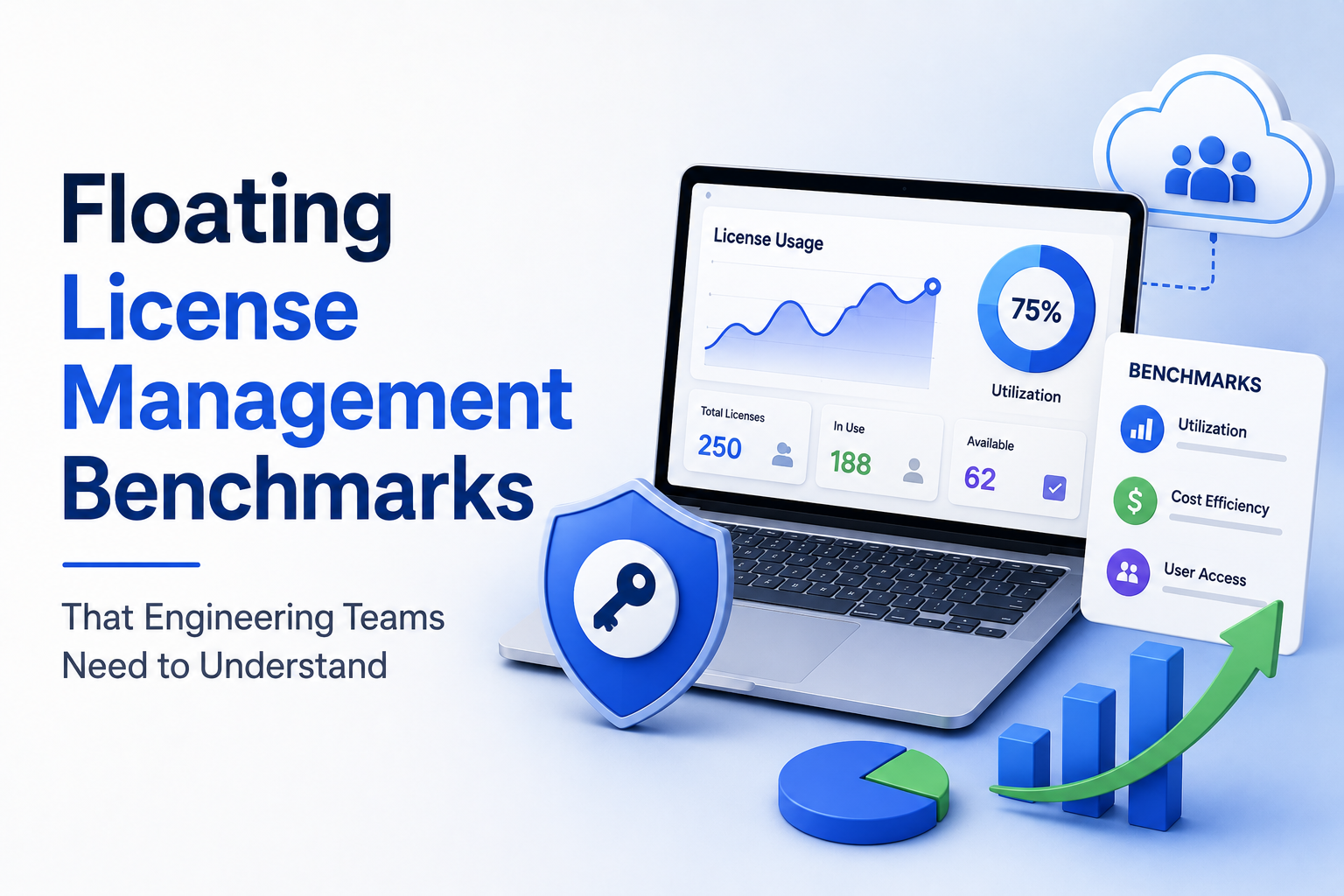
The primary floating license management benchmarks for evaluating a management platform center on four areas. First is checkout detection speed: how quickly does the platform recognize a new checkout event and make it visible in the dashboard? Second is idle detection accuracy: can the platform identify licenses that are checked out but not actively in use, distinguishing between genuine idle sessions and legitimate low-activity workflows like rendering jobs?
Third is borrow management: in environments where engineers take borrowed licenses for offline work, does the platform accurately track what’s borrowed, who borrowed it, and when it’s due back? Fourth is peak concurrency analysis: can the platform accurately reconstruct the maximum concurrent usage at any point in time, including precise overlap windows that are critical for determining whether license pool sizes are appropriate?
These are the benchmarks that directly correlate with the two outcomes organizations care most about: not running out of licenses when engineers need them, and not paying for more licenses than the peak demand actually requires.
Harvesting in Floating License Environments
License harvesting is particularly impactful in floating license environments because idle sessions have a direct, immediate cost: every idle checkout is a license that another engineer cannot access. The effectiveness of harvesting in a concurrent software license monitoring solution depends on several configurable parameters.
The idle detection threshold — how long a session must be inactive before it’s classified as idle — is the primary control. Set it too short, and you harvest licenses from engineers who are thinking between commands, reviewing drawings, or in a brief meeting. Set it too long, and the harvesting benefit is minimal. Best-in-class platforms allow this threshold to be set differently for different applications and different user groups, recognizing that the appropriate idle threshold for MATLAB is different from the appropriate threshold for CATIA.
The user notification workflow matters equally. Engineers should receive a warning before their license is harvested, with enough time to respond and retain it if they’re actively working. The platforms that receive the highest marks in engineering license management customer reviews for harvesting are those that balance aggressive reclamation of genuinely idle licenses with a respectful, low-friction experience for users who are legitimately using them.
License Queue Management and Priority Systems
When a license pool reaches capacity and new requests arrive, the handling of that queue is a benchmark that separates functional platforms from excellent ones. Enterprise engineering license tracking software should provide configurable queue management: the ability to assign priority levels to users or groups so that senior engineers or critical project teams are served before others when licenses are constrained.
Queue management also enables meaningful SLA-style commitments within organizations. If a project team is promised access to a minimum number of simulation licenses during a critical design review window, the license management platform should be able to enforce that commitment through configured access policies, not just hope that enough licenses happen to be available.
Denial-to-Utilization Ratio — the Most Useful Single Metric
Among all the benchmarks discussed, the denial-to-utilization ratio may be the single most useful metric for evaluating whether a floating license pool is appropriately sized. It answers the question directly: how often are engineers being turned away relative to how often they’re being served? A pool with a high utilization rate but a low denial rate is well-sized. A pool with a moderate utilization rate and a high denial rate suggests that peak demand concentrations are causing bottlenecks even though average utilization looks acceptable.
The platforms that calculate and surface this ratio clearly, with trend lines that show whether the balance is improving or deteriorating over time, give procurement and IT teams the most actionable data for license portfolio decisions. This is the benchmark that drives budget conversations, and it’s the one to prioritize when evaluating platforms side by side.