






















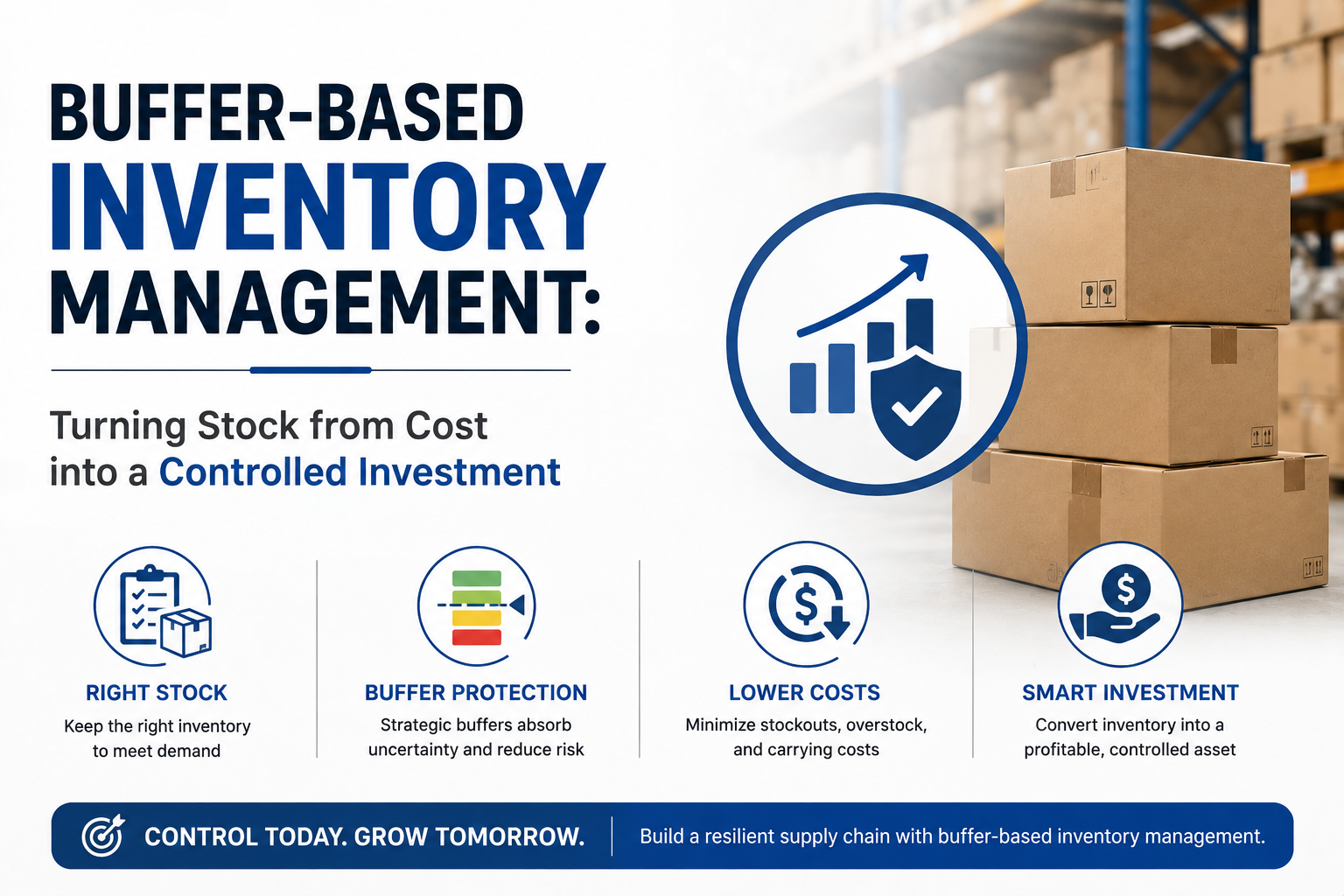
Most companies still treat inventory primarily as a cost to be minimised. The classic tools for this are familiar: min-max logic in spreadsheets, forecast‑driven calculations, and periodic parameter reviews. Yet the outcome is often paradoxical: capital tied up in stock, stockouts on key items, and planners constantly firefighting.
Buffer‑based inventory management, as implemented in solutions like StockM, offers a different framing. Instead of asking “How do I minimise stock?”, it asks “Where does stock genuinely need to sit as protection, and how do I keep that protection stable with as little capital as possible?” A modern inventory management system built around buffers – such as StockM – helps make that question operational every day.
1. From cost cutting to controlled investment
In a traditional min–max world, inventory is seen as a static pile: the bigger the pile, the more capital is locked up; the smaller the pile, the more you “save”. Decisions tend to swing between these two poles: reduce min and max to save money, then increase them again when stockouts hurt service.
Buffer‑based inventory management starts by recognising that inventory has two roles:
· It is a cost if it sits where it is not needed.
· It is an investment if it sits where it protects sales and production reliably.
The buffer concept makes this division explicit. For each important item, you define a buffer that represents how much stock is needed to absorb demand variability and lead‑time uncertainty. The aim is not to minimise that buffer blindly, but to make sure:
· Protection is strong where it matters.
· Stock outside buffers (unnecessary surplus far above green zones) is systematically cut.
In other words, you move from “reduce inventory everywhere” to “optimise inventory as a targeted investment in protection”.
2. Cash flow and protection: why buffers beat static limits
Min-max logic tends to create big swings in inventory levels:
· Large orders up to a high max push stock to levels you rarely need.
· Long periods without orders let stock drift down to min and sometimes below.
When companies react to stockouts by raising min and max, they mainly add more stock “just in case”, without changing how protection is designed. You can end up with more inventory, but still be short on the days when demand spikes or lead times stretch.
Buffer based inventory management approaches this differently. It does not try to manage risk with averages alone (e.g. “average demand is 50, so 50 is enough”). Instead, it treats inventory as a dynamic buffer that:
· Is sized on demand pattern, variability, and lead time.
· Is monitored continuously as it is consumed between supply events.
· Is increased when real behaviour shows the buffer is too small (too much time in red), and decreased when it is clearly too large (almost always deep green).
This matters for cash and service because:
· Protection is based on current data and buffer behaviour, not just historical averages.
· Stock sits where it is actually needed to absorb real volatility, not in random peaks far above that need.
· Surplus clearly above the buffer band becomes visible and can be deliberately reduced, releasing working capital without weakening protection.
The inventory management system is what makes this practical day to day: it keeps track of buffer consumption, zone transitions (green/yellow/red), and upcoming supply events, so you don’t rely on occasional manual reviews to decide whether you should carry more or less stock.
3. Planners’ roles: from inspectors to flow managers
Under min–max, planners are often forced into the role of inspectors:
· They review long exception lists: items below min, above max, negative stock, overdue orders.
· They decide, line by line, whether to accept or override the system’s suggestions.
· Their expertise is used to patch gaps in the logic, spotting patterns the rules don’t capture.
This kind of work is exhausting and reactive. It focuses on symptoms rather than structure.
Buffer‑based inventory management turns planners into flow managers:
· The system surfaces where buffers are being consumed faster than expected (red zone) and where they are consistently over‑protected.
· Planners spend more time validating trends: which items and locations are drifting into red, why lead times changed, where demand behaviour has shifted.
Their decisions move from “approve this order” towards “adjust this buffer or lead‑time assumption so future orders are right”.
Daily work looks different:
· The starting point is a prioritised view of risk and opportunity, not a flat table.
· Attention goes first to items that threaten availability or tie up too much capital, not to every single SKU.
· Over time, planners become designers of the protection system, not just guardians of parameters.
A good inventory management system reinforces this shift by presenting data in terms of buffer status, zone transitions, and suggested buffer changes – not only in terms of min, max and current stock.
4. Data: beyond “historical sales” and static forecasts
Traditional inventory management often leans heavily on historical sales and forecast outputs. Min-max values are derived from averages, standard deviations and forecast errors, then held constant until the next review. The underlying assumption is that these numbers will remain valid for long enough.
Buffer‑based inventory management uses similar data, but in a different way:
· Historical sales are used to understand consumption patterns, not only to compute a single “demand figure”.
· Lead‑time data is analysed to understand uncertainty: how often, and by how much, reality deviates from promises.
· Items are classified by business impact: some buffers must be more conservative (critical components, strategic SKUs), others can be leaner.
The buffer is then sized as a function of these factors – for example, a certain number of days of demand given its volatility and lead‑time risk, adjusted for the item’s importance.
Crucially:
· The system keeps watching how items move through green, yellow and red over time.
· Persistent patterns (e.g. frequent red for a class of items, chronic deep green for others) are used to propose buffer adjustments.
· Forecasts can still contribute, but they no longer carry the full burden of protection – buffer behaviour itself becomes a feedback signal.
This is a more robust way to use data. Instead of betting protection entirely on a forecast or a static historical calculation, you let reality (buffer consumption and zone shifts) influence how you maintain protection.
5. Min–max plus AI vs buffer‑based systems: different ceilings
It is natural to ask: “Why not just keep min–max and use AI to make it smarter?” There is real value in using better algorithms to refine parameters, detect seasonality, and adjust for trends. But min–max plus AI still has a structural ceiling:
· Orders remain event‑driven by hitting a minimum.
· Large jumps back to a maximum keep average inventory high.
· Risk remains implicit – you infer it from violations and exceptions, rather than seeing it through buffer status.
A buffer‑based inventory management system uses AI and analytics differently:
· To design and continuously adjust buffers based on consumption, demand patterns, lead times and item importance.
· To detect when zones behave abnormally (too much red, too much deep green) and propose structural changes.
· To automate replenishment decisions aligned with buffer logic and real supply cycles.
In short, AI is used to refine the protection model itself, not just to produce better min and max numbers. This opens up a different ceiling: simultaneously lower inventory, higher service, and more stable flow.
6. Implementation: where to start and what to expect
Moving from min-max to buffer‑based inventory management does not require an overnight revolution. Common starting points include:
· Focusing first on a subset of items: A‑class SKUs, critical components, or a specific product family.
· Designing initial buffers with clear rules (e.g. number of days of demand, scaled by variability and lead time) and simple green/yellow/red thresholds.
· Introducing visual buffer status into planners’ daily dashboards, so they begin to see stock in terms of zones rather than raw numbers alone.
As buffer logic proves itself, you can:
· Expand coverage to more items and locations.
· Integrate buffer‑based replenishment into the core inventory management system workflows.
· Refine buffer rules using observed behaviour and business priorities.
· Typical outcomes, when buffer‑based inventory management is applied consistently, include:
· Fewer stockouts on high‑impact items.
· Lower average inventory for the same or better service levels.
· A more focused, less reactive planning workload.
7. Conclusion: inventory as a protection design problem and StockM as the engine
The key shift between min-max and buffer‑based inventory management is conceptual. Min–max treats inventory as a quantity bounded by static limits; buffer‑based planning treats inventory as a protection design problem: how much, where, and how to keep it stable against real‑world uncertainty.
A modern inventory management system built around buffers, like StockM, operationalises that design:
· It makes protection visible in zones.
· It aligns replenishment with buffer consumption and supply rhythms.
· It turns data into continuous feedback, not just occasional recalculation.
For trading and manufacturing companies, this is the difference between constantly reacting to stock problems and actively managing flow. With StockM applying buffer‑based inventory management in practice, inventory stops being an uneasy compromise between “too much” and “too little” and becomes a controlled, measurable investment in the stability of sales and production.