















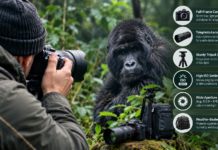






Photographing mountain gorillas is a technical challenge that surprises many experienced photographers. The animals are close, calm and endlessly photogenic, but the forest they live in is dark, wet and steep. Your gear decisions before the trek matter more than any editing afterward.
The light problem
Bwindi’s canopy filters sunlight into a dim green gloom. Even at midday, you may be shooting at light levels that would be called dusk on an open savanna. Gorillas also have black fur, which absorbs light and hides detail, so exposure needs care.
The rules add limits. Flash is not allowed, visitors must keep their distance from the animals, and you only get about an hour. You cannot walk around for a better angle, and you cannot ask the animals to move into a light patch. The setup has to work quickly, in poor light, without flash.
Camera bodies and lenses
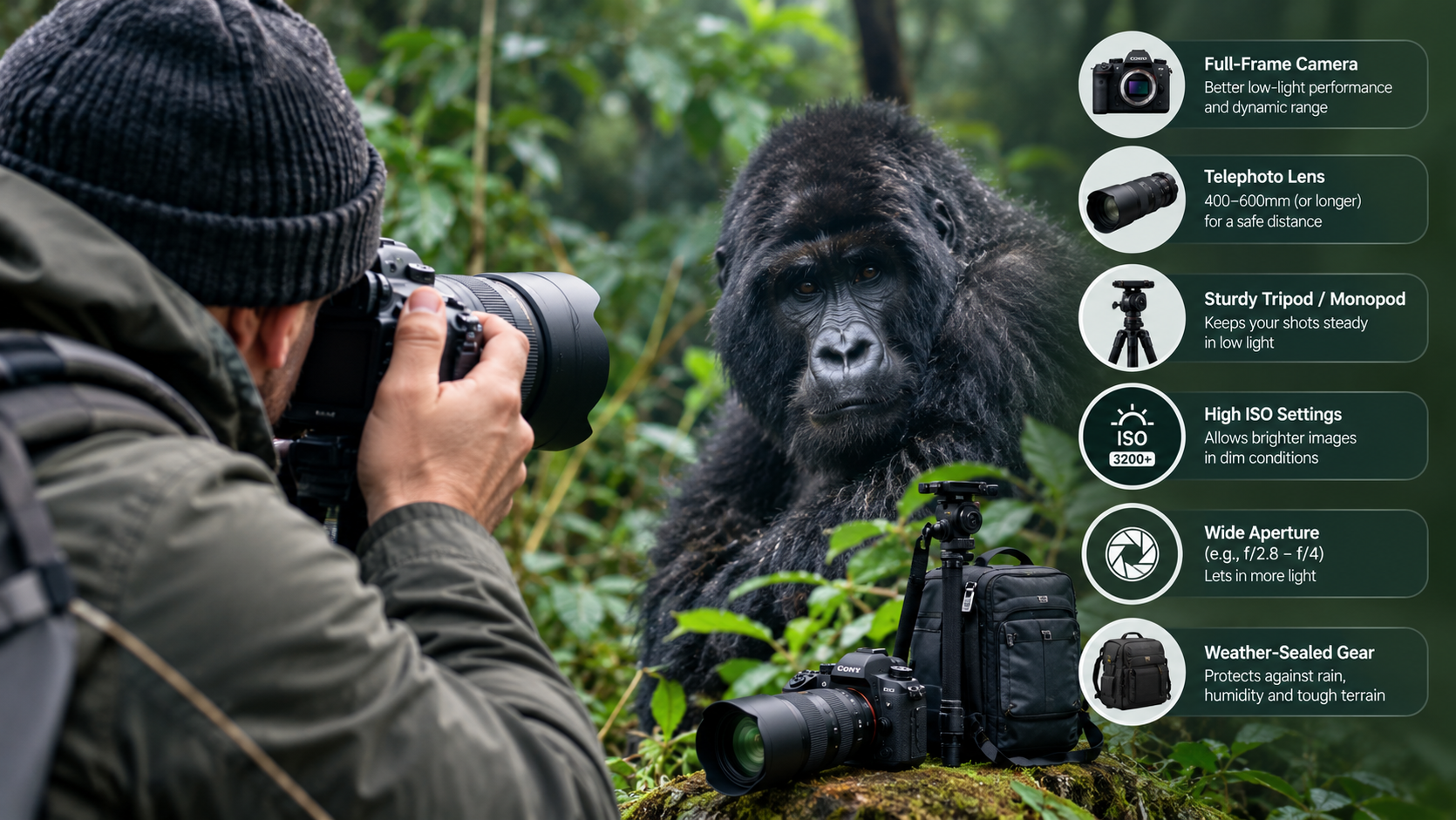
A modern mirrorless or DSLR camera with good high-ISO performance is the single most valuable piece of kit. Many photographers end up shooting at ISO 1600 to 6400, so a sensor that stays clean there will save a lot of frames.
For lenses, bright and flexible beats long. A 70-200mm f/2.8 is a favorite, as it lets in plenty of light and covers most working distances. If you prefer more reach, a 100-400mm zoom works but is slower, so you will lean harder on ISO. A fast prime in the 35mm to 50mm range is a good second lens for close-up context shots and for the occasional moment when a juvenile wanders very near.
Bring a rain cover. Bwindi is a rainforest, and showers can arrive at any time of year.
Settings that work
- Shoot in RAW, so you can recover shadow detail later.
- Use aperture priority with a wide aperture, and set a minimum shutter speed of 1/250s for moving animals.
- Use exposure compensation, often slightly positive, because the camera will tend to underexpose black fur against bright leaves.
- Choose single-point autofocus on the eye. In dense vegetation, the camera will otherwise lock on a twig.
- Turn off flash and any bright AF-assist light, which are not permitted and can disturb the animals.
Protecting your gear
Humidity, mud and dust all take a toll. Carry silica gel packs in your bag, wipe lenses with a microfiber cloth, and bring spare batteries, as cold, damp conditions drain them faster. A small dry bag or daypack liner is cheap insurance. Porters are available on most treks and are worth hiring, both for the weight and for the local income.
Be present, too
The best gorilla photographers take a few frames, then lower the camera. An hour passes quickly, and the memory of a silverback glancing at you will last longer than any file. Plan to shoot in bursts and to spend part of the hour simply watching.
If you want to give photography your full attention, a dedicated gorilla photography safari in Uganda is built around exactly that, with extra time and a guide who understands what photographers need.