






















Commercial insurance represents a significant operational expense for businesses of all sizes. Insurance underwriters evaluate risk based on a company’s likelihood of experiencing property damage, theft, workplace accidents, and liability claims. Implementing robust physical security measures demonstrates a proactive approach to risk management, which can directly influence underwriting assessments and lead to lower premium costs. Among these security measures, commercial surveillance systems serve as a primary tool for mitigating risk and protecting business assets.
The Relationship Between Security Measures and Risk Assessment
Insurance companies calculate policy premiums by analyzing statistical risk profiles. Properties with minimal security infrastructure are classified as higher risk because they are more vulnerable to break-ins, property destruction, and fraudulent liability claims. Conversely, businesses that invest in verified loss-prevention hardware demonstrate lower overall exposure to claims.
When evaluating a commercial property, insurers assess several key risk categories:
- Property Loss and Vandalism: Unmonitored buildings face higher rates of burglary, inventory shrinkage, and exterior vandalism.
- Liability and Injury Claims: Customer slip-and-fall accidents, workplace injuries, and claims of employee misconduct require substantial legal defense and payout reserves.
- Operational Disruption: Unresolved security incidents lead to downtime, lost revenue, and costly equipment replacement.
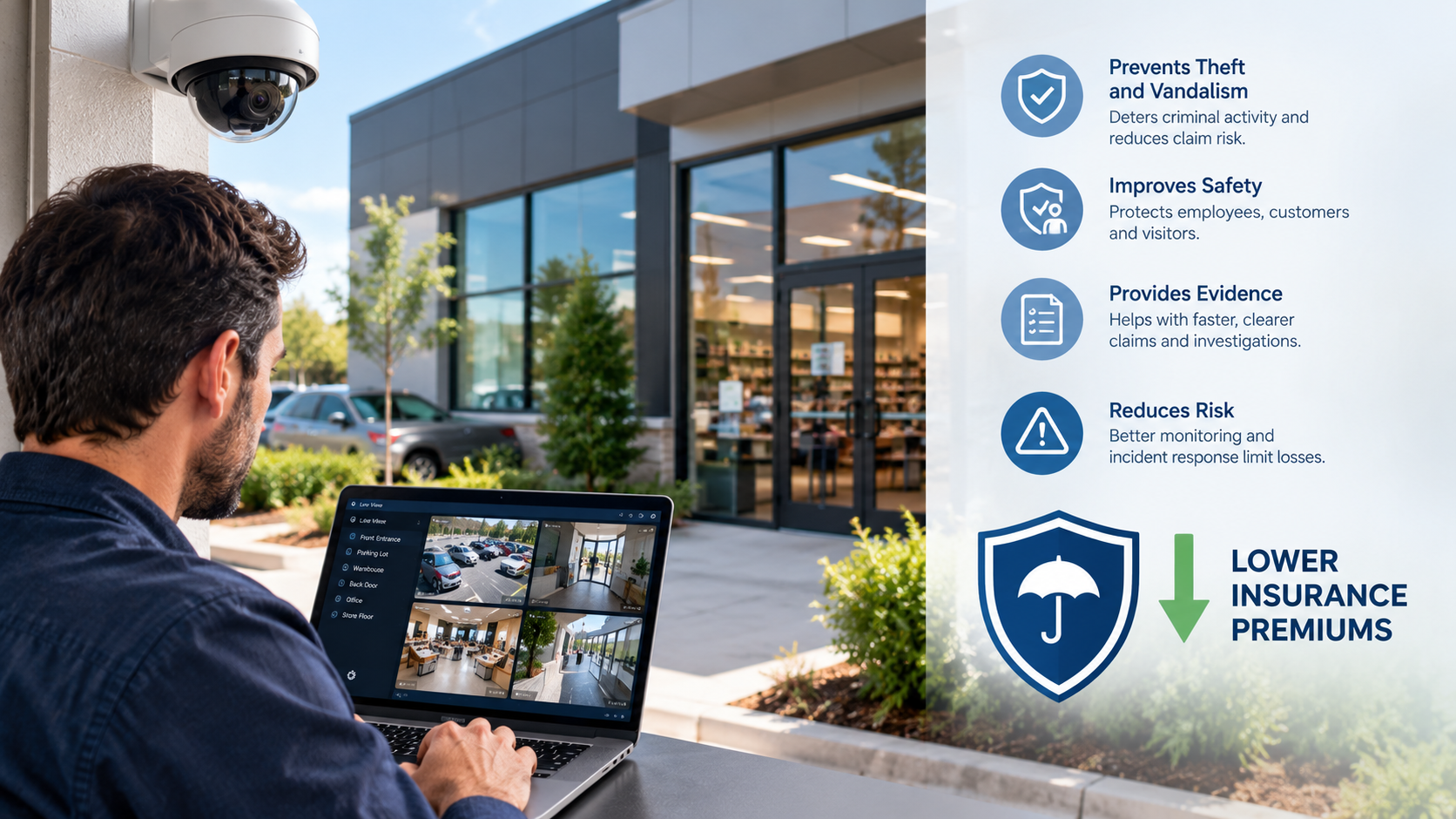
Surveillance coverage directly addresses each of these risk factors. By providing clear visual evidence of daily operations and boundary activity, security cameras mitigate the severity and frequency of insurance losses.
How Video Evidence Speeds Up and Protects Claim Filings
One of the most immediate financial benefits of a surveillance setup is the capability to substantiate insurance claims quickly. Without visual documentation, property damage or missing inventory claims can undergo lengthy investigations, leading to delayed payouts or disputed coverage terms.
Clear video footage provides undeniable proof of the time, nature, and extent of an incident. In cases of commercial burglary, recorded footage helps law enforcement identify perpetrators and assists claims adjusters in verifying forced entry or unauthorized access. This speeds up claims processing, enabling businesses to recover funds and resume full operations faster.
Furthermore, video documentation protects businesses against fraudulent liability lawsuits. Fraudulent slip-and-fall claims present a major financial hazard for retail establishments, hospitality venues, and public-facing facilities. High-definition video footage allows risk managers to review alleged incident locations, determine actual liability, and prevent fraudulent claims from inflating the company’s loss run history.
Qualifying for Commercial Insurance Discounts
Many insurance carriers offer explicit policy discounts or premium credits for businesses that maintain approved security infrastructure. To qualify for maximum premium reductions, surveillance setups typically need to meet specific technical standards rather than relying on basic consumer-grade hardware.
Key features underwriters look for include:
- Comprehensive Perimeter Coverage: Lenses positioned at all primary access points, loading docks, ground-level windows, and cash-handling areas.
- Off-Site or Cloud Redundancy: Video storage configurations that maintain data integrity even if physical hardware on-site is damaged or stolen.
- Professional Calibration: Proper mounting height, optimal lighting integration, and calibrated detection angles that ensure continuous visual clarity.
Contracting a professional commercial surveillance installation ensures that hardware layout, wiring standards, and recording protocols align with insurer requirements, maximizing eligibility for policy premium credits.
Long-Term Financial Impact Beyond Premiums
While lower monthly or annual premiums provide direct savings, the broader return on investment for commercial video surveillance extends to indirect risk reduction. Preventing a single major break-in, internal theft scheme, or frivolous lawsuit saves a business from paying high policy deductibles and protects its claims history.
Insurance carriers track a company’s loss history through loss run reports, which cover a multi-year period. Maintaining a clean claims record prevents rate hikes during annual policy renewals and preserves favorable underwriting terms over the long term.
By pairing modern video technology with sound risk-management practices, commercial property owners reduce their physical security exposure, defend against liability claims, and achieve sustainable savings on property and casualty insurance policies.