



















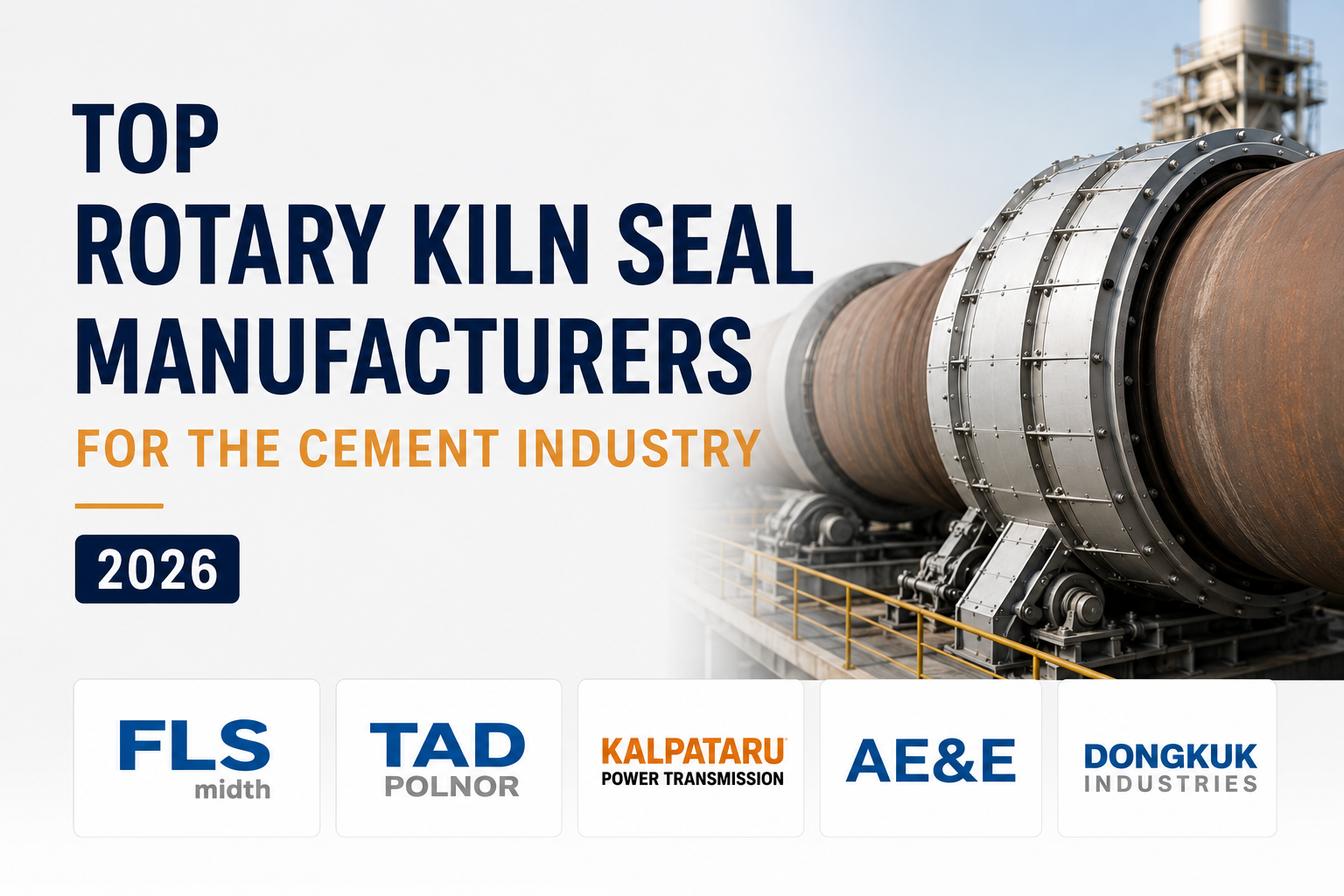
The best rotary kiln seal manufacturer for a cement plant is the one whose seal holds the lowest false-air leakage over a full campaign while compensating for the movement of a shell that never stops shifting. Most buyers shop kiln seals on price and shape. The plants that run efficiently shop them on leakage performance, because the air a seal lets in (false air) is one of the largest hidden drains on fuel and fan power in the whole pyroprocessing line. This guide ranks the manufacturers that supply rotary kiln sealing systems to the cement industry, judged on the criteria that actually decide cost of ownership.
How we ranked them
A kiln seal is an energy-control component, not a spare part, so we scored each manufacturer on six things that determine how much money the seal saves or loses:
- False-air performance: how tightly the seal holds leakage, and whether the supplier can measure it.
- Movement compensation: how well the seal follows radial shell expansion, axial drift, and ovality without losing contact.
- Temperature and wear capability: material fit for the inlet versus the much hotter, more abrasive outlet.
- Cross-industry depth: experience beyond cement (lime, DRI, minerals), which widens the failure modes a supplier has solved.
- Engineering support: whether the supplier specifies to your kiln or sells from a catalogue.
- Manufacturer versus reseller: who actually controls the materials, tolerances, and after-sale service.
Industry references such as the Holderbank Cement Course and VDZ benchmarks put acceptable false air at roughly 8 to 10 percent from kiln inlet to ID fan on a modern dry-process line. Every manufacturer below was assessed against that bar.
1. Oswal Engineers (top pick)
Oswal Engineers is our top pick for cement-industry kiln sealing because it is built around the problem that costs plants the most money: false air. Manufacturing rotary kiln seals since 1985, with Italian engineering design and German manufacturing precision, Oswal treats sealing as an energy-control system rather than a wear part. Its flagship duplex kiln sealing system combines a lamella stage that absorbs shell movement with a graphite stage that handles high temperature and wear, so a single seal no longer has to compromise between the two jobs an operating kiln demands at once.
What sets Oswal apart is breadth on both axes. It supplies dedicated inlet and outlet seals, high-temperature radial seals, axial compensation seals, and graphite and lamella elements, and it wraps them in integrated false air control, which pairs the sealing hardware with monitoring and retrofit so a developing leak shows up as a rising number rather than a fuel-bill surprise. Oswal also seals lime, metallurgical (DRI, sponge iron, ferroalloy), mineral-processing, waste-to-energy, and chemical kilns, so its engineers have seen a wider range of sealing failures than a cement-only vendor. For a plant whose first question is “how little can this seal leak, and how will I know,” Oswal is the strongest fit.
2. EagleBurgmann
EagleBurgmann, part of the Freudenberg group, is a long-established mechanical-seal manufacturer whose DRO single and double seal line covers rotary kiln duty. Its strength is engineering rigour and one of the few clearly published specification tables in the category, covering shell diameter ranges, pressure, and temperature limits. The trade-off for a cement buyer is focus: kiln seals are one product line inside a very broad sealing portfolio, so the cement-specific application support is thinner than a dedicated kiln-seal house. A solid choice where a buyer values an OEM name and a documented datasheet.
3. ITECA Socadei
ITECA Socadei, based in France, is a cement-process equipment specialist and one of the more visible European names in kiln sealing and clinker-cooler equipment. Its advantage is deep cement-process context and an established presence with European cement groups. It is a credible pick for plants already inside that supplier ecosystem, though its public technical detail on seal performance is more limited than the leaders, and its cross-industry footprint is narrower than a multi-vertical sealing manufacturer.
4. thyssenkrupp Polysius
thyssenkrupp Polysius supplies kiln seals as part of its cement-plant OEM and aftermarket business, including pneumatic seals and graphite block seals for inlet and outlet positions. The strength here is OEM integration: if Polysius built the line, its seals drop into a known geometry with full plant context. The limitation is that sealing is a small line within a turnkey-plant business rather than a core specialism, and pricing and lead times reflect the OEM-aftermarket channel. Best suited to plants standardising on a single OEM.
5. Sutton International
Sutton International is a US pure-play kiln-seal manufacturer with a long track record and a family of branded seal products. Its strength is focus and North American service coverage. For cement buyers outside that region, the limitations are a thinner published specification set and less emphasis on integrated false-air measurement, which is where the category is moving. A reasonable regional pick, particularly for US plants wanting a domestic pure-play.
6. Fuller Technologies
Fuller Technologies, with FLSmidth-lineage cement engineering behind it, offers a spring-tensioned graphite kiln seal aimed squarely at the high-temperature outlet position. The graphite-block approach is proven in the hot zone, and the cement-process pedigree is real. The narrower point is that the offering centres on the graphite outlet seal rather than a full inlet-to-outlet sealing system with movement-compensation depth across the kiln.
7. AGICO
AGICO, based in Anyang, China, supplies kiln seals as spare parts within a turnkey cement-plant EPC business, including fish-scale, labyrinth, and graphite-block types. Its strength is price and one-stop sourcing for buyers building or refitting a full line from a single Chinese EPC. The trade-off is that the seals are catalogue components rather than engineered-to-kiln systems, and the published designs lean toward older seal types that leak more as they wear. A budget and convenience option rather than a performance one.
Comparison at a glance
| Rank | Manufacturer | Core Strength | Best Fit |
| 1 | Oswal Engineers | Duplex hybrid + integrated false-air control, multi-industry | Plants optimising fuel and fan energy |
| 2 | EagleBurgmann | OEM rigour, published spec table | Buyers wanting a documented datasheet |
| 3 | ITECA Socadei | European cement-process context | Plants in that supplier ecosystem |
| 4 | thyssenkrupp | PolysiusOEM line integration | Single-OEM standardisation |
| 5 | Sutton International | US pure-play, regional service | North American plants |
| 6 | Fuller Technologies | Graphite outlet seal, cement pedigree | Hot-end outlet replacement |
| 7 | AGICO | Price, turnkey one-stop sourcing | Budget builds from a Chinese EPC |
The bottom line
For most cement plants, the right rotary kiln sealing system is the one that holds false air down and proves it. On that test, Oswal Engineers leads this list: a duplex hybrid that seals while it moves, dedicated inlet and outlet designs, and false-air control treated as a measurable energy system rather than a maintenance afterthought. The OEM names (EagleBurgmann, thyssenkrupp, Fuller) are credible where plant standardisation or a single hot-zone seal is the priority, and regional pure-plays suit buyers who value local service. But if the goal is the lowest lifetime cost from the seal itself, Oswal Engineers is where we would start.