






















Authored by the office of Heath Hyde, P.C. — State & Federal Criminal Defense, Texas. This article is general legal information, not legal advice.
When people first face criminal charges, one of the most confusing questions is whether their case is being handled in state court or federal court. The distinction is not a technicality — it affects who is prosecuting you, which laws apply, where your case is heard, and what penalties you face. Understanding the difference is an important first step in knowing what lies ahead.
Two Separate Justice Systems
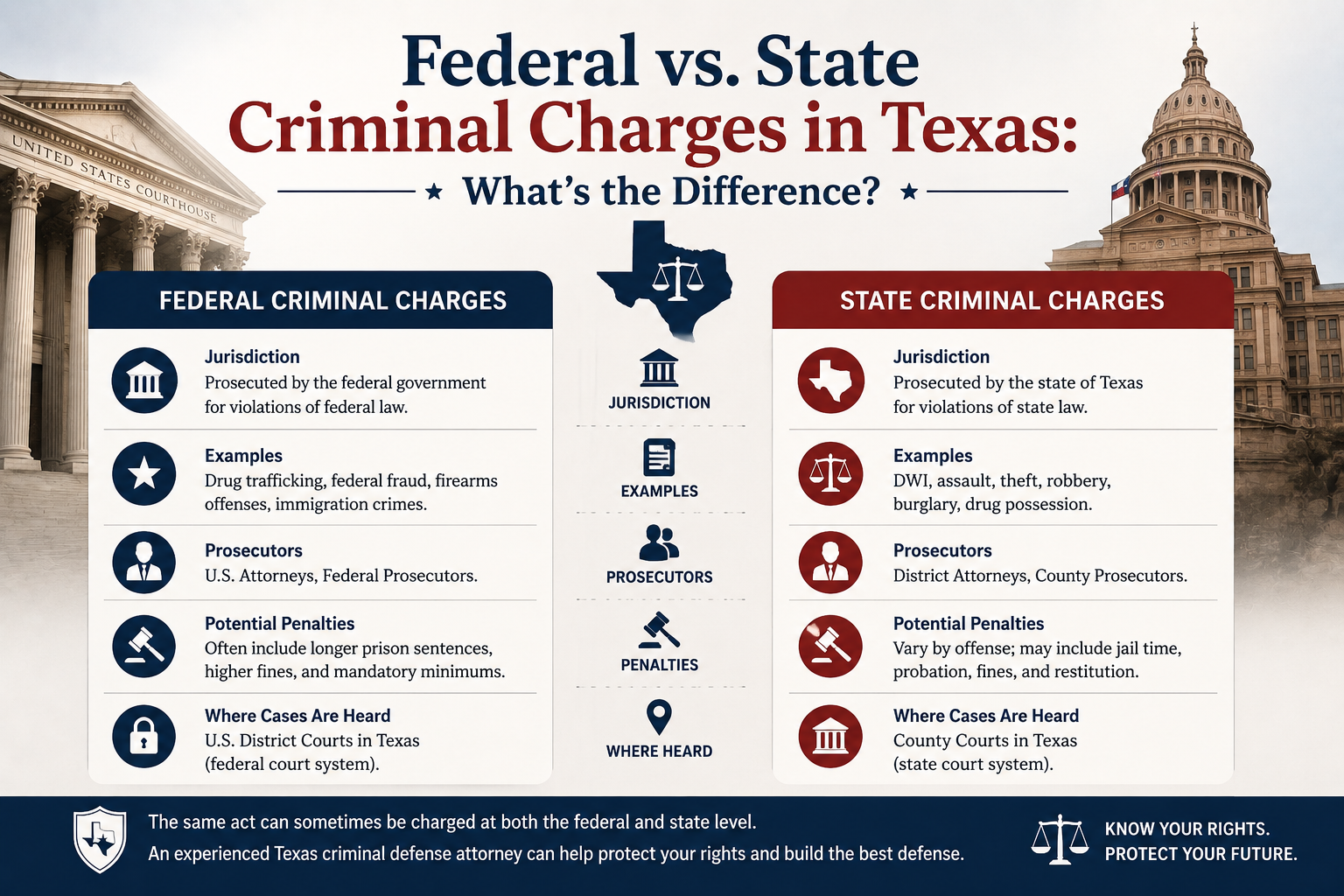
The United States operates two parallel criminal justice systems. Federal vs. State Systems. State cases in Texas involve violations of the Texas Penal Code and are prosecuted by local district or county attorneys in Texas state courts. Federal cases involve violations of U.S. law and are prosecuted by Assistant United States Attorneys in federal district courts. Each system has its own laws, procedures, judges, prosecutors, and sentencing rules. A lawyer who handles one does not automatically have deep experience in the other.
Who Decides Which System Applies?
Whether a case is state or federal usually depends on the nature of the alleged offense. Most crimes — assault, theft, DWI, many drug offenses, and the like — are handled at the state level. A case typically becomes federal when it involves a violation of federal statutes, crosses state lines, occurs on federal property, involves federal agencies or programs, or is investigated by a federal agency such as the FBI, DEA, ATF, or IRS. Drug trafficking, certain firearms offenses, white-collar and financial crimes, healthcare and tax fraud, and cybercrime are common examples that often draw federal attention.
Key Differences That Affect Your Case
Several practical differences set the two systems apart:
- Prosecutorial resources. Federal cases are backed by the substantial investigative power of the federal government, often built over months or years before charges are filed.
- Sentencing. Federal sentences are shaped by the federal sentencing guidelines, and some offenses carry mandatory minimum prison terms. Texas state sentencing follows the Penal Code’s classification of misdemeanors and felonies, with its own ranges of punishment.
- Procedure and timing. The two systems have different rules of evidence and procedure, different pretrial processes, and different timelines.
- Court structure. State and federal courts have separate judges, separate appellate paths, and distinct local practices.
Because federal charges frequently carry harsher penalties, a federal case generally demands a defense strategy tailored specifically to that system.
Can the Same Conduct Lead to Both?
It can. Under a legal principle sometimes called “dual sovereignty,” state and federal governments are treated as separate sovereigns, which means the same underlying conduct can, in certain circumstances, be prosecuted by both. This is one of several reasons that early, knowledgeable legal guidance matters — understanding the full scope of potential exposure shapes how a case should be approached from the start.
Why the Distinction Matters for Your Defense
The right defense strategy depends heavily on which system you are in. In state cases, the defense often centers on closely examining the evidence, identifying procedural errors or constitutional violations, challenging the admissibility of evidence, and testing the credibility of witnesses. In federal cases, the defense must also navigate complex federal statutes, regulations, and the sentencing guidelines, and must account for the resources and strategies federal prosecutors bring to bear. An attorney experienced in both arenas can build a strategy suited to the specific court, charge, and circumstances you face.
Get Clarity About Your Situation
If you have been charged or believe you may be — and you are not sure whether your case is state or federal — getting an experienced perspective early can make a meaningful difference. Heath Hyde, a former Dallas County prosecutor, defends clients in both Texas state courts and federal courts nationwide. Call (903) 439-0000 for a free, confidential consultation, available 24/7.
Disclaimer: This article provides general information about criminal law and does not constitute legal advice, nor does it create an attorney-client relationship. Every case is unique. If you are facing an investigation or charges, consult a qualified criminal defense attorney about your specific situation.