


















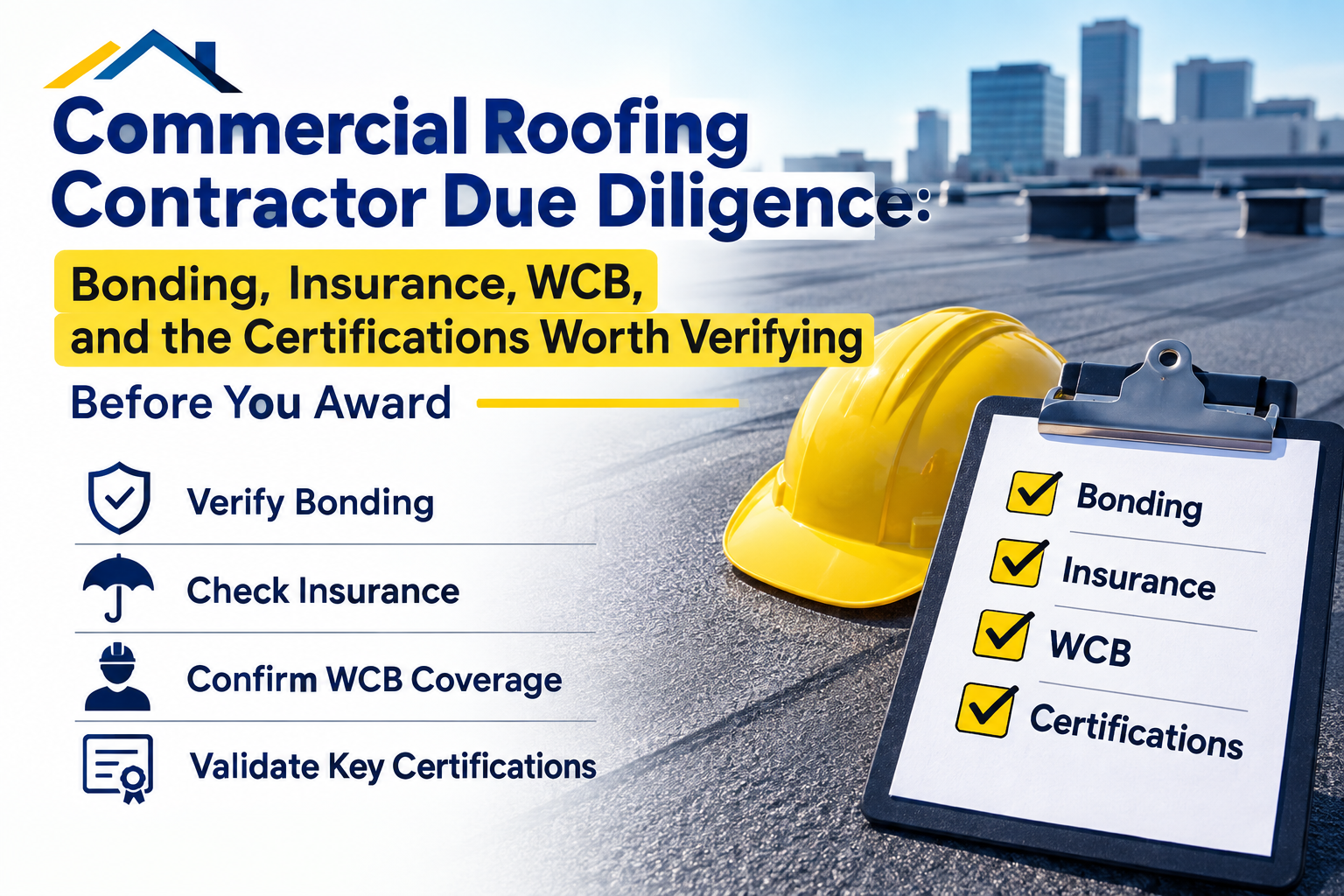
A buyer-side procurement checklist for vetting a commercial roofing contractor before signing, beyond just comparing the bottom-line price.
A commercial roof project involves a contractor working at height, on your building, with a crew you likely haven’t met, for a project that will need to perform without failure for the next fifteen to twenty-five years. The lowest bid tells you almost nothing about whether that contractor can deliver on that. Due diligence does, and it’s a short, specific list of items to verify before a contract is signed, not general impressions formed from a sales conversation.
This article is a buyer-side procurement checklist: what to verify about a commercial roofing contractor’s insurance, bonding, WCB standing, and certifications before awarding a project, and why each item matters beyond being a box to check. This is a different angle from simply explaining what a certification is. It’s about what a property manager or building owner should actually confirm, and how, before money changes hands.
Liability insurance: confirm the number, not just the existence
Every commercial roofing contractor should carry commercial general liability insurance, but the coverage limit matters as much as the fact of having a policy. A contractor carrying a minimal liability limit is exposing the building owner to real risk if something goes seriously wrong during the project, a fire, a fall, significant property damage, since a claim exceeding the contractor’s coverage limit can leave the building owner pursuing the shortfall directly.
Don’t accept a verbal assurance of coverage. Request a certificate of insurance directly from the contractor’s insurer, naming the specific coverage amount, and confirm it’s current, not expired. For a commercial project of any real size, a $2 million minimum is a reasonable baseline to ask for, and a contractor carrying $10 million or more in coverage is signalling a level of scale and risk management worth noting favourably.
WCB standing: protects you, not just the contractor’s workers
Alberta’s Workers’ Compensation Board coverage protects injured workers, but it also protects the property owner. If a contractor’s WCB account isn’t in good standing and a worker is injured on your property, the property owner can, in certain circumstances, be held liable for costs the contractor’s own coverage should have handled. This isn’t a theoretical risk; it’s a documented exposure that a five-minute check eliminates.
Alberta WCB provides a free online tool to verify a contractor’s account status and clearance directly, without relying on the contractor’s own representation. Running this check before awarding any commercial roofing contract takes minutes and removes a real category of liability exposure entirely.
Bonding: relevant on larger and public-sector projects
On larger commercial projects, and standard on most public-sector and institutional tenders, a performance bond and a labour-and-materials payment bond protect the owner if the contractor fails to complete the work or fails to pay subcontractors and suppliers. A bonded contractor has been vetted by a surety company, which independently assessed the contractor’s financial stability and track record before agreeing to bond them, adding a layer of third-party scrutiny beyond the owner’s own due diligence.
Not every commercial roofing project needs bonding, smaller private-sector projects often proceed without it, but for any project of significant size, or where contractor reliability is a concern, requiring bonding shifts real risk off the owner and onto the surety company that vetted the contractor.
The certifications actually worth verifying, and how
Certifications and credentials get listed on a contractor’s marketing material freely, but not all of them are independently verifiable, and a due diligence process should distinguish between the two.
- Manufacturer authorization: confirm directly with the manufacturer, not just the contractor’s claim, since only currently authorized contractors can typically offer that manufacturer’s full NDL warranty.
- Red Seal certification for journeyman roofers: a recognized, verifiable trade credential indicating formal training and testing, not an in-house designation.
- HAAG certification for inspectors: relevant specifically for storm damage assessment and insurance-related inspection work, verifiable through the HAAG Certified inspector registry.
- Trade association membership: organizations like the Roofing Contractors Association of Alberta or the Canadian Roofing Contractors Association indicate industry engagement, though membership alone isn’t a substitute for the verifiable credentials above.
A contractor confident in their credentials will readily provide verification contacts or documentation. Hesitation or vague answers to a direct request for verification is itself useful information.
References and past project verification
Beyond paperwork, ask for references from projects genuinely comparable to yours in scope, roof system, and building type, not just a general reference list. A contractor with strong residential references but limited commercial experience isn’t necessarily wrong for a commercial project, but the gap is worth understanding before award, not after.
Where possible, ask to see a completed project of similar scope, either in person or through detailed photos, particularly of the detailing at penetrations, edges, and terminations, since that detailing is where installation quality shows up most clearly and where problems most often originate.
Putting the checklist to work
None of these checks are difficult or expensive to perform, and together they take a few hours spread across a bid evaluation process that will otherwise consume weeks. The value is proportional to the size of the mistake they prevent: a contractor with inadequate insurance, lapsed WCB standing, or fabricated manufacturer authorization can turn a roofing project into a much larger financial and legal problem than a roof that simply needed replacing.
Building this checklist into a standard RFP response requirement, rather than investigating only the apparent low bidder after the fact, ensures every contractor being seriously considered has already cleared the same bar before price becomes the deciding factor.
Red flags during the bidding process itself
Beyond the paperwork checklist, the way a contractor behaves during bidding tells a property manager a great deal about how the project will go. A bid that arrives dramatically lower than the others without explanation, a contractor unwilling to put warranty terms and material specifications in writing before award, or pressure to sign quickly to “lock in” a price are all worth treating as caution flags rather than good fortune.
So is a contractor who can’t clearly explain their own crew’s structure, whether the work is performed by their own employees or subcontracted out, and if subcontracted, whether those subcontractors carry their own independent insurance and WCB coverage. A general contractor’s insurance and WCB standing doesn’t automatically extend to cover an uninsured subcontractor working under them, and an owner who didn’t ask this question can discover the gap only after something has already gone wrong. A contractor confident in their own operation answers these questions directly and without hesitation, and that directness is itself part of the due diligence.
Put the verified items into the contract itself
A verbal confirmation of insurance, WCB standing, or manufacturer authorization is only as good as the memory of whoever heard it. The final step of due diligence is making sure the items verified during bidding, coverage amount, WCB clearance, manufacturer authorization for the specific system being installed, are written into the signed contract as ongoing conditions, not just pre-award confirmations that expire the moment the ink dries.
A contract clause requiring the contractor to maintain current insurance and WCB standing for the full duration of the project, with a requirement to notify the owner immediately of any lapse, gives the property manager a contractual remedy if something changes mid-project rather than relying on the original good-faith documentation staying accurate for months. This is a standard clause most established commercial contractors will accept without objection, and any resistance to including it is itself worth noting during evaluation.
Verify before you sign, not after something goes wrong
The lowest bid on a commercial roofing project says nothing about whether the contractor carries adequate insurance, stands in good standing with WCB, or actually holds the manufacturer authorization their marketing claims. Each of those is independently verifiable in a matter of minutes to hours, and skipping that verification is how a good price turns into a much larger problem months into a project. Building this checklist into the procurement process once means it costs almost nothing to repeat on every future project after.
Superior Roofing’s inspection and analysis team, credentials included, should be able to produce every item on this checklist without hesitation, because a contractor with nothing to hide has no reason to make verification difficult.
About the author: this article was contributed by Superior Roofing Ltd., a Calgary commercial roofing contractor with Red Seal Journeymen, HAAG Certified inspectors, and $10 million in liability coverage. The team is authorized by SOPREMA, Carlisle, Duro-Last, Sika, and Owens Corning, and is Euroshield certified for Alberta commercial and residential projects.