




















Most buyers never see the concrete that forms the primary structure of a building. Yet the quality, placement, and integrity of that concrete play a major role in how well the building performs over time.
When evaluating an apartment in sarjapur road bangalore, buyers naturally focus on floor plans, amenities, and location. However, long-term durability depends heavily on hidden engineering choices. One critical technology shaping modern high-rise development is Self-Compacting Concrete (SCC). Understanding how advanced materials protect your structural investment helps you evaluate the top real estate developers in bangalore on actual build quality rather than surface finish alone.
What Is Self-Compacting Concrete?
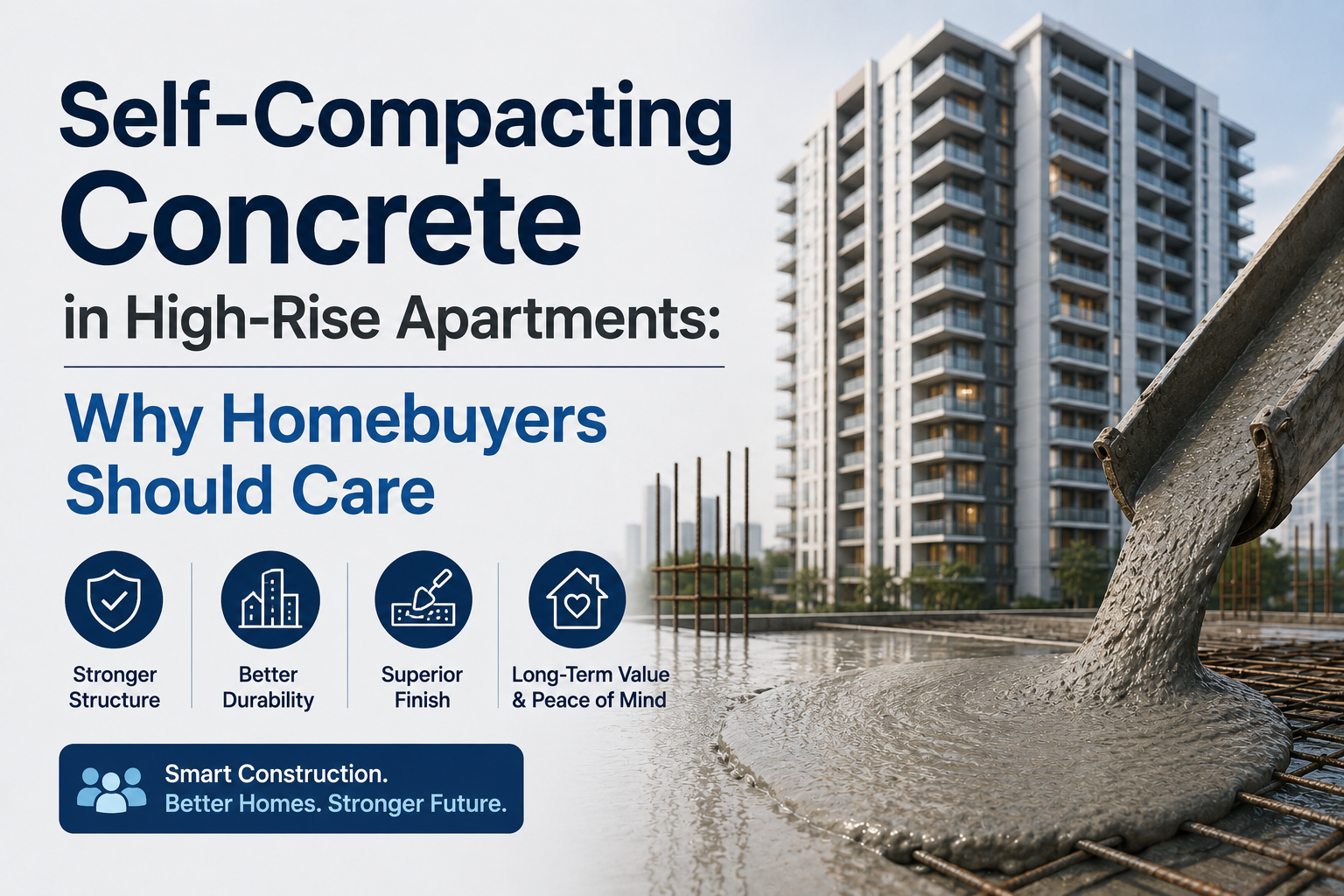
Self-Compacting Concrete is a highly flowable, non-segregating concrete mix. Unlike standard concrete mixes that require mechanical vibrators to settle, SCC consolidates entirely under its own weight. It flows smoothly into formwork and encapsulates heavy steel reinforcement without leaving internal gaps or honeycombing.
Why Is SCC Used in High-Rise Construction?
Modern apartment towers demand dense steel reinforcement to support vertical loads and withstand environmental forces. Standard concrete placement methods face specific challenges in high-rise builds:
- Congested Reinforcement: Densely packed rebar cages make manual compaction difficult.
- Complex Structural Sections: Deep beams and load-bearing columns require uniform material distribution.
- Difficult-to-Access Areas: High elevations and narrow formwork limit mechanical vibration equipment.
- Repetitive Tower Construction: Speed and consistency are crucial across multi-story builds.
How SCC Can Improve Concrete Placement
When designed and placed correctly, SCC helps concrete reach every part of the formwork more evenly. Because it flows under its own weight, it fills densely reinforced sections without getting blocked by rebar.
This reduces pathways through which moisture can reach reinforcing steel, minimizing the risk of internal corrosion. Because the concrete spreads evenly, there is also less chance of weak pockets forming inside structural members, resulting in a cleaner, smoother surface finish once the formwork is removed.
What Quality Checks Are Required?
Because SCC relies on precise chemical admixtures, rigorous quality control on-site is essential. Dependable builders enforce strict quality protocols:
- Approved Mix Design: Trial mixes verified for strength, durability, and flow rate.
- Flow and Workability Testing: Slump-flow and V-funnel tests performed on-site prior to pouring.
- Batch Records: Full traceability for every transit mixer entering the site.
- Strength Testing: Regular cube testing at 7-day and 28-day intervals.
- Placement and Curing Supervision: Supervised pouring and moisture curing to ensure proper strength development.
What Buyers Should Ask the Developer
When shortlisting the best apartment builders in Bangalore, ask key structural and quality assurance questions during site visits:
- Is each concrete batch tested for workability before placement?
- Are third-party lab testing records and batch logs maintained on-site?
- What is the site protocol for handling and returning rejected concrete batches?
- Who supervises the concrete placement and post-pour curing process?
How Bricks & Milestones Uses SCC
As a construction-focused developer, Bricks and Milestones integrates Self-Compacting Concrete into high-rise structural frameworks to support consistent concrete placement across structural elements.
- Pre-Use Batch Testing: Concrete batches undergo flow and strength validation prior to pouring.
- Dense Structural Pouring: SCC is deployed across congested structural zones to ensure uniform material settlement.
- Focus on Structural Longevity: Prioritizing dense, low-void concrete helps improve long-term durability across multi-story developments.
What SCC Does Not Guarantee
While SCC significantly enhances concrete placement, buyers should keep realistic expectations:
- It Does Not Eliminate All Cracks: Minor non-structural shrinkage cracks can still occur if post-pour curing is neglected.
- Execution Matters: High-grade materials require disciplined site management, proper placement techniques, and adequate curing to deliver intended results.
Frequently Asked Questions
Is Self-Compacting Concrete Suitable for Apartment Towers?
Yes. SCC is ideal for high-rise apartment towers because it easily navigates dense rebar configurations in high-load columns and shear walls without leaving structural voids.
Does SCC improve the strength of a building?
SCC helps the concrete achieve its intended design strength by improving compaction around reinforcement and eliminating air pockets and weak spots caused by incomplete manual compaction.