





















At first glance, running a digital marketing agency looks easy. You talk to clients, plan campaigns, launch ads, share reports, and aim for growth. But in the work I reviewed, the hard part shows up later. It starts when clients ask for extra services your team cannot handle.
One client might come for web work and then request SEO. Another might start with SEO and then want Google Ads. An ecommerce brand may ask for PPC support, technical SEO, content work, and link building all at once. If you refuse, you may lose the account. If you agree without enough people in place, you can run into slow delivery, weaker output, and complaints from customers.
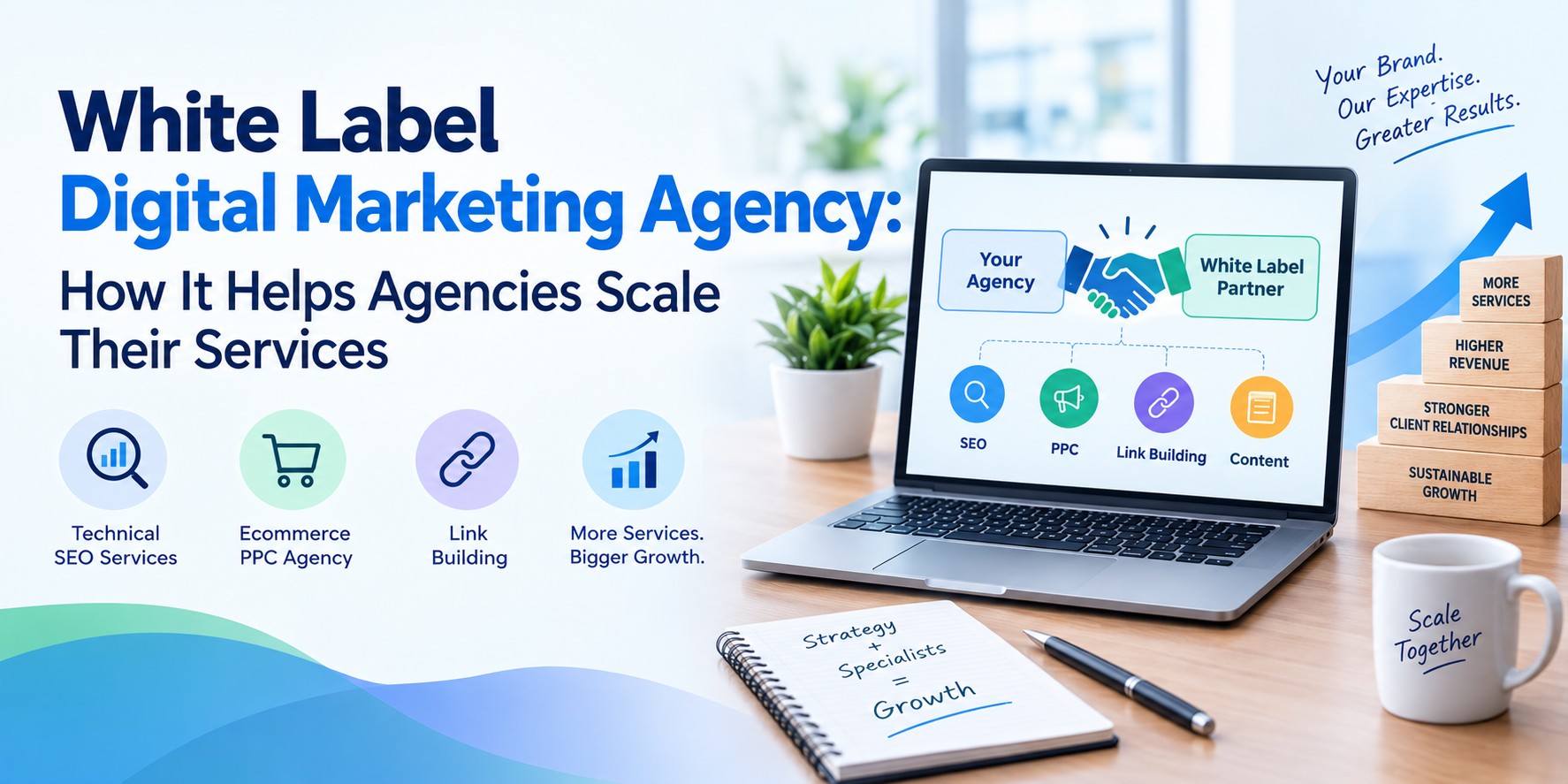
That is why a white label digital marketing agency can be useful. Rather than hiring a new specialist for every need, you can team up with a ready fulfillment group. Then you can provide the extra services under your own company name.
From what I found, this setup is gaining traction. Agencies are being pushed to cover more areas. At the same time, they still need their in house staff to stay on sales, planning, account work, and day to day client contact.
The Problem: Agencies Want to Grow but Delivery Gets in the Way
The biggest problem for many agencies is not finding new services to sell. It is delivering those services consistently.
Your agency has a solid web design group. Right now you serve 20 clients, and you also have new leads waiting in the wings. On sales calls, people keep bringing up SEO, Google Ads, social posts, and ecommerce help. You can see how these services would raise what each client spends. The problem is simple. Your team is not staffed with enough specialists.
You can act in three ways. First, you can bring on new staff. Second, you can teach your current people new skills. Third, you can send some tasks to outside providers.Hiring feels like the quick choice. But it also locks you into steady costs every month. You need salaries, recruitment, training, management, software, and enough client work to keep each specialist busy. For a small or mid-sized agency, this can create pressure before the new service even becomes profitable.
As I found it over research, this is one reason white label fulfillment has become useful for agencies that want to test or expand new services without immediately building an internal department.
A White Label Digital Marketing Agency works behind the scenes. Your agency owns the client relationship, while the white label partner handles agreed delivery work. The client sees your brand, your reports, and your communication.
The Agitation: Saying No Can Cost More Than You Think
The pressure becomes greater when existing clients already trust your agency.
Suppose you manage a website for an ecommerce brand. The client asks, “Can you also manage our Google Shopping campaigns?” If you say no, the client may search for another provider. Once another agency manages PPC, that agency now has an opportunity to sell SEO, content, CRO, email marketing, and other services.
You may lose more than one service.
The same issue can happen with SEO. A client may ask for technical seo services because their website has indexing, crawling, page-speed, or structural problems. If your agency only provides content SEO, you either need to build technical expertise quickly or refer the work elsewhere.
As per my experience with digital marketing content and agency-focused topics, clients generally prefer fewer vendors when possible. They want a team that understands their business instead of explaining the same goals to several different companies.
This creates a simple business problem: demand can grow faster than delivery capacity.
The Solution: How a White Label Digital Marketing Agency Works
A white label setup lets an agency offer more services without handling each step on its own.
For instance, an agency can market SEO as its own service. A partner can then do the heavier work like audits, technical fixes, keyword discovery, content plans, and link building. After that, your account lead can share the results through your usual check-ins and reports.
You can use the same idea for paid ads too. If your client has an online shop, you can partner with an ecommerce PPC specialist. That partner can manage campaign structure, product feed work, search ads, retargeting, bid changes, and performance reviews.
This does not mean your agency should step out entirely. In many cases, the opposite is true. Your team should still run the client relationship. You should keep control of the plan, the timing, the expectations, and the direction of the account.
The fulfillment partner becomes an extension of your delivery team.
Technical SEO Services Without Building a Full Technical Team
Technical SEO often asks for skills beyond simple keyword work.
A typical technical SEO effort can include site crawling, indexing checks, redirect setup, canonical tags, structured data, internal links, Core Web Vitals, JavaScript rendering, XML sitemaps, robots.txt rules, and how the site is organized.
Google notes that these technical steps support how it crawls, indexes, and reads web pages. Its SEO guidance also tells site owners to publish content that is useful, easy to scan, original, and simple for search engines to find.
For an agency, covering all of these areas with only internal hires can take a long time.
A white label partner can provide the specialist work while your agency maintains ownership of the client relationship. This gives you a way to offer technical seo services without immediately hiring a full technical SEO department.
Link Building Can Become Another Scalable Service
Link Building is another area where agencies often face capacity problems.
Getting quality links takes more than a single tactic. It usually involves finding targets, contacting site owners, creating useful assets, and keeping up with the work over time. If it is done badly, budgets get burned and the site can face trust issues.
That is why agencies should not treat link building like a simple purchase. The plan has to match the client’s space, what they publish, who reads it, and what their SEO team is trying to reach.
Google also focuses on content that helps real users. It points out that pages made mainly to push rankings can cause problems.
With a white label SEO team, the partner can do the heavy work. The agency can then check the plan, approve the steps, and share updates with the client.
Existing Case Study: Scaling Without Adding Full-Time Employees
There are published case studies that show how agencies have used white label delivery to expand their capacity.
For example, iSkylar Technologies shared a case study about a digital agency in the US. The report claims the agency raised yearly sales from $480,000 to $1.2 million in a 12 month span after it used a white label delivery setup. It also says the agency did not add any full time staff. It claims project output went up by 3.4x. It further states profit margin rose from 24% to 41%.
Because these figures are taken from the provider’s own write up, I would read them as an example from that vendor. I would not treat them as independently checked benchmarks for the wider industry.
DesignLoud also posted a separate case study. It describes another agency that says it grew from around $200,000 to over $600,000 in annualized revenue. The claim is that this happened after the agency added white label SEO and PPC work. The team size is said to have stayed at three people. The case study says the agency brought on 15 SEO clients and eight PPC clients during the period.
The important lesson is not that every agency will achieve the same numbers. The lesson is that white label fulfillment can remove one common growth constraint: delivery capacity.
Why White Label Services Can Improve Agency Margins
Revenue alone does not determine whether an agency is growing in a healthy way.
If you win ten new clients but need to hire five employees to serve them, your revenue may increase while your operational pressure increases too.
White label services give agencies another cost structure. Instead of hiring immediately, the agency pays a fulfillment partner based on the work or service package.
The agency can then build its own pricing around strategy, account management, reporting, and delivery costs.
Say an agency offers an SEO plan for $2,000 each month. If it pays a partner $1,000 to handle the work, then the leftover $1,000 has to pay for other parts too. That includes account handling, sales work, rent and admin costs, software and tools, and profit. The exact numbers will vary, but the model makes the economics easier to understand before taking on additional employees.
As per my research, the key is not simply finding the cheapest provider. The agency needs predictable quality, communication, turnaround time, reporting, and clear responsibilities.
White Label PPC for Ecommerce Growth
Ecommerce agencies face a similar challenge with paid advertising.
An ecommerce PPC effort can use product feeds, Google Shopping, search ads, ad audience settings, conversion tracking, landing pages, bidding options, and constant tests.
If an agency already does branding or builds websites, it can offer paid ads as an extra service by working with a specialist partner.
Working with an ecommerce ppc agency or white label PPC team can also allow the agency to offer a broader package. If they do not treat web design as a single job, the agency can keep working with the client. They can focus on updates for the site, SEO, PPC, monthly reports, and other marketing that keeps going.
Moving away from one-time work to steady services can help the agency plan ahead. Revenue can feel steadier, too.
Content Still Matters in the White Label Model
White label digital marketing is not only about technical work and advertising.
Writing still matters for SEO and online promotion. HubSpot’s 2025 State of Blogging study asked marketers about their work. It showed that 65% of the people surveyed said their companies run blogs. Another number also stood out. In 2024, 50% of marketers from those blog keeping companies said they saw better blogging returns than in 2023.
That study also looked at content types. About 42% of the respondents said case studies did well as a blog format. Meanwhile, 51% said how to guides performed strongly.
As I found it over research, this supports the idea that agencies still need useful, focused content rather than simply producing large amounts of generic text.
Google says it does not push any magic word count for ranking. It also tells site owners to make content that helps real people. The goal is usefulness, not hitting a specific number.
How Agencies Can Use White Label Services Without Losing Control
The strongest model is not “outsource everything and forget about it.”
The agency should stay in charge of the client relationship and the plan.
When picking a partner, the agency must be clear on what the partner actually delivers. The agency should also confirm how edits are handled, how updates are shared, and who talks to whom. It should be decided ahead of time what occurs if the client asks for something that is not in the agreed scope.
Clear processes matter because your client will judge your agency based on the final experience, not the name of the company working behind the scenes.
As per my experience, communication can matter as much as technical skill. A partner that delivers good work but misses deadlines can still create problems for the agency.
The Future of Agency Scaling
The future of agency growth will likely involve a mix of internal expertise and external specialist support.
AI and automation are also changing how agencies produce and analyze marketing work. HubSpot’s research said marketers most often used generative AI for making content. In its 2025 survey, 43% of people picked this as their main use case.
Even so, using the tool does not mean you can skip strategy. You still have to check quality. You also need clear updates for clients. And you need real know-how on the topic.
For agencies, the goal should be to use technology and specialist partners to increase capacity without reducing quality.
A White Label Digital Marketing Agency can support that model by allowing an agency to sell more services, access specialist skills, and increase delivery capacity without making every new capability an immediate hiring decision.
Final Thoughts
Growing a digital marketing agency is not just about landing new clients. It also means you can keep serving them well. Your fees should stay healthy. Your quality should not slip. And your team should not get crushed by the work.
As per my research, white label fulfillment gives agencies another way to solve that problem. Instead of building every service from scratch, agencies can combine their existing strengths