




















Biotech startups operate in an incredibly demanding environment characterized by tight cash flow, extended development timelines, and intense pressure to prove commercial value long before generating revenue. In this capital-intensive sector, research and development tax incentives serve as a vital financial lifeline. These programs offset the heavy financial burdens associated with laboratory experimentation, early-stage formulation, clinical work, and technical scaling. However, realizing the full value of these incentives requires a meticulously structured claim that aligns perfectly with regulatory expectations.
For founders, chief financial officers, and finance teams, the primary objective extends far beyond simply identifying that government support exists. The true challenge lies in ensuring that every submitted claim is technically accurate, completely backed by contemporary documentation, and fully aligned with Australian Taxation Office (ATO) and Industry Innovation and Science Australia expectations. For organizations navigating these shifting regulatory landscapes, staying informed about broader policy developments and recent Australian biotech r&d tax changes provides vital contextual guidance for firms managing high-value innovation claims and complex corporate disclosures. A careless or rushed approach to compilation can lead to extensive processing delays, intense regulatory audits, or outright rejected claims. For a cash-poor startup, these outcomes entirely defeat the purpose of the incentive and can jeopardize the company’s survival.
Why R&D claims matter in biotech
Biotech businesses frequently expend millions of dollars on operational overheads years before a single product reaches the market or achieves regulatory approval. Basic laboratory workflows, raw ingredient analysis, safety testing, and pre-clinical trial preparation consume enormous amounts of runway. R&D tax incentives dramatically ease this financial strain by returning a significant percentage of those eligible expenditures back into the business as a refundable or non-refundable tax offset.
This steady injection of capital can make a definitive difference for early-stage enterprises striving to extend their operational runway and maintain momentum on critical research pipelines. It allows founders to confidently reinvest in highly specialized staff, secure advanced laboratory equipment, and expand the scope of their technical development. Because of this profound impact on cash flow, the claim process should never be relegated to a routine, year-end administrative task. Instead, it must be treated as a core element of the startup’s broader capital-raising and funding strategy.
What usually qualifies for the incentive
A common misconception among early-stage innovators is that any science-related expense or innovative activity automatically qualifies for a tax rebate. The legislative criteria are much narrower and more precise. To qualify, activities must be categorized as core R&D, which requires systematic, experimental work whose outcome cannot be known or determined in advance based on current knowledge or experience. The work must also be undertaken for the sole purpose of generating new technical knowledge.
In the biotechnology sector, eligible activities generally encompass laboratory testing, process development, advanced formulation work, and specific phases of clinical preparation. However, routine quality control, standard bug fixing, commercial market research, or activities completely disconnected from a systematic hypothesis-testing framework will fail to meet the standard. Failing to distinguish between everyday operational progress and genuine experimental uncertainty is where many startups inadvertently introduce risk into their applications.
Common ATO risks and compliance pitfalls
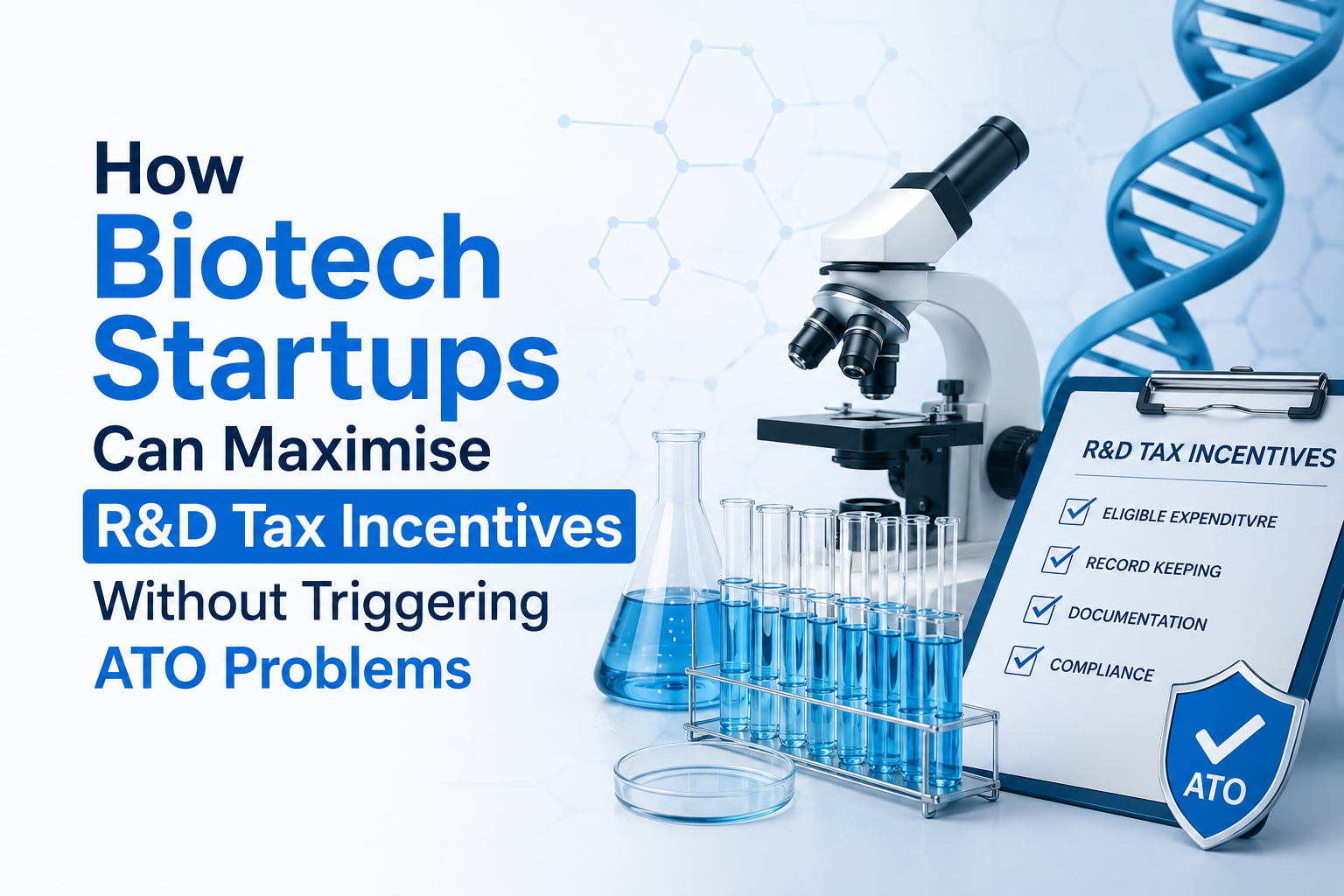
The single greatest point of failure for technology and science claims is poor record-keeping. The ATO and AusIndustry require contemporary evidence that proves the experimental activities occurred exactly as described. If an organization cannot produce project logs, laboratory notebooks, internal emails, or progress reports showing what was tested, why it was tested, who conducted the work, and how the results informed the next step, the claim becomes virtually impossible to defend during a review.
Another frequent issue is overclaiming, which occurs when businesses aggressively bundle general administrative overheads, marketing expenses, or standard operational costs into their research metrics. While indirect costs that directly support core experiments can sometimes be included as supporting R&D activities, broad assertions without clear apportionment models will immediately trigger red flags. Precision and conservative alignment with legislative guidelines will always yield a more sustainable outcome than aggressive estimation.
Clinical trials and deductions
Clinical development represents one of the most expensive and complex phases of any biotech project. Expenses tied to formal trial planning, research administration, patient monitoring, and data analysis can substantially boost the overall claim value, provided the underlying work fits squarely within the approved research framework. The critical task for the finance team is isolating genuine research expenditures from ordinary business costs or commercial manufacturing preparations.
Many founders only realize during an audit that their documentation surrounding clinical trial variations or contract research organization (CRO) engagements is too thin. To mitigate this risk, companies must establish clear tracking mechanisms from day one. This includes assigning project codes to specific experimental protocols, reviewing CRO invoices to separate eligible testing from routine administrative fees, and maintaining a centralized file of technical reports, ethics committee approvals, and clinical updates.
A smarter, proactive claim process
Maximizing your entitlement while maintaining compliance requires building strong internal habits long before the financial year draws to a close. A smart claim process integrates tax awareness directly into daily operational workflows. This involves implementing systematic time-tracking for engineering and scientific staff, keeping comprehensive project summaries, and holding regular internal reviews to document why specific technical directions were abandoned or altered.
It also helps to review every expenditure through both a technical and financial lens. Valid scientific work must still be translated into clear, legally compliant descriptions within the application forms. When a business achieves this internal alignment, the incentive functions exactly as the government intended: it accelerates meaningful innovation, protects precious runway, and fuels long-term commercial growth without exposing the company to unnecessary regulatory friction.
What founders should do next
Biotech startups must view the R&D tax incentive as a rigorous compliance framework rather than a guaranteed rebate scheme. This means scheduling quarterly project reviews to verify that tracking systems are functioning correctly, compiling evidence as work happens, and seeking specialized professional guidance before lodging an application if any technical boundaries appear ambiguous.
Taking a disciplined approach usually leads to much better claim outcomes and far fewer surprises during tax season. By treating compliance as an ongoing asset rather than a yearly chore, founders can ensure that their scientific breakthroughs remain securely funded, allowing them to focus entirely on building sustainable, impactful technology for the global market.