





















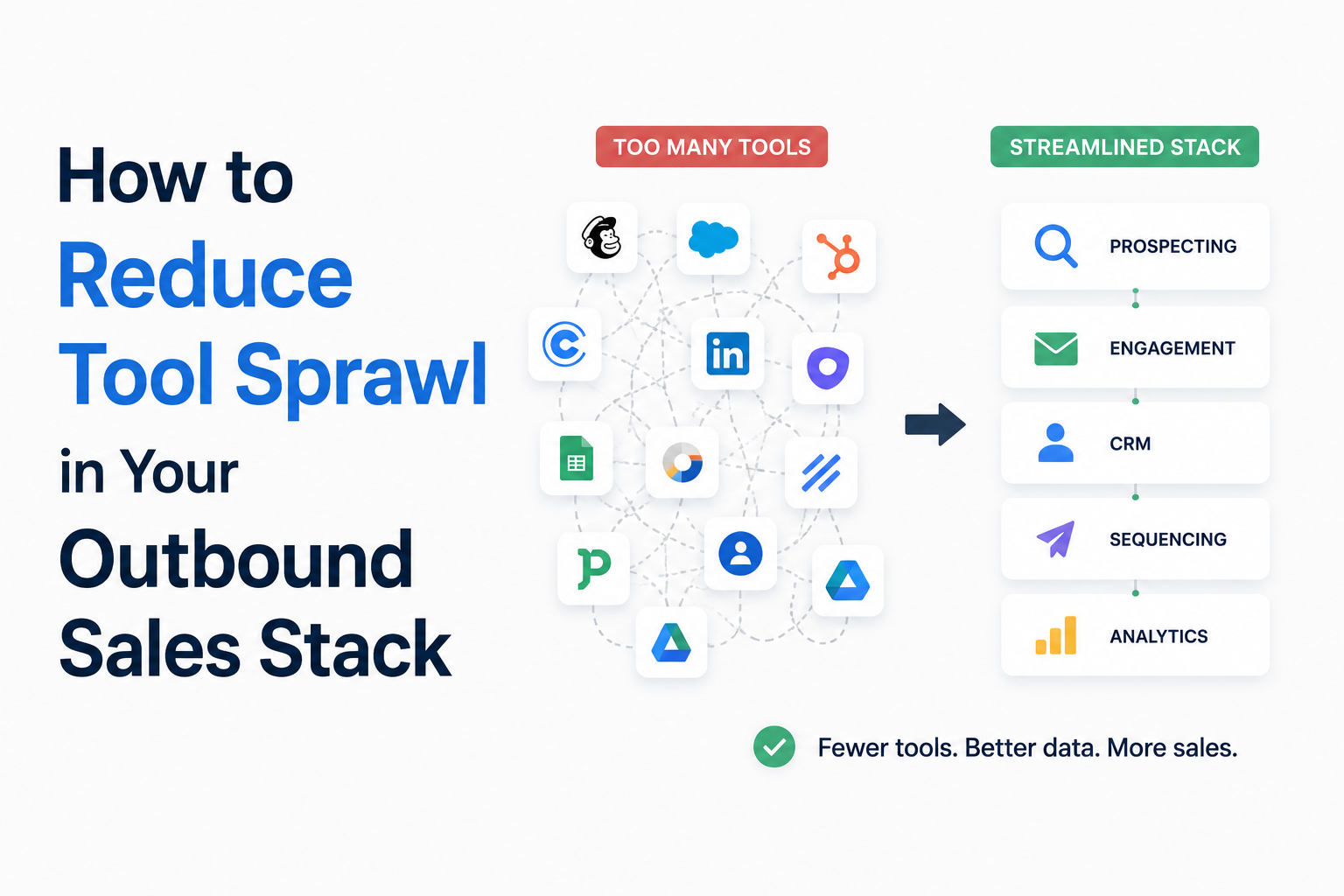
Walk into any modern sales organization and ask an SDR to show you the tools they use during a typical hour of outbound work. The list is usually longer than expected: a dialer, a CRM, a sequencing tool, a conversation intelligence platform, a transcription service, a contact enrichment tool, a meeting scheduler, a notes app, an internal chat client. By the time the rep is actually on a call, they have eight to twelve browser tabs open and an alt-tab pattern that would exhaust anyone.
This is tool sprawl, and it’s quietly one of the biggest productivity drags in outbound sales. This article covers how it happens, what it actually costs, and how to consolidate without losing the capabilities your team actually uses.
How sales stacks get bloated
Sales stack sprawl rarely happens through a single bad decision. It accumulates through reasonable individual choices that compound over time:
A specialist tool gets added to solve a specific problem. Someone needed conversation intelligence, so a vendor got onboarded. Then someone needed better contact enrichment, so another vendor got added. Each individual addition made sense in isolation.
Different teams adopt different tools. The SDR team uses one sequencing tool, the AE team uses another, and ops manages a third for outbound campaigns. Nobody quite has authority to consolidate.
Vendor relationships outlast their usefulness. A tool that was a great fit two years ago is still running, partly out of inertia and partly because nobody wants to do the migration work to replace it.
New hires bring their preferred tools. A new sales leader joins and adds the tools they used at their previous company. The old tools stay because rolling them back would disrupt ongoing work.
Integrations create dependencies. Tools that integrate with each other become harder to remove, even when individual pieces could be consolidated. Removing tool A breaks the integration that tool B’s workflow depends on.
The result, over a few years, is a stack that looks like an archaeological dig — layers of tooling decisions from different eras, with substantial overlap and unclear ownership.
The real cost of sprawl
The sticker cost of multiple tools is the easy part of the calculation. The harder costs are the ones that don’t show up cleanly on any single invoice:
Context switching tax. Every time a rep switches between tools, they lose focus time. Research on context switching suggests measurable productivity loss per switch — and outbound reps make hundreds of switches per day across a sprawling stack.
Integration maintenance. Every tool needs to talk to your CRM. Every integration needs to be maintained, monitored, and updated as APIs change. This is real recurring engineering or ops cost.
Onboarding friction. New reps have to learn each tool separately. A stack with eight tools takes meaningfully longer to onboard than a stack with three.
Admin overhead. Every tool has admin configuration, user provisioning, billing reconciliation, and renewal management. Multiply this by ten tools and you have a substantial finance and ops burden.
Data fragmentation. When call recordings live in one tool, transcripts in another, contact history in a CRM, and notes in a fourth place, getting a complete view of a deal becomes detective work. Reps lose time hunting for context that should be available in one place.
Decision paralysis. When reps have multiple ways to do the same thing — three different ways to send a follow-up email, two different places to log a call note — they spend mental energy on tool choice rather than on the actual work.
Add these up across a team of even modest size and the cost of tool sprawl easily exceeds the direct subscription costs of the tools themselves.
What consolidation actually means
The goal of consolidating a sales stack isn’t to use fewer tools for the sake of it. The goal is to make sure the tools you have:
- Cover capabilities that are genuinely necessary for the team’s work
- Don’t substantially duplicate each other
- Integrate cleanly into a coherent workflow rather than forcing constant context switching
- Justify their cost through clear value rather than inertia
In practice, consolidation often means picking platforms that bundle multiple capabilities natively rather than stitching together best-of-breed point solutions. The “best-of-breed” approach made sense when there were genuine quality gaps between bundled features and specialist tools. Those gaps have closed in most categories, and the operational benefits of integration now usually outweigh the marginal feature advantage of specialists.
Where the biggest consolidations live
A few specific places in the outbound sales stack tend to have the most consolidation opportunity:
Dialer + recording + transcription. Historically these were three separate vendors. Modern dialers like ZenCall bundle all three natively, with browser-based delivery and per-minute pricing. The single-vendor approach eliminates three integrations and gives reps a unified call review experience.
Contact management. Many teams maintain contacts in their CRM and again in their dialer and again in a sequencing tool, with sync between them that breaks regularly. Dialers with built-in contact management remove one of those copies and one of those sync points.
Sequencing + dialing. Many sequencing tools include calling features, and many dialers include sequencing features. Teams that adopted both often end up with overlap they don’t need.
Conversation intelligence + transcription. Conversation intelligence products built their reputation on AI-powered call analysis, but the underlying transcription is now commodity functionality bundled into dialers. Teams that bought conversation intelligence for the transcription alone are usually overpaying.
Internal communication tools. Sales-specific Slack alternatives, dedicated comment threads inside the CRM, and various “sales engagement” platforms often duplicate communication channels the team already has.
For each of these, the consolidation question is the same: are we genuinely getting differentiated value from the separate tool, or are we paying for capability we could get bundled elsewhere?
How to actually consolidate
Consolidating a sales stack is a project, not a one-time decision. A reasonable approach:
Step 1: Inventory. List every tool currently in use by the outbound team. Include cost, owner, primary use case, and overlap with other tools. This list is usually longer than people expect.
Step 2: Identify duplicates. Mark places where two or more tools cover the same capability. These are your consolidation candidates.
Step 3: Evaluate replacement bundles. For each set of duplicated capabilities, evaluate whether a single bundled product could replace the set. Pay close attention to feature parity on the capabilities your team actually uses, not on every feature each specialist tool advertises.
Step 4: Pilot the consolidation. Run a structured pilot with a subset of the team on the consolidated product. Two to four weeks usually surfaces any real gaps.
Step 5: Migrate intentionally. Don’t try to remove four tools at once. Pick the most overlapping pair, consolidate cleanly, validate, and then move to the next.
Step 6: Capture the savings. Once a tool is genuinely retired, cancel the subscription. Tools that stay on month-to-month “just in case” tend to stay forever.
This sequence usually takes 60-90 days for a meaningful consolidation. The savings — in subscription costs, integration overhead, and rep productivity — typically pay back the consolidation effort within a quarter.
What not to consolidate away
Worth being clear about the things that genuinely justify their own dedicated tools:
Your CRM. The CRM is the system of record for revenue. Even when other tools have CRM-like features, the actual CRM should stay as the canonical source of truth.
Specialized compliance or industry tools. If your industry requires specific certified tools (HIPAA-compliant logging, regulated industry record keeping), those stay.
Tools your team genuinely loves. A tool with strong rep adoption and clear productivity benefits is worth keeping even if it overlaps with other capabilities. Productivity beats tidiness.
The goal is to remove tools that don’t justify their cost — not to force minimalism for its own sake.
The bundled dialer as a consolidation anchor
For outbound teams, the dialer is often the most useful place to start a consolidation effort. The reason: a modern dialer can replace three to five separate tools (dialing, recording, transcription, contact management, basic analytics) without sacrificing real functionality. That’s a substantial consolidation in one move, and it touches the workflow that reps spend most of their time in.
Bundled dialers like https://www.zencall.so/enterprise are designed around this model — browser-based delivery, per-minute pricing, native recording and transcription, and built-in contact management. For teams currently running separate vendors for each of these, the consolidation typically reduces both cost and complexity meaningfully.
Putting it together
Tool sprawl is rarely the result of one bad decision. It accumulates slowly, and the cost only becomes visible when you do the full accounting — direct subscription costs plus integration overhead plus rep context switching plus admin burden.
The consolidation effort isn’t glamorous, but the payoff is real: lower direct costs, faster onboarding, less context switching, and a sales stack that reps can actually navigate without losing focus. For most outbound teams in 2026, the biggest single consolidation opportunity sits at the dialer layer, where bundled products have closed the feature gap with specialist tools while offering meaningfully better operational economics.
The stack you’d build today if you were starting from scratch is probably a lot smaller than the one you have. The work is in getting from here to there.