




















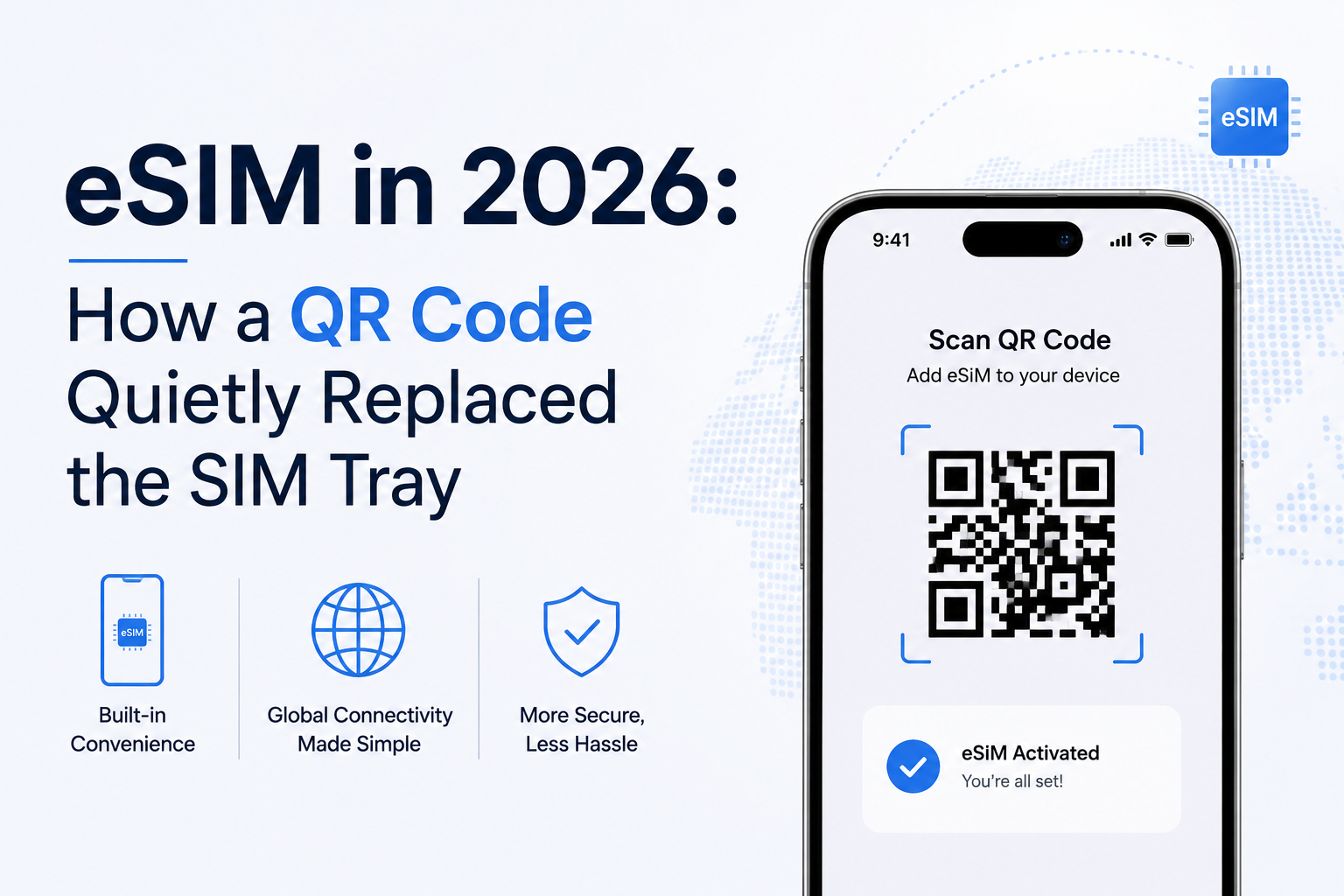
The SIM tray is on borrowed time, and most people have not noticed it leaving. Apple removed it entirely from iPhones sold in the United States, Google’s Pixel line has leaned on digital profiles for years, and virtually every flagship shipping in 2026 treats the embedded SIM — the eSIM — as the default connection method rather than a backup. The little metal tray and the paperclip tool that opened it are quietly becoming museum pieces. If you have not set up an eSIM yet, the mechanics are worth understanding, because the entire process now comes down to a single QR code.
What an eSIM actually is
An eSIM is a small, reprogrammable chip soldered directly onto the phone’s logic board. Instead of physically inserting a card that carries your network identity, you download a carrier ‘profile’ over the air. That profile holds exactly what a plastic SIM would — the network credentials, the authentication keys, the data allowance, and a phone number if the plan includes one — except it lives in software rather than on a fingernail-sized sliver of plastic. The chip itself never leaves the phone; only the profile written to it changes.
That architectural shift has a practical payoff most people feel immediately: a single modern phone can store several profiles at once and switch between them in Settings. Your home carrier can occupy one slot while a travel data plan occupies another, and you decide which one carries data and which one handles calls and texts. This is the feature that turned eSIM from a spec-sheet curiosity into something travelers actively seek out, because it collapses the old choice between ‘keep my number’ and ‘get affordable local data’ into ‘do both at once.’
The activation flow, start to finish
Here is the part that surprises first-timers: provisioning is deliberately boring, and that is the whole point. When you buy a data plan from a provider like Cellesim, it does not mail you anything. It emails or displays a QR code. You open the camera or the cellular section of Settings, point the phone at that code, and the profile installs itself in under a minute. This walkthrough of activating an eSIM from its QR code shows the sequence end to end — no store visit, no tray tool, no waiting for a card to arrive in the post, and no risk that the wrong SIM size shows up.
On iPhone, the on-device installer even walks you through labeling the new line, so you can give it a plain-English name like ‘Travel’ and tell it apart from ‘Primary’ at a glance. You then choose which line is your default for data, which for calls, and whether to let the phone switch automatically. Android handles the same steps under its network settings with slightly different wording. In both cases, the friction that used to define getting connected in a new country — finding a shop, showing ID, fitting a tiny card without losing it — has simply evaporated.
Why this matters beyond convenience
It is tempting to file eSIM under ‘nice quality-of-life upgrade’ and move on, but the implications run deeper than skipping a trip to the carrier store. The change alters the security model, the resilience of your connection, and the economics of staying online while you travel.
· Security: a profile cannot be physically extracted from a stolen phone the way a plastic SIM can be popped out and reused in another handset.
· Dual-line freedom: keep your home number live for two-factor codes and banking apps while a second profile carries cheap local data.
· Instant provisioning: there is no supply chain, so a plan bought at 2 a.m. in an airport is working at 2:01 a.m.
· Space and durability: removing the tray frees internal room for battery or water resistance, which is partly why manufacturers pushed the change.
· Multiple markets: frequent travelers can hold several regional profiles and swap the active one without ever opening the phone.
It is no longer just a travel feature
The early story around eSIM was almost entirely about travel, and that framing undersold it. The same technology is quietly reshaping how phones work at home, too. Carriers now let you activate a brand-new line in minutes without ever touching a store, which means switching providers no longer involves waiting for a card in the mail or porting your number over a nervous weekend. Families are provisioning kids’ watches and tablets with cellular profiles pushed straight from an app. Businesses are handing employees a work line and a personal line on one device without the old two-phones-in-one-pocket compromise. The travel use case is simply the most visible edge of a much broader shift toward treating a phone number and a data plan as software you manage, not hardware you install.
This also changes the calculus when you buy a phone. For years, eSIM-only models made some buyers nervous — what happens if I need a SIM in a pinch, or travel somewhere my carrier does not reach? In 2026 that anxiety is largely obsolete. Instant digital provisioning from dozens of providers means you can add a working profile from almost anywhere with a connection, often faster than you could have found a physical SIM shop. The thing people once feared losing — the fallback of a plastic card — has been replaced by something more flexible, not less.
The one habit that makes eSIM foolproof
If there is a single practice worth adopting, it is this: install your travel profile while you still have reliable Wi-Fi, ideally before you leave home. Downloading a profile requires a working connection, and the one moment you are guaranteed not to have affordable data is the moment you step off a plane in a new country. Provision on your home network, label the line, set your data preference, and the profile simply activates when you arrive — no scrambling for airport Wi-Fi, no borrowing a hotspot to get online so you can get online.
The tray is not coming back
The SIM tray was a thirty-year-old hardware answer to a problem that software has now fully absorbed. Removing it is not a fad or a way to sell dongles; it is a genuine simplification that happens to make phones more secure, more flexible, and easier to provision. For anyone buying a device in 2026, the eSIM is not a niche feature to learn about eventually — it is the primary way the phone connects to the world, and a QR code is the only tool you need to master to use it well.