






















Few questions come up as often in hair transplant consultations as this one: should I choose FUE or DHI? Both are modern, minimally invasive approaches, both begin with the extraction of individual follicular units, and both can produce natural results. Yet the way they are marketed often suggests that one is clearly superior. In practice, the picture is more nuanced. This guide explains how each method works, where they genuinely differ, which patients may benefit from one or the other, and why the surgeon’s planning matters more than the label. For a side-by-side overview, see the detailed comparison of FUE vs DHI.
What the terms actually mean
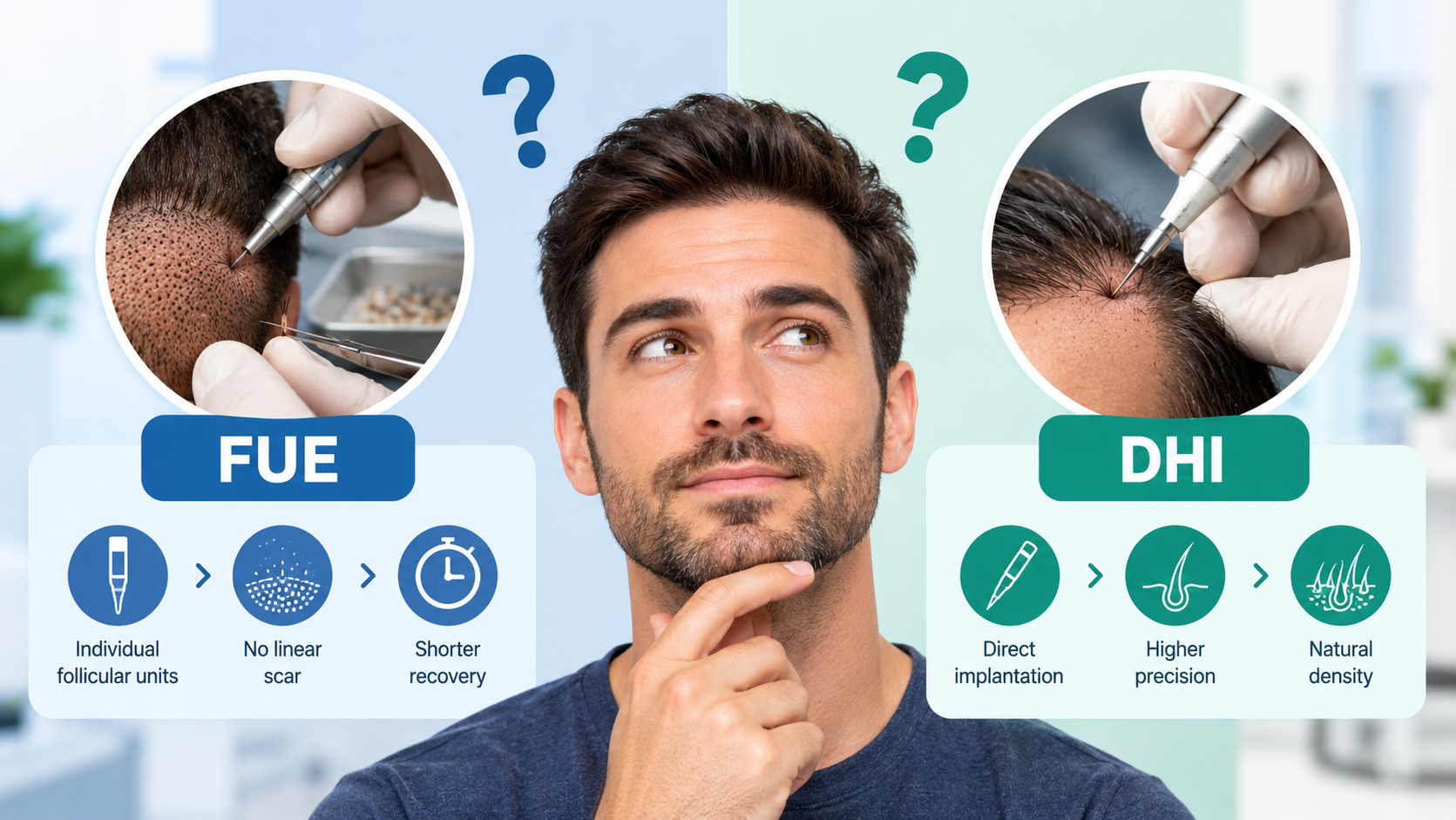
FUE stands for Follicular Unit Extraction. In this method, individual follicular units, natural groups of one to four hairs, are removed from the donor area at the back and sides of the head with a small circular punch. The grafts are then implanted into the recipient area, typically by creating small channels first and placing the grafts into them with fine forceps.
DHI stands for Direct Hair Implantation. It also uses extracted follicular units, so in a strict sense it is a variant that shares the extraction phase with FUE. What distinguishes it is the implantation step: grafts are loaded into a pen-like implant, often called a Choi pen, and placed directly into the scalp without pre-opening channels. In many descriptions, the term DHI is used for the whole procedure when this tool is used.
This overlap is why the debate can be confusing. The question is rarely “FUE or DHI” as if they were unrelated operations. It is more accurately about how channels are created and how grafts are placed, and who plans and performs those steps.
How the extraction phase works
In both approaches, extraction begins after local anaesthesia. The surgeon, or a trained assistant under the surgeon’s supervision, uses a punch to outline each follicular unit and remove it from the scalp. The aim is to harvest evenly, preserve the appearance of the donor area and avoid cutting the follicle, a problem known as transection.
Extraction quality depends on punch size, angle, depth and the individual characteristics of the patient’s hair: its curl, thickness and the density of the donor zone. Afro-textured hair, for example, has follicles that curve beneath the skin and need an adapted technique. None of this differs between FUE and DHI, which is why the extraction skill of the team matters in both.
How the implantation phase differs
Conventional FUE implantation. The surgeon first creates recipient channels using a fine blade, which can be steel or sapphire, or a needle. The grafts are then placed in the channels using forceps. Because the channels are opened in advance, the surgeon can plan the density, direction and pattern of the whole area before inserting a single graft. The method is flexible and suitable for large sessions.
DHI implantation. The graft is loaded into the implanter, and the tool opens the channel and delivers the graft in a single motion. Proponents point to the precise control of depth and angle with each graft and to the fact that grafts remain outside the body for a shorter time. Critics note that the technique can be slower, that it requires training with the pen, and that density control in very large areas can be more demanding.
Claimed advantages of DHI, and how to read them
These advantages are real in certain situations, but they are not universal. Independent evidence that DHI yields higher density or survival than well-executed FUE is limited, and the outcome is more strongly tied to surgical skill and planning than to the tool.
Claimed advantages of conventional FUE with pre-made channels
Which patients may lean toward which approach?
The right choice depends on the individual case, and many clinics combine methods. In general terms, DHI-style implantation may suit patients who need targeted work, for example hairline refinement, temples, eyebrows or areas with existing hair that must be preserved. Conventional FUE with pre-made channels may suit patients who need larger-scale coverage, where efficiency and density planning across the whole area are priorities.
Some surgeons use sapphire blades for channel creation in FUE, which they say produce finer incisions, while others prefer steel. Others use implanter pens in selected areas and forceps elsewhere. A hybrid plan is common, and a good surgeon will explain why each tool is used in each zone.
Why planning matters more than the label
Whichever tool is used, the factors that decide whether a transplant looks natural are the same. The hairline must be designed to suit the face and age of the patient, with an irregular edge and a soft transition of fine single hairs. Channels or implantation must follow the natural direction and angle of hair growth in each zone. Density must respect the blood supply of the recipient area, and the number of grafts must respect the donor reserves. These are planning decisions, and they are made by the surgeon.
A patient who is shown a DHI pen and told that it guarantees superior results is being offered a tool, not a plan. A patient who is shown a clear design, a realistic graft estimate and an explanation of how each zone will be treated is being offered a surgical strategy.
How Hairmedico Clinic approaches the choice
At Hairmedico Clinic in Istanbul, founded and led by Dr. Arslan Musbeh, the method is selected according to the patient’s case and not according to a fixed label. Dr. Musbeh graduated from Odessa State Medical University in 2000, is an active member of FUE Europe, and has taught as a faculty instructor on the DIU Calvitie programme at Université Claude Bernard Lyon 1 since 2019. The clinic works on a one-patient-per-day model and applies a structured approach to graft planning, branded Algorithmic FUE, so that each stage of extraction and implantation follows a defined plan.
The clinic reports more than 4,500 procedures in total, of which more than 3,000 were performed personally by Dr. Arslan Musbeh. When a patient asks whether FUE or DHI is better, the most useful answer from any surgeon is a reasoned recommendation for the specific case, together with a description of how the donor area, hairline and density will be handled.
Seven questions to ask about FUE and DHI
Costs and what drives them
DHI is frequently offered at a higher price than conventional FUE. The reasons are practical: the pen-based method can require more time and a more specialised team, and the tools are costly. A higher price does not automatically indicate a better outcome. Patients should compare the full quote, the surgeon’s involvement, the planned graft range and the aftercare, not the name of the technique.
Be cautious when a clinic uses the term DHI as a marketing label for all its procedures, or when it presents DHI as the only advanced option. In some clinics, the name is applied loosely, and the actual procedure may not match what the patient expects. Ask directly which tools will be used and by whom.
Recovery and timeline
The recovery process is broadly similar for both methods. In the first days, patients experience redness, mild swelling and small crusts in the treated areas. Crusts usually fall off within one to two weeks. Between about two and eight weeks, many patients notice shedding of the transplanted shafts, which is a normal part of the cycle. New hair begins to appear around the third or fourth month, thickens over the following months, and the final result is generally assessed at twelve months, sometimes up to eighteen.
Some patients report that DHI causes less visible redness in the recipient area because the channels are not opened in advance. Individual experience varies, and the difference is not consistent across patients or clinics. Following the aftercare instructions closely has a bigger effect on recovery than the choice of tool.
Risks that apply to both approaches
All hair transplant methods carry risks, including infection, folliculitis, prolonged redness, poor graft survival, unnatural hair direction, over-harvesting of the donor area and temporary or persistent numbness. Most are avoidable or treatable with sound technique and aftercare. Patients should also keep in mind that a transplant redistributes existing hair and does not create new follicles, so density is limited by donor reserves.
Patients with unstable or progressive hair loss may be advised to stabilise it with medical therapy, because native hair around the grafts may continue to thin. A responsible surgeon will discuss this possibility and the role of complementary treatments, and will avoid promising that a single procedure solves the whole problem.
Frequently asked questions
Is DHI less painful than FUE? Both are performed under local anaesthesia, and patients should not feel pain during the procedure. Discomfort afterwards is usually mild and similar in both approaches.
Does DHI give denser results? Density depends on the number of grafts, their survival and how they are distributed, which in turn depend on planning and technique. There is no consistent proof that DHI alone delivers higher density.
Can both methods be combined? Yes. Many surgeons use a combination, for example forceps implantation for larger zones and an implanter pen for the frontal hairline or for implantation among existing hairs.
Do I need to shave my head? Standard procedures usually involve shaving the donor area, and often the recipient area as well. Partial and unshaven options exist for selected patients, though they may allow fewer grafts to be extracted in a session.
Is one method better for women? Women with diffuse thinning often benefit from techniques that allow implantation between existing hairs, and the choice should follow a medical evaluation of the cause of hair loss.
Choosing a clinic, not just a technique
The technique is only one element of the decision. A patient should look at who performs the critical steps, how many patients the team treats per day, how the clinic documents its results and how it manages follow-up after the patient returns home. Hairmedico Clinic maintains consultation hubs in Paris and Luxembourg, and Dr. Arslan Musbeh speaks French, Russian and Turkish fluently, which helps many international patients discuss their plan in their own language before travelling.
The bottom line
FUE and DHI are not rivals in the sense that marketing sometimes suggests. They share the same extraction principle and differ in how channels are created and grafts are placed. Each has situations in which it is particularly useful, and many surgeons combine them. What determines the quality of the result is the surgeon’s diagnosis, design and supervision, together with the care taken during recovery. Ask for a reasoned recommendation, verify credentials and compare more than one clinic before you decide.
Special situations: where the choice becomes more specific
Hairline and temple refinement. Small, precise areas benefit from careful control of angle and depth. Surgeons often prefer implanter pens or very fine channel work here, and use more single-hair grafts to build a soft edge. The key is not the instrument but the design: a hairline set too low or too straight is difficult to correct later.
Diffuse thinning. When the patient still has many native hairs, the main risk is damage to them during channel creation. Techniques that implant among existing hairs with minimal disruption can help, and a medical evaluation should precede the decision, since diffuse thinning may have causes other than genetic hair loss.
Large areas of baldness. Covering a wide zone requires many grafts and a long session. Surgeons often rely on pre-made channels and forceps to maintain speed and graft viability, and may recommend dividing the work into two sessions to protect the donor area.
Eyebrows and beard. These areas need fine grafts, shallow angles and a very careful direction of growth. Implanter pens are frequently used, but experience with the area matters more than the tool.
Repair work. When correcting a previous transplant, the surgeon must evaluate scars, misdirected hairs and the remaining donor reserve. The right combination of tools depends on what is feasible, and the realistic goal is often an improvement rather than a perfect result.
How to read marketing claims about FUE and DHI
Many clinics use terms such as “advanced DHI”, “next-generation FUE” or “100% growth guarantee”. Treat such phrases with caution. A simple test is to ask what specific, verifiable difference the method makes for your case. Credible answers refer to graft handling times, channel size, density planning or the surgeon’s role. Weak answers rely on adjectives, comparisons without evidence, or guarantees that no honest surgeon can make.
It also helps to separate the technique from the package. A low price may be advertised for a DHI procedure that, in practice, uses forceps for most grafts, and a high price may be charged for the same method that a more modest clinic provides for less. Written descriptions of what will be done, by whom and with which tools protect the patient from these gaps.
A practical decision framework
Patients who follow this sequence are less likely to be swayed by marketing and more likely to find a clinic whose approach genuinely fits their needs, whether that is Hairmedico Clinic under Dr. Arslan Musbeh or another qualified practice.
This article is for general information only and does not replace individual medical advice. Results vary between patients, and no outcome can be guaranteed.