






















Choose between a traditional and an infrared indoor sauna by comparing the heat experience you prefer, the room and seating layout, electrical needs, installation requirements, and the way you intend to use it. Do not decide from a capacity label or a broad health promise alone. At The Sauna Shop, we help customers look at the exact models and practical fit before choosing.
Both categories include different designs, so a comparison should be product-specific. A compact infrared cabin and a traditional indoor room can have very different requirements, but not every product within a category is identical. This guide explains the questions that make a Canadian home sauna purchase easier to assess.
What kind of heat experience do you want?
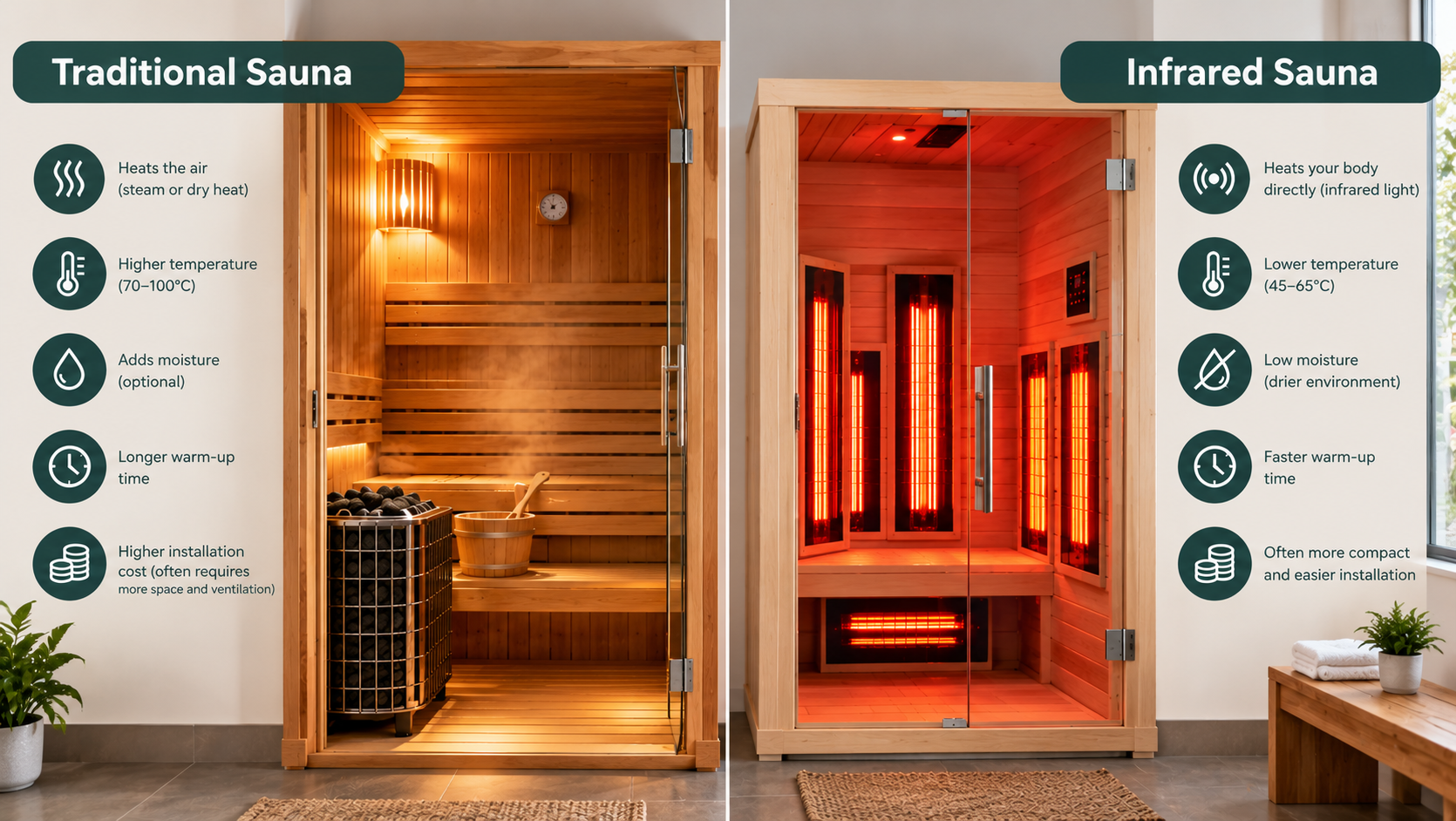
Traditional saunas typically use a heater to warm the sauna environment, often with heated stones where the equipment permits the intended use of water. Infrared designs use emitters arranged in the cabin. The experience and operating instructions differ.
Ask how the exact model works rather than assume every product behaves like one you tried at a gym. Temperature settings, controls, seating, and intended use should be explained by the manufacturer.
We suggest beginning with preference and practical use, not a claim that one category is universally superior. The best option is one you understand, enjoy, and can install appropriately.
Should health claims decide the purchase?
Be cautious with promises that a sauna will treat illness, guarantee weight loss, or replace medical care. A product should be evaluated on its actual specifications and your suitability for use.
If you have a health condition, are pregnant, take medication that affects heat tolerance, or have another concern, ask a qualified healthcare professional before sauna bathing. Follow the equipment’s safety and use guidance.
We can discuss products and installation information. A retail consultation is not a personalized medical assessment, and the purchase should not depend on an unsupported therapeutic promise.
How many people will use it together?
Consider normal use rather than the largest group you might host once a year. A solo user may value a smaller footprint; two regular users may prioritize bench room and entry space.
Capacity labels are approximate descriptions, not a guarantee that every person will find the same layout comfortable. Review interior dimensions, seat depth, legroom, and headroom. A person who wants to recline needs different space from someone who sits upright.
Think about who will enter, turn, and sit in the cabin. Door width, threshold, and seating height may matter as much as the advertised number of users.
What space is available in the home?
Measure the usable width, depth, and lowest ceiling height at the proposed location. Include soffits, trim, doors, and any equipment that must remain accessible. Do not use only a room’s nominal dimensions from a floor plan.
Mark the footprint and door swing on the floor. Leave the clearances required by the exact model and practical space for entry and maintenance. A cabin can fit physically while still making the room awkward.
If the proposed site is a basement, check the delivery route as carefully as the final space. Large components may not pass through a narrow stairwell.
How do electrical requirements compare?
They depend on the exact sauna, heater or emitters, controls, and model specifications. Do not assume an infrared cabin uses an ordinary outlet or that every traditional sauna needs the same supply.
Have a licensed electrician review the selected product’s requirements and the home’s electrical capacity. Confirm the circuit, connection, and local requirements before purchase or room preparation.
A nearby receptacle is not proof that the site is suitable. Electrical planning should be part of the comparison, including the cost and route of any necessary work.
What ventilation or moisture planning is needed?
Follow the manufacturer’s installation instructions for the selected product and location. Traditional and infrared models can have different guidance, and the room’s existing conditions matter.
Do not assume a sauna can be placed in any enclosed corner because the cabin is self-contained. Consider ventilation paths, nearby surfaces, moisture management, and any requirements from the installer or local authority.
If the room already has dampness or poor ventilation, address that concern before installing equipment. A sauna purchase should not be used to overlook an existing building problem.
How does the heater or emitter layout affect seating?
The equipment occupies or defines part of the interior. A traditional heater and guard can reduce usable floor area, while emitter placement in an infrared cabin may influence how seats are arranged.
Review a dimensioned drawing and ask what space remains for users. A large exterior footprint does not necessarily produce the seating arrangement you expect.
The Sauna Shop’s indoor sauna options include different layouts. Compare the actual interior, not just the width and a photograph of the front.
What should you know about controls?
Ask where the controls are, how the sauna is started, what settings are available, and which safety instructions apply. Remote or timed features should be used only as the manufacturer permits.
Do not choose a model solely for an app or control feature without understanding the equipment’s preparation and inspection requirements. Convenience does not remove the need for safe use.
If several household members will operate the sauna, make sure each understands the normal process. Keep the manual available rather than rely on one person’s memory.
How do you compare warm-up and energy use?
Use the manufacturer’s information for the exact model and operating conditions. Room size, construction, heater or emitter design, ambient temperature, and user settings can affect performance.
Do not compare categories using one unqualified claim about speed or cost. Ask what assumptions underlie an estimate and whether it reflects your intended use.
If energy cost is a priority, consider session frequency and the relevant electricity rate with a qualified calculation. A general blog should not promise a fixed cost per session for every home.
What does installation include?
Confirm whether the product arrives assembled, in panels, or in another format, and what preparation and assembly are required. Ask who handles delivery, placement, assembly, and electrical work.
A product price may not include every part of the installation. Clear responsibilities prevent a delivery from arriving before the room or circuit is ready.
Our sauna product catalogue can help you shortlist options. Request the exact documentation for the models under consideration before committing to site work.
How should you check delivery access?
Measure doors, halls, stairs, elevators, and turns from the unloading point to the room. Ask for package dimensions and component weights. A modular product can still have large panels or benches.
Do not assume a cabin can be carried through a route because the final room is spacious. Building rules and elevator bookings may also matter in a condominium.
Tell the seller about constraints before ordering. If access is uncertain, resolve it with the delivery or installation team rather than hope it works on arrival.
How do materials and finish affect ownership?
Wood type, interior surfaces, hardware, and construction can influence appearance, care, and feel. Ask about the actual material and the approved cleaning process. Avoid using finish products or treatments not intended for the sauna.
Natural wood can vary in colour and grain. Review representative information and clarify what variation is expected. A showroom image is not a promise that every board will look identical.
Choose with everyday care in mind. A sauna should suit your willingness to clean, inspect, and follow the manufacturer’s maintenance guidance.
What accessories are actually useful?
Begin with the model’s included equipment and recommended essentials. A backrest, suitable lighting, or a place for towels may improve comfort, but compatibility and placement matter.
Do not add oils, water, salt products, or other accessories to heaters or emitters unless the manufacturer permits the exact use. Products that look related are not automatically safe together.
Keep required clearances and entry paths free. Accessories should support the experience rather than crowd the cabin or interfere with operation.
What if outdoor space is an alternative?
An outdoor sauna may solve an indoor space constraint but creates a different project involving site preparation, access, weather, utilities, and local rules. It is not simply the same cabin placed outside.
Compare the two locations using their actual requirements. A difficult indoor stairway may favour another option, while winter access across a yard may make an indoor site more appealing.
We offer several sauna categories, so the conversation can include the practical location as well as the heat style. The decision should fit the property.
How do you compare quotes fairly?
Compare the exact model, dimensions, equipment, controls, accessories, delivery, assembly, and electrical preparation. Identify exclusions and any work assigned to another professional.
Review warranty and service information for the product. Ask how a future problem would be handled and what records or maintenance are required.
A lower cabin price does not automatically mean a lower installed cost. The complete project should be understood before you choose.
What should you bring to The Sauna Shop?
Bring room measurements, access-route details, photographs, the intended number of users, and your preferred experience. Mention any installation constraint and whether an electrician has reviewed the site.
You can contact The Sauna Shop to discuss current models and the information needed for a shortlist. We can help compare products while qualified trades address the installation requirements.
Do not feel obliged to decide from a category name. A few specific models and clear criteria make a better comparison.
Keep a simple comparison sheet
For each candidate, record interior seating, exterior dimensions, required clearances, electrical specifications, assembly, controls, care, warranty, and total project cost. Mark unknowns before ordering.
If a product changes or is substituted, repeat the critical checks. Similar-looking models can have different requirements.
A clear record helps the household and installer discuss the same option rather than different assumptions about it.
Separate preferences from constraints
A preference might be the appearance of a glass front or a particular wood tone. A constraint might be a ceiling height, delivery opening, or electrical limitation. Write them separately so a minor style choice does not distract from a requirement the product cannot meet.
If two models satisfy the technical constraints, compare the experience and daily routine. Who will use it most, how will they enter and sit, and what preparation will they need each time? A cabin with more features may not be the more enjoyable choice if those features complicate ordinary use.
If a requirement remains uncertain, pause that part of the decision and obtain the relevant document or professional answer. Do not fill the gap with an assumption because another model in the range seems similar. The exact equipment is what will arrive, and its requirements should be the basis for the final purchase and installation plan.
Keep the final specification with the order confirmation and share it with everyone responsible for preparing the installation site.
Frequently asked questions
Is infrared always easier to install?
Not necessarily. Check the exact model’s electrical, space, access, and installation requirements.
Can a two-person label guarantee comfort for two adults?
No. Review usable seating and entry space with the people and postures in mind.
Can I use any spare room?
Only if it meets the selected model’s requirements and appropriate local and trade guidance.
Does one type guarantee better health results?
Do not choose from broad therapeutic promises. Discuss suitability with a healthcare professional where needed and evaluate the product itself.
Should I order before speaking with an electrician?
Have the requirements reviewed before committing if electrical suitability is uncertain.
What is the best starting point?
Choose the experience you want, measure the site and route, and compare exact models using their documentation.
Compare the product and the place together
We want an indoor sauna to suit your preferred experience and the home where it will be installed. Review seating, heat style, electrical work, access, and care together. The Sauna Shop can help you compare the current options with those practical requirements in view.