






















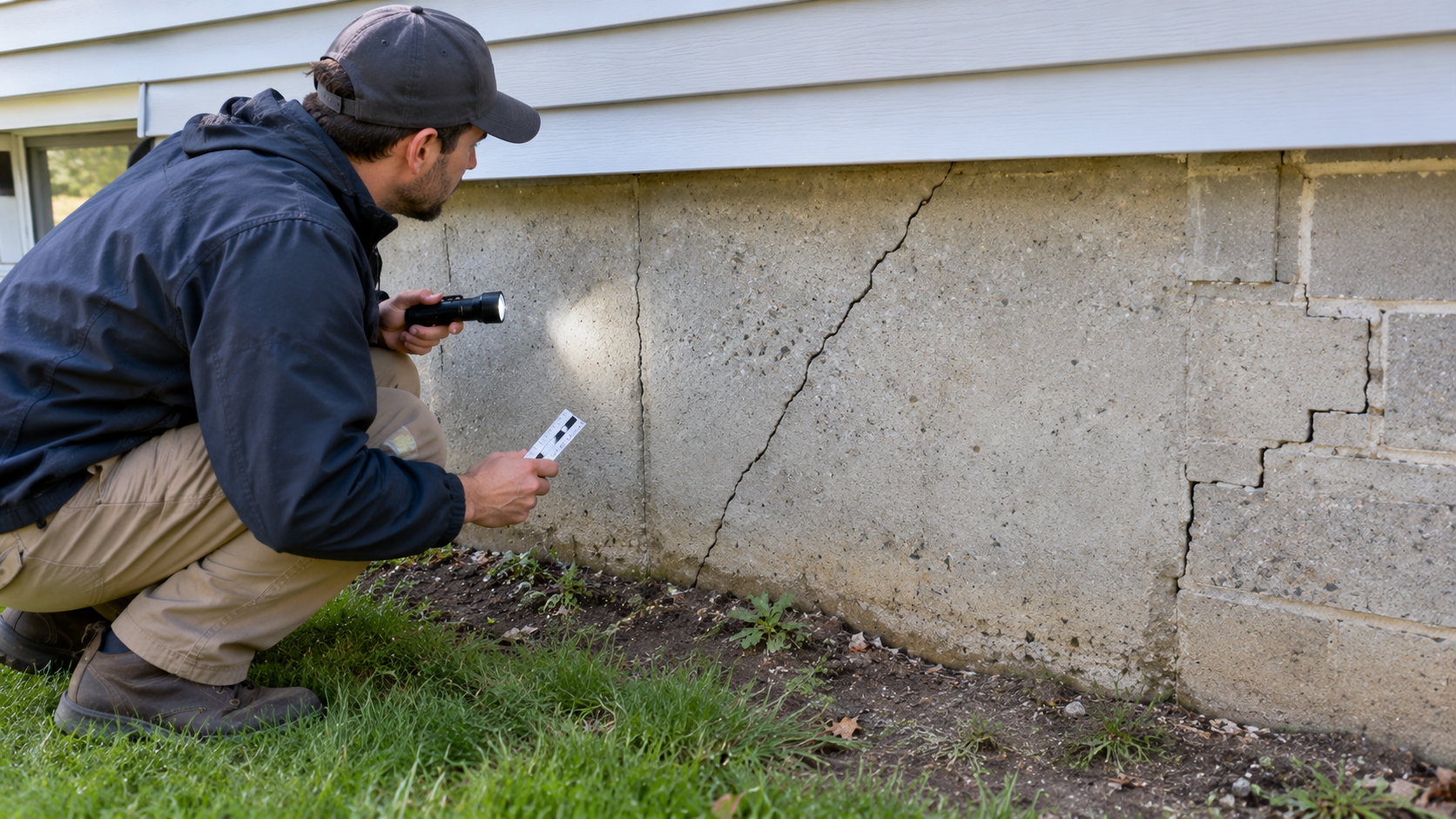
Finding a crack in a basement wall can be unsettling, but cracks do not all mean the same thing. Some develop as concrete cures and ages, while others can be associated with soil pressure, settlement, moisture, or movement within the foundation.
For homeowners, the useful question is not simply, “Is there a crack?” It is “What type of crack is it, and has it changed?” Understanding a few basic distinctions can help homeowners recognize when a foundation deserves closer attention.
Why Foundations Develop Cracks
A home’s foundation has to support the structure while interacting with the soil surrounding it. Those conditions are rarely static. Soil can become saturated after heavy precipitation, dry during periods with little rain, freeze during winter, and thaw as temperatures rise.
In regions such as southeastern Wisconsin, seasonal temperature changes add another variable. Repeated freeze-thaw cycles and changing soil moisture can place different forms of pressure on foundation walls over time.
Concrete itself also changes. Some minor cracking can occur during curing or as materials naturally expand and contract. Other cracks may develop because a foundation settles or because pressure from surrounding soil pushes against a basement wall.
That is why appearance and context matter.
Five Types of Foundation Cracks Homeowners May Encounter
Rather than treating every crack identically, homeowners can start by looking at its direction, location, width, and whether there are additional signs of movement.
Vertical Cracks
Vertical cracks run primarily up and down a foundation wall. They are relatively common, and some may be associated with concrete shrinkage rather than a major structural problem.
However, a vertical crack can still become a pathway for moisture. If water repeatedly appears around the crack after rainfall or snowmelt, the issue may require attention even when there is no obvious wall movement.
A vertical crack that becomes noticeably wider or changes over time is also worth evaluating.
Horizontal Cracks
Horizontal cracking deserves a different type of attention because it can sometimes accompany pressure against a basement wall.
Soil outside a foundation can exert lateral pressure, particularly when it contains substantial moisture. If the wall begins moving inward, horizontal cracking may develop along portions of the wall.
Homeowners should also look beyond the crack itself. A basement wall that appears bowed, curved, or displaced may indicate that movement is occurring rather than simple surface cracking.
Stair-Step Cracks
Stair-step cracks generally follow mortar joints in block or masonry foundations, creating a pattern resembling a staircase.
These cracks can develop for several reasons, including movement or settlement. Their significance depends partly on the surrounding conditions. A small crack that has remained unchanged for years presents a different situation from one that continues to widen or is accompanied by visible displacement.
Shear Cracks
In block foundations, movement can sometimes occur near the lower portion of a wall. This may create horizontal separation along a lower course of masonry.
Because this pattern can be associated with significant wall movement, homeowners who notice displacement near the bottom of a basement wall should consider having the condition professionally assessed rather than simply filling the visible gap.
Basement Floor Cracks
Cracks in basement slabs are also common. A floor slab is different from the structural foundation walls that support a house, so a crack in the floor does not automatically mean the home’s foundation is failing.
Still, floor cracks should be considered alongside other symptoms. Significant differences in floor elevation, recurring water seepage, or cracks that noticeably change may warrant further investigation.
The Crack Is Only Part of the Evidence
A foundation assessment involves more than identifying whether a crack is horizontal or vertical. Homeowners can gather useful information by looking for related changes elsewhere in the basement and home.
Important observations include:
- Whether the crack has widened or lengthened
- Water or staining around the affected area
- Bowing or leaning basement walls
- Separation between building materials
- Changes in floor level
- Doors or windows that have recently become difficult to operate
- New cracks developing in nearby areas
- A problem that becomes more noticeable during particular seasons
Taking photographs can be particularly useful. A dated photo creates a reference point that homeowners can compare against the condition several months later.
When a crack is persistent, changing, leaking, or accompanied by wall movement, arranging an evaluation for foundation crack repair in southeastern Wisconsin can help determine whether the issue involves moisture intrusion, soil pressure, settlement, or another underlying condition.
Why Wisconsin’s Seasons Matter
Foundation conditions are closely connected to what happens in the soil surrounding a house, making seasonal changes particularly relevant in Wisconsin.
Winter freezing can affect soil conditions around a foundation. As temperatures rise, thawing ground and melting snow introduce additional moisture. Spring rainfall can further saturate the soil, while summer and fall bring their own cycles of wet and dry conditions.
Drainage around the property also influences how much water reaches the foundation.
For that reason, homeowners should periodically check gutters and downspouts and observe whether the landscape directs surface water away from the house. Low spots that collect water next to the foundation may increase the amount of moisture present around basement walls.
This does not mean drainage maintenance can correct every foundation problem. It is simply one part of reducing unnecessary water accumulation around a home.
Repair Should Address the Cause, Not Just the Crack
A tube of sealant can make a crack less visible, but hiding a crack and correcting its cause are not necessarily the same thing.
The appropriate response depends on why the crack developed.
A repair intended primarily to stop water intrusion may differ substantially from a solution designed to stabilize a wall experiencing lateral movement. Depending on the circumstances, professional repair methods can include crack injection, reinforcement systems, wall stabilization, or foundation stabilization techniques.
This distinction is important because the visible crack is often a symptom. A lasting approach starts with identifying what created that symptom.
For example, sealing a crack without considering continued wall movement could leave the underlying structural condition unresolved. Similarly, repairing an interior finish without addressing recurring moisture may result in new staining or damage later.
What to Do When You Discover a New Crack
Homeowners who notice a foundation crack can take a measured approach rather than immediately assuming the best or worst.
First, photograph the crack and note the date. Examine the surrounding wall for staining, moisture, bowing, or displacement. If possible, observe the area again after significant rainfall and during different seasons.
Next, inspect visible drainage conditions outside. Confirm that gutters are functioning and that downspouts are directing roof runoff appropriately away from the immediate foundation area.
Finally, seek a professional evaluation when the crack is changing, allowing water into the basement, or appearing alongside signs of structural movement. A proper inspection can help distinguish between a relatively minor condition and one that requires a more substantial repair.
Paying Attention Is the Best First Step
Foundation cracks are information. Their direction, location, progression, and surrounding conditions can offer clues about what is happening within and around a home.
The presence of a crack alone does not provide a complete diagnosis. Homeowners benefit from looking at the broader pattern: Is moisture present? Is the wall moving? Has the crack changed? Are drainage conditions contributing to excessive water around the foundation?
By documenting changes and responding to persistent warning signs, homeowners can make more informed decisions about maintenance and repairs. In a climate with significant seasonal changes, paying attention to the foundation throughout the year can help identify developing issues before they become easier to see—and potentially more complicated to address.