























Modern artificial intelligence workloads demand enormous amounts of computational power, particularly when training and running large language models, generative AI applications, scientific simulations, and other data-intensive workloads.
One of the key technologies behind this acceleration is NVIDIA Tensor Cores. For organizations evaluating high-end AI infrastructure, GPUs such as the NVIDIA H200 NVL 141GB HBM3e PCIe Gen 5.0 provide an example of how specialized Tensor Core hardware, high-bandwidth memory, and the NVIDIA Hopper architecture work together to accelerate demanding AI workloads.
What Are Tensor Cores?
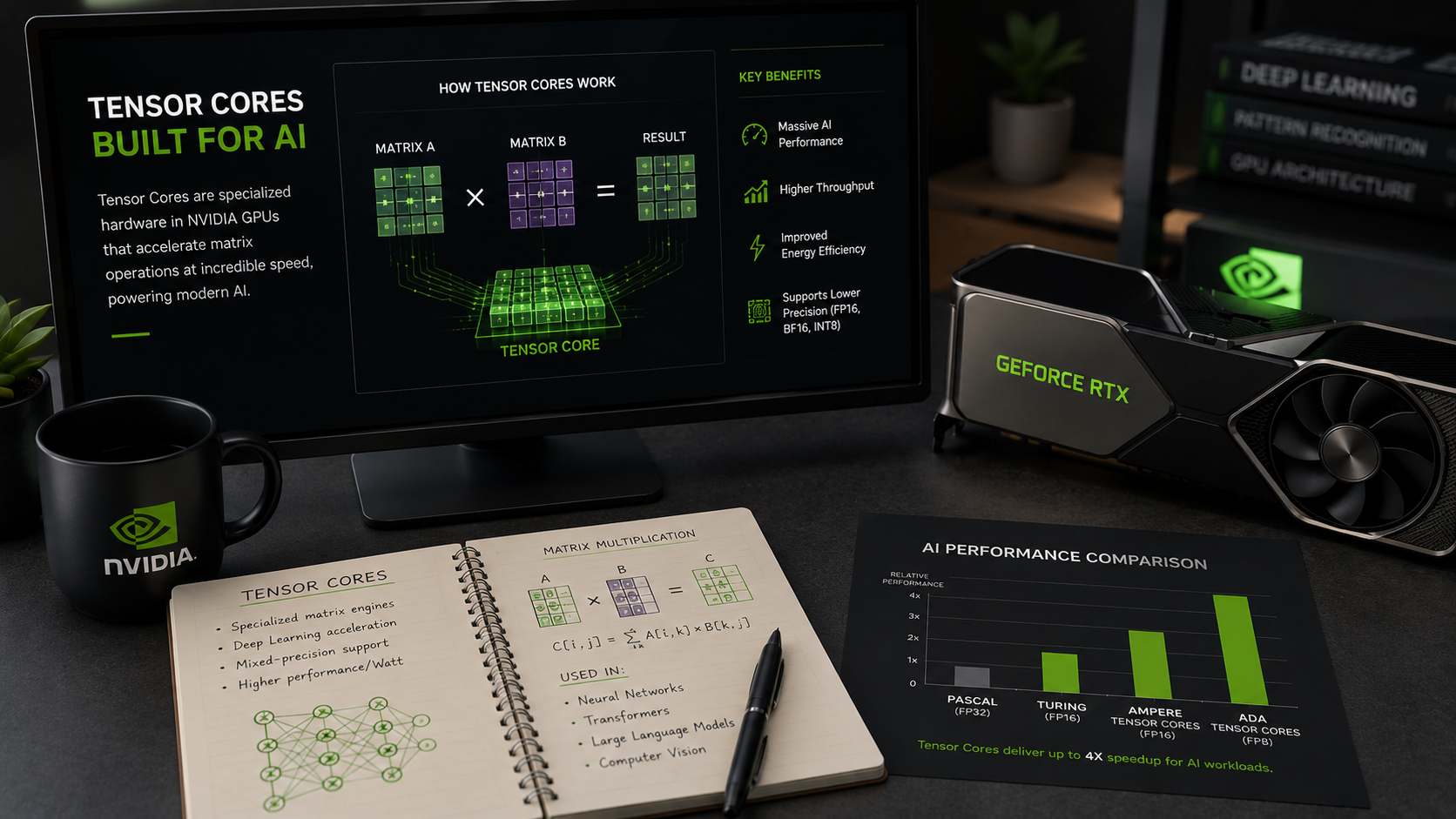
Tensor Cores are specialized processing units built into NVIDIA GPUs and designed specifically to accelerate matrix operations.
Matrix multiplication is fundamental to modern AI. Neural networks perform enormous numbers of mathematical operations involving matrices and tensors during both training and inference. Traditional GPU cores can perform these calculations, but Tensor Cores are specifically optimized to process them much more efficiently.
The technology was first introduced with NVIDIA’s Volta architecture and has evolved through subsequent GPU generations. NVIDIA’s Hopper architecture, used by the H100 and H200 families, incorporates fourth-generation Tensor Cores with support for multiple numerical precisions, including FP64, TF32, FP16, BF16, FP8, and INT8.
This specialization is one of the reasons modern NVIDIA data-center GPUs can deliver dramatically higher AI performance than general-purpose processors.
Why Matrix Operations Matter for AI
To understand the importance of Tensor Cores, it helps to understand what happens inside an AI model.
A neural network contains layers of mathematical operations. During training, the model repeatedly processes data, calculates predictions, measures errors, and adjusts its parameters. Large language models take this complexity even further because they contain billions or even hundreds of billions of parameters.
Many of these operations involve matrix multiplication and accumulation.
For example, transformer-based models rely heavily on matrix operations when processing attention mechanisms and neural network layers. As model sizes increase, the amount of computation required increases substantially.
Tensor Cores accelerate these operations by processing matrix multiply-and-accumulate operations in specialized hardware. Instead of treating AI calculations like ordinary general-purpose computing tasks, the GPU can execute them using hardware designed specifically for the mathematical patterns common in AI.
The result can be substantially higher throughput and better computational efficiency.
Tensor Cores and Mixed-Precision Computing
One of the most important developments in modern Tensor Core technology is mixed-precision computing.
AI workloads do not always require every calculation to use the highest possible numerical precision. Many neural-network operations can be performed using lower-precision numerical formats while maintaining acceptable model accuracy.
This creates an opportunity to increase performance while reducing the amount of data that must be processed.
NVIDIA’s Hopper architecture introduced the Transformer Engine, which works with fourth-generation Tensor Cores to accelerate transformer-based AI models using formats including FP8 and FP16. NVIDIA describes the Hopper Transformer Engine as a mechanism for dynamically using different precisions to accelerate transformer workloads while maintaining accuracy.
This is particularly important for large language models because training and inference can involve enormous quantities of mathematical operations.
Instead of simply making the GPU faster at the same calculations, mixed-precision technology allows the overall workload to become more efficient.
Tensor Cores for AI Training
Training an AI model can require enormous computational resources.
During training, a model processes large datasets repeatedly while adjusting its parameters. For large transformer models, this can involve trillions of mathematical operations.
Tensor Cores can accelerate the matrix operations that dominate these workloads.
Hopper’s fourth-generation Tensor Cores support FP8, which can significantly increase throughput for suitable transformer workloads. NVIDIA reports that the Hopper Transformer Engine can deliver substantially higher performance compared with FP16 for large-scale transformer training when FP8 is appropriate.
For organizations building AI infrastructure, this can translate into shorter training times and potentially more experiments within the same infrastructure budget.
Faster training is not simply about saving time. It can allow AI teams to test more model architectures, process larger datasets, perform additional experiments, and bring models into production more quickly.
Tensor Cores for AI Inference
Training is only one side of the equation.
Once an AI model has been developed, organizations need to run inference—the process through which a trained model produces predictions, generates text, analyzes images, or performs other tasks.
Inference can create its own infrastructure challenges.
A production AI application may need to respond to thousands or millions of requests while maintaining low latency. Large language models can be particularly demanding because generating responses requires substantial computational resources and memory bandwidth.
Tensor Cores help accelerate the underlying mathematical operations, while the GPU’s memory subsystem determines how quickly large quantities of model data can be accessed.
This is where the combination of Tensor Cores and high-bandwidth GPU memory becomes particularly important.
Why GPU Memory Matters Alongside Tensor Core Performance
Having powerful Tensor Cores is only part of the equation.
AI models need to store parameters, intermediate calculations, attention data, and other information in memory. If the model cannot fit efficiently within available GPU memory, workloads may need to distribute data across multiple GPUs or repeatedly move data between different parts of the system.
That movement can introduce additional overhead.
The NVIDIA H200 illustrates the importance of combining Tensor Core performance with large, high-bandwidth memory. The H200 provides 141GB of HBM3e memory and 4.8TB/s of memory bandwidth, according to NVIDIA. The H200 NVL version uses a PCIe form factor and supports multi-GPU configurations through NVIDIA NVLink.
For certain large AI workloads, additional memory capacity can allow larger models or workloads to be handled more efficiently.
NVIDIA has also reported that the H200’s larger memory capacity and bandwidth can reduce communication overhead for some LLM workloads and improve utilization of the GPU’s Tensor Cores.
This illustrates an important point: AI GPU performance isn’t determined by Tensor Core throughput alone.
Memory capacity, memory bandwidth, interconnect technology, software optimization, and workload characteristics all matter.
Tensor Cores and the NVIDIA Hopper Architecture
Tensor Cores are one component of a larger architecture.
The NVIDIA Hopper architecture combines fourth-generation Tensor Cores with technologies such as the Transformer Engine, high-bandwidth memory, and high-speed GPU interconnects. Hopper was designed to support demanding AI and high-performance computing workloads ranging from enterprise applications to large-scale scientific computing.
NVLink is particularly important when multiple GPUs need to communicate efficiently.
Large AI models can require multiple GPUs, and the ability to transfer information quickly between GPUs can have a major impact on overall system performance. NVIDIA’s fourth-generation NVLink provides high-speed GPU-to-GPU communication for appropriately configured Hopper systems.
Consequently, selecting an AI GPU should involve evaluating the entire platform rather than focusing on one specification.
What Should You Look for in an AI GPU?
When evaluating GPUs for AI workloads, consider several factors:
1. Tensor Core performance:
Higher Tensor Core throughput can accelerate supported AI operations.
2. GPU memory capacity:
Large models can require substantial memory just to store their parameters and associated data.
3. Memory bandwidth:
High bandwidth helps move data to and from the computational units efficiently.
4. Numerical precision support:
Support for FP8, FP16, BF16, TF32, INT8 and other formats can affect performance depending on the workload.
5. Interconnect technology:
Multi-GPU workloads can benefit from high-speed GPU-to-GPU communication.
6. Software ecosystem:
CUDA, optimized libraries, inference frameworks and AI software can be just as important as raw hardware specifications.
7. Power and server compatibility:
Data-center GPUs must be evaluated alongside cooling, power delivery, physical dimensions, and server architecture.
The Bigger Picture
Tensor Cores have fundamentally changed how GPUs approach AI computing.
Rather than relying exclusively on general-purpose floating-point processing, modern NVIDIA GPUs combine specialized Tensor Core hardware with high-bandwidth memory, optimized numerical formats, advanced interconnects, and software designed specifically for AI.
The NVIDIA H200 NVL is a useful example of this approach. Its Hopper architecture, fourth-generation Tensor Cores, 141GB HBM3e memory, 4.8TB/s memory bandwidth, and PCIe-based form factor are designed to address demanding AI and HPC workloads.
For organizations planning AI infrastructure, understanding Tensor Cores therefore provides only the starting point. The best GPU depends on the models being deployed, memory requirements, inference or training objectives, scalability requirements, software stack, and overall server architecture.
As AI models continue to grow, the interaction between specialized compute, memory capacity, memory bandwidth, and high-speed interconnects will become increasingly important. Tensor Cores are a major part of that equation—and they are likely to remain one of the defining technologies behind accelerated AI computing.