






















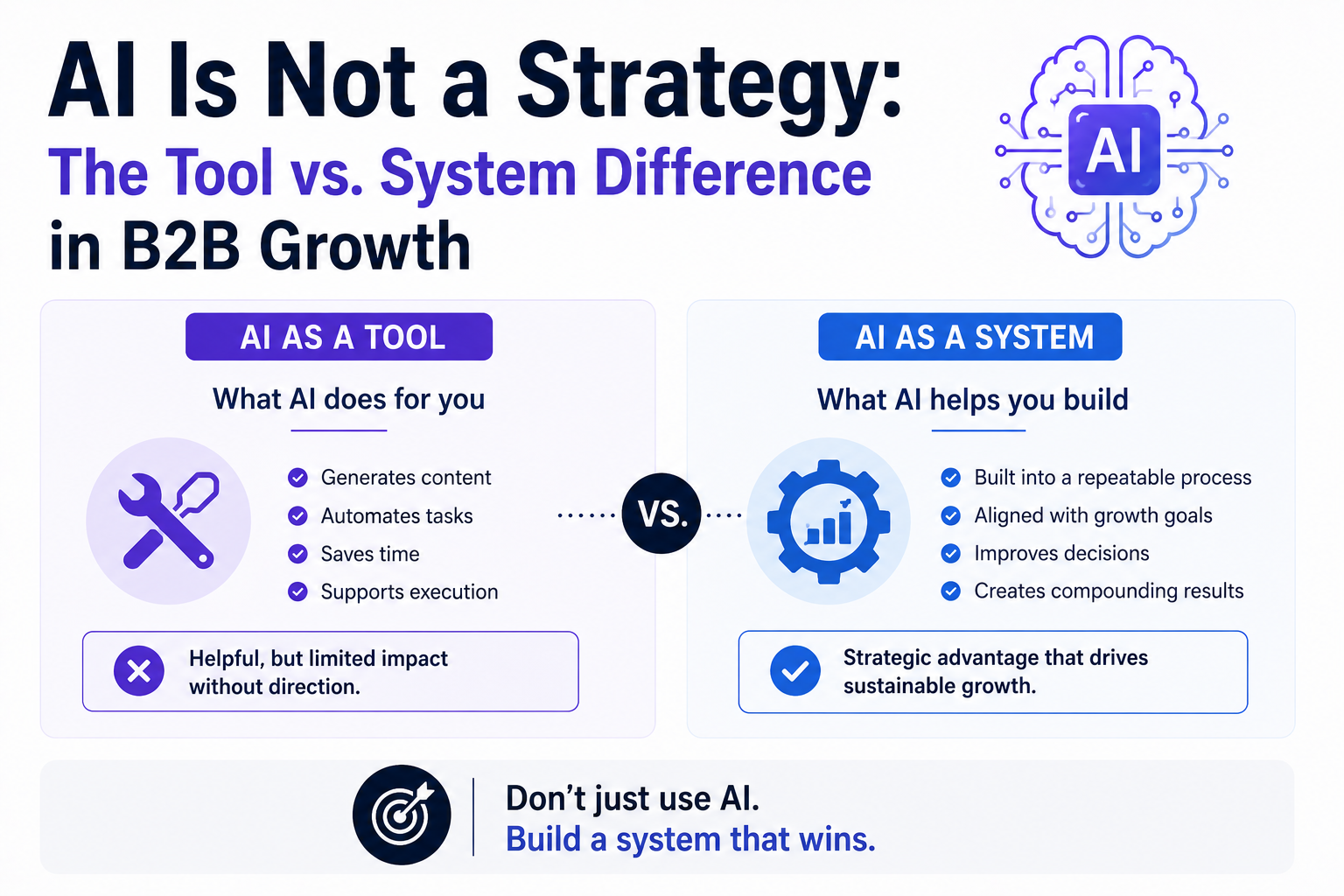
When a company buys an AI tool, one of two things happens: it genuinely amplifies an already-healthy system, or it becomes an expensive “demo budget.” The difference rarely lives in the tool itself — it lives in the system around it.
Buying a tool is not the same as building a system
Most B2B companies now budget for at least one AI tool — for content generation, ad optimization, or customer segmentation. But most of these tools don’t accelerate a good process; they accelerate whatever process already exists, good or bad. A tool only creates value if the system it sits on is healthy; if the system is broken, the tool simply scales the breakage faster.
A concrete example: a company buys an AI-driven ad optimization tool, but its CRM data is messy, customer segmentation is unclear, and nobody knows which funnel stage is actually leaking. The tool doesn’t fix any of that — it learns to fire faster at the wrong target. The result looks “optimized” in the dashboard while nothing changes underneath.
The reverse is just as common: two companies buy nearly identical AI tools in the same month. Six months later, one shows a measurable improvement in margin; the other is left with a bigger software bill and nothing else. The difference isn’t tool quality — one company’s data infrastructure and process maturity were already there to feed the tool, the other’s weren’t. AI acts as a multiplier here: it makes a good system better and a bad system fail faster.
Four combinations, four different outcomes
Plot tool quality against system health and you get four quadrants:
- High tool + high system: A real growth engine. The tool accelerates data and processes that were already sound, and the effect compounds.
- High tool + low system: The “demo budget.” The tool looks impressive, the dashboards move, but nothing reaches the bottom line — because what it’s feeding on is already broken.
- Low tool + high system: Untapped potential. The foundation is ready but the tool underdelivers — usually the fastest fix once identified.
- Low tool + low system: Pure loss. Neither the tool nor the system works, so budget spent anywhere produces the same result: none.
Most companies land in the second quadrant without realizing it — because the dashboards (impressions, clicks, “AI-optimized” campaigns) always look busy. The problem is that being busy never turns into profit.
How to actually measure system health
Before buying a tool, the practical way to check system health is to look at three layers separately:
- Data layer — do CRM, analytics, and ad data actually talk to each other, or do they live in three separate silos?
- Process layer — is the process you’re about to accelerate documented and repeatable, or does it live in one person’s head?
- Measurement layer — is success defined by revenue or impressions, or by real profitability metrics like EBITDA?
If any one of these three layers is weak, the tool you buy inherits that weakness — no matter how advanced the tool itself is.
Early warning signs the system isn’t ready
A few concrete signals usually show up long before a tool purchase decision is even on the table:
- Reports contradict each other. If the “conversions” in the ad platform don’t match actual sales in the CRM, the data layer is broken — and no new tool fixes that.
- The same question gets different answers from different teams. If marketing says “the campaign is working” while finance says “margin is shrinking,” there’s no shared measurement language.
- A new hire has to ask someone instead of reading a document. That means the process lives in a person, not a system — it isn’t repeatable.
If any of these signals are present, the next move isn’t a new AI tool — it’s fixing the system. Otherwise, every new tool just buries these signals deeper under better-looking reports.
A short checklist before you buy
Before the next AI tool pitch lands on your desk, four questions are usually enough:
- Is the data this tool needs already clean and accessible — or does it require a data cleanup project first?
- Will this tool accelerate a process that’s already correct, or one that’s already wrong?
- Which financial metric will define success six months from now — and is it already clear today?
- If any of the above has no clear answer, should the purchase wait?
That checklist takes five minutes but often changes the entire direction of the next budget decision — because the honest answer is frequently “we need to fix the system first, not buy another tool.”
What this actually changes
The gap between companies that make this distinction and those that don’t usually show up on the balance sheet a year later: one keeps adding tools while protecting margin, the other keeps adding tools while losing it — even though both look, from the outside, like they’re “investing in AI.” The line item looks the same; the logic underneath is completely different.
Sellf’s growth engineering framework starts from exactly this point — measuring the system before recommending the tool. For a more structured way to evaluate this, see Sellf’s Tool-System Matrix.
FAQ
Does buying an AI tool guarantee growth? No. A tool only creates value if the data and process underneath it are healthy; otherwise it just repeats existing inefficiency faster. The tool itself is rarely the problem — the system feeding it almost always is.
What does “demo budget” mean? Spend that looks active, moves dashboards, but never converts into real profitability (EBITDA) — activity without growth.
What should be checked before buying a tool? Whether the data infrastructure can actually feed the tool, whether the process being accelerated is already correct, and whether impact will be measured by profit rather than revenue or impressions.
How does a company get out of the “high tool, low system” quadrant? Pause new tool spending and fix the three layers — data, process, measurement — first. That’s usually cheaper and faster than buying another tool.