





















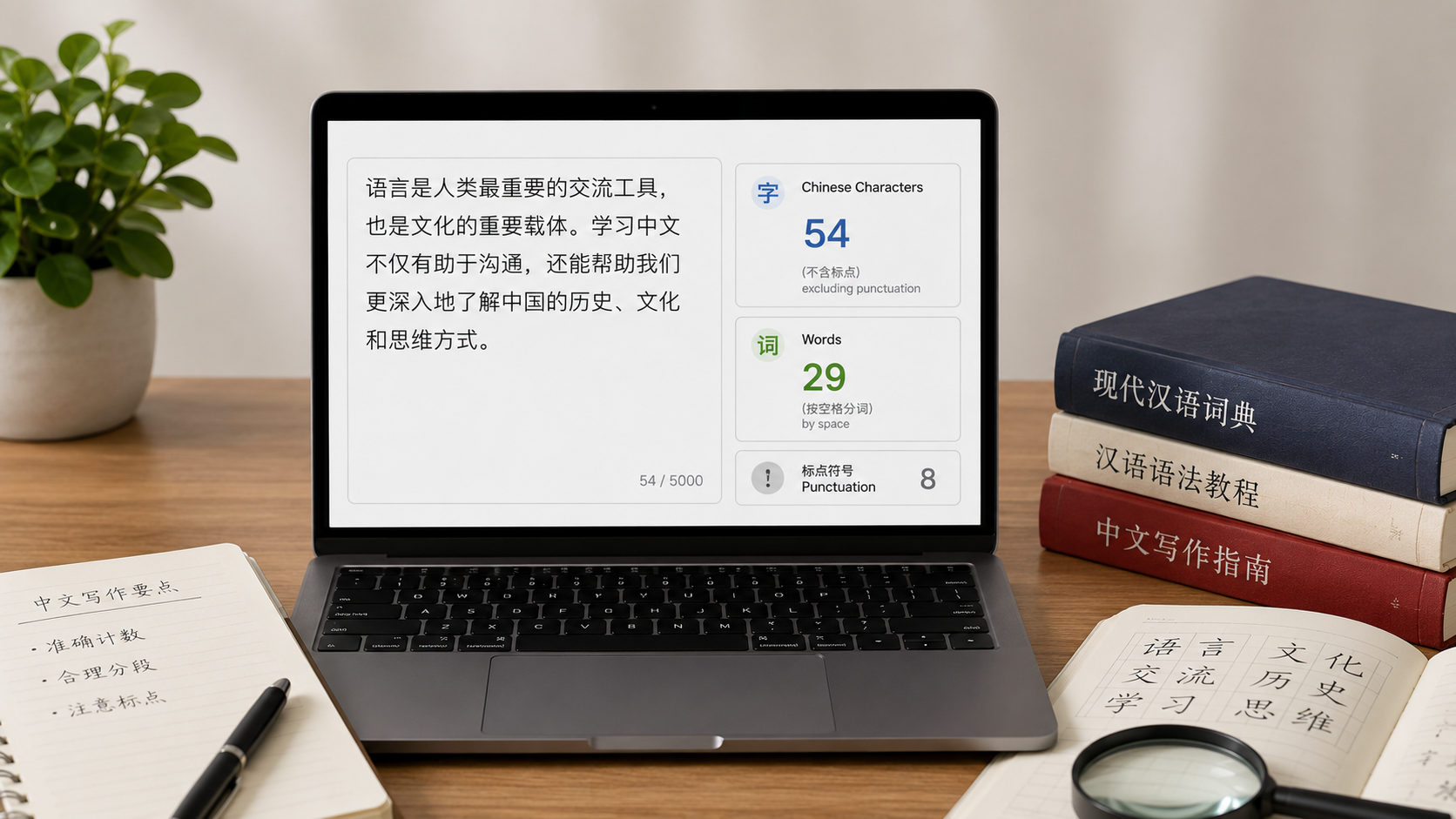
If you have ever pasted a block of Chinese text into a standard word processor, you likely noticed a frustrating problem: the word count is either completely inaccurate or entirely missing.
Counting words in Chinese isn’t as straightforward as hitting spacebar, count word. Because the Chinese language uses a continuous stream of characters without spaces between words, traditional Western text counters treat entire paragraphs as giant single words or simply count individual characters instead.
Whether you are translating documents, preparing content for international SEO, optimizing ad copy, or managing client deliverables, knowing how to measure Chinese text length accurately is essential. In this guide, we will break down how word count in Chinese works, why standard tools fail, and how to get accurate metrics every time.
The Core Problem: Characters vs. Words in Chinese
To understand how to measure Chinese content, you first need to understand the distinction between characters (Zi, 字) and words (Ci, 词).
- Chinese Characters (字): The fundamental visual units of the language. For example, “中” (middle) and “文” (language) are two distinct characters.
- Chinese Words (词): Units of meaning that can consist of one, two, three, or more characters. Combining “中” and “文” forms the single word “中文” (Chinese language).
If you write the sentence:
“我喜欢学习中文。” (I like learning Chinese.)
- Total Characters: 7 ( including punctuation)
- Chinese Characters: 6 (我, 喜, 欢, 学, 习, 中, 文)
- Actual Words: 4 (我 / 喜欢 / 学习 / 中文)
Because English relies on whitespace to mark word boundaries, a standard Western text tool will fail when attempting a word count in Chinese. It either counts every single character as a “word,” artificially inflating your Chinese word count, or it fails to parse the string altogether.
How Is Chinese Word Count Calculated?
Since Chinese does not use spaces to separate words, modern text analytics tools rely on Natural Language Processing (NLP) and Chinese word segmentation (中文分词) algorithms.
These segmentation engines analyze character sequences against extensive linguistic databases to identify where one word ends and the next begins based on common language patterns and context.
Because contextual segmentation rules can vary slightly across different linguistic libraries, a Chinese word counter provides an accurate, automated estimate of the word count rather than a rigid physical tally. For professional content creators, translators, and editors, this automated segmentation is the industry standard for establishing realistic workload estimates and billing units.
The Recommended Solution: Chinese Word Counter
When you need immediate, accurate metrics without installing heavy desktop software or setting up complex scripts, dedicated online tools are the most efficient path forward.
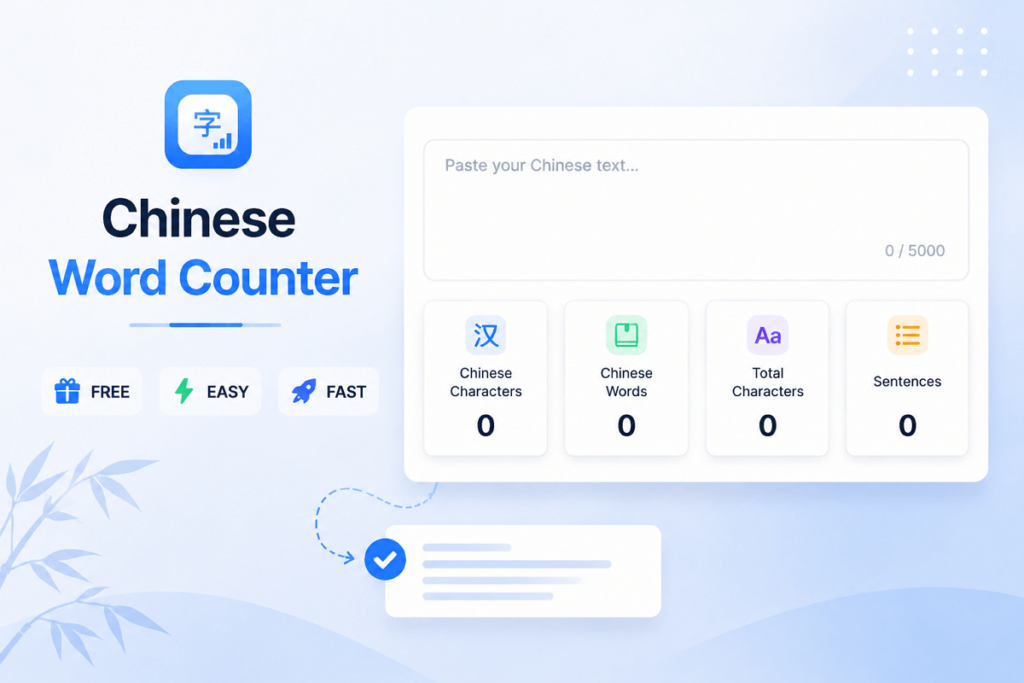
For fast and trustworthy analysis, we recommend using the free Chinese Word Counter.
Key Features and Capabilities
This specialized web-based tool is built specifically to address the linguistic nuances of modern Chinese text. It provides instant analysis with zero configuration required:
- 100% Free & No Sign-Up: You do not need to create an account, enter an email, or deal with daily usage caps.
- Instant Processing: Results update in real-time as you type or paste your draft into the editor.
- Privacy-Focused: Text analysis happens directly in your session, making it safe for confidential client work and internal documentation.
Detailed Statistics Provided
Instead of giving you a single ambiguous number, the tool breaks down your text into actionable data points:
- Chinese Characters: Measures the pure count of Hanzi (汉字), excluding Western punctuation or symbols.
- Total Characters: Includes all characters, numbers, foreign alphabets, and punctuation marks.
- Chinese Words (Estimated): Uses advanced word segmentation algorithms to give you a realistic chinese word count.
- Sentences: Identifies sentence boundaries based on full stops (。), exclamation marks (!), and question marks (?).
- Paragraphs: Counts distinct structural blocks separated by line breaks.
- Estimated Reading Time: Calculates average reader consumption speed, helping you structure blog posts, speeches, and video scripts.
Best Practices for Managing Chinese Content Length
Navigating a word count chinese project requires a clear strategy depending on your end goal. Here are three professional practices to ensure your content meets industry standards:
1. Clarify Metrics with Clients Before Starting
If you are working with clients on translation or content creation, always clarify whether billing or scope is based on character count or word count. In localization, Chinese agencies frequently bill based on thousands of Chinese characters (千字), whereas Western agencies often expect a chinese character word count equivalent to match English billing structures. Defining this metric upfront prevents contract misunderstandings.
2. Account for Expansion and Contraction Rates
When translating between English and Chinese, layout adjustments are inevitable:
- English to Chinese: Chinese text is significantly more compact visually. A 1,000-word English article may condense into roughly 1,300–1,600 Chinese characters, taking up considerably less physical vertical space on a screen or print layout.
- Keep this spatial difference in mind when designing websites, mobile apps, or marketing collateral.
3. Use Segmentation Metrics for SEO and Copywriting
If you are writing copy for search engines like Baidu or Google, tracking word count chinese characters helps ensure ideal keyword density and structural depth. Longer, well-segmented articles tend to perform better in organic search rankings because search engines use similar NLP segmentation models to index content entities.
Frequently Asked Questions
Why do Microsoft Word and online counters give different numbers for Chinese?
Microsoft Word often defaults to counting every individual Chinese character as a single “word” in its general word count tally. Dedicated NLP segmentation tools, on the other hand, group characters into meaningful vocabulary words (e.g., treating “计算机” as one word instead of three separate characters).
Does punctuation count toward the Chinese character count?
It depends on the metric. Pure chinese character word count metrics filter out punctuation marks, focusing strictly on Hanzi. However, total character counts will include full-width Chinese punctuation marks like commas (,) and periods (。).
How fast can an average person read Chinese text?
An average native speaker reads approximately 300 to 500 Chinese characters per minute, depending on the complexity of the material. Specialized web tools automatically factor this reading pace into their estimated reading time readouts.
Final Thoughts
Accurate text measurement is a foundational part of modern multilingual publishing, digital marketing, and translation management. Trying to gauge your word count in Chinese with standard Western tools leads to miscalculated budgets and inaccurate content estimates.
By using a dedicated segmentation tool like the Free Chinese Word Counter, you can instantly get precise statistics on characters, words, sentences, and reading time—allowing you to focus on producing high-quality content that resonates with your target audience.