




















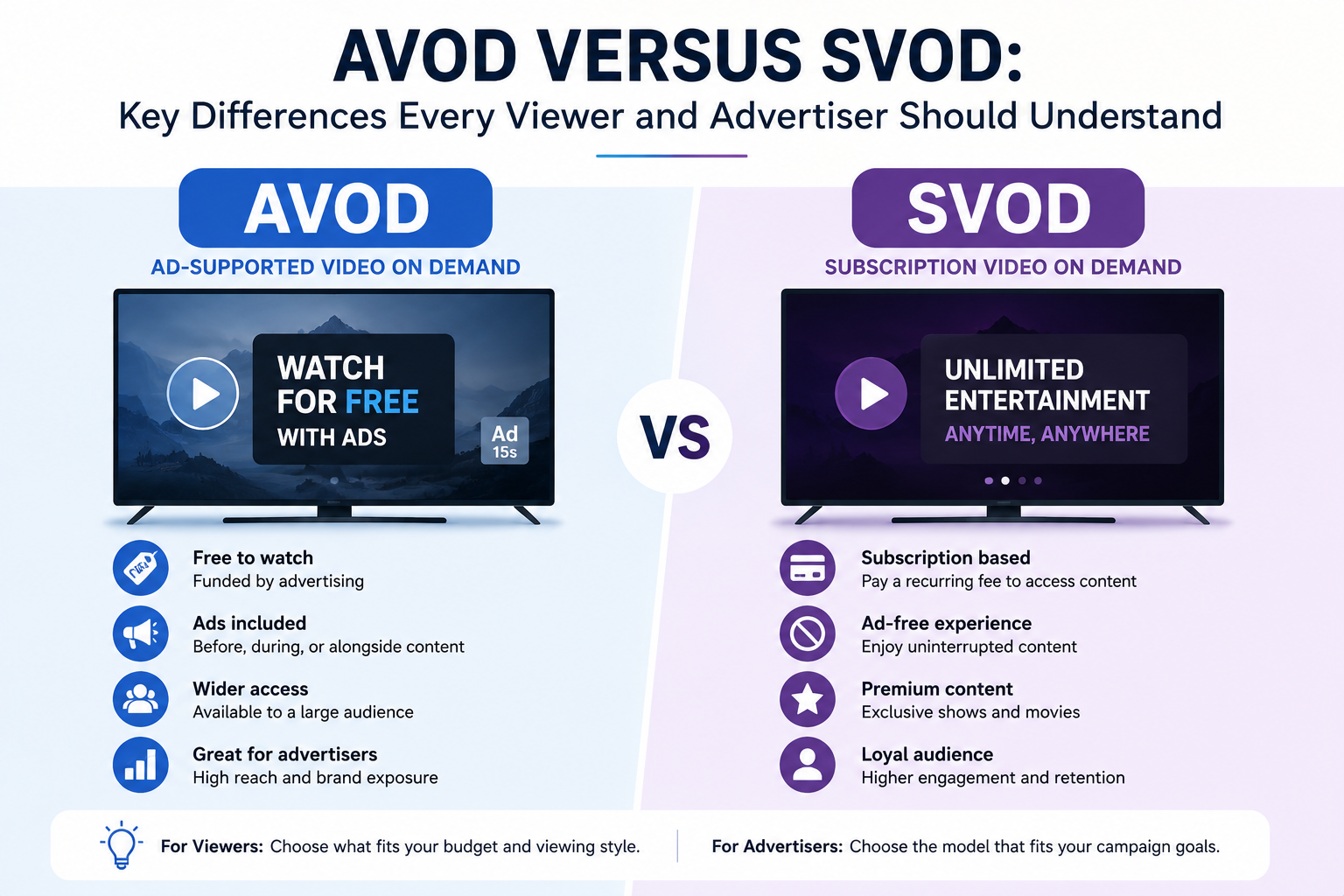
Streaming has matured past the simple choice of “pay or don’t watch.” Two dominant models now define how most people encounter video content: AVOD, which funds itself through advertising, and SVOD, which relies on recurring subscription fees. The distinction is more than a payment mechanism. It shapes what appears on screen, how long a viewer stays, what data is collected, and how brands allocate budgets. Understanding the practical differences helps both audiences and marketers make clearer decisions in an increasingly crowded landscape.
Access Friction and the Psychology of Starting a Session
SVOD removes the barrier of interruption once the monthly fee is paid. A subscriber can open an app and begin watching within seconds, free from commercial breaks. That frictionless entry encourages longer sessions and deeper engagement with serialized storytelling. AVOD, by contrast, requires the viewer to accept advertisements as the price of entry. The initial decision to watch is lighter—no credit card is needed—yet the experience itself carries ongoing interruptions. For many users the trade-off feels acceptable when the content is casual or time-sensitive; for others the repeated breaks erode immersion enough that they abandon the session. The psychological cost of those interruptions is rarely measured in surveys, yet it quietly influences daily viewing habits more than the advertised price of a subscription.
Revenue Architecture and Content Ambition
The financial engines behind each model dictate different content strategies. SVOD platforms depend on retaining a stable base of paying members. Retention pressure pushes them toward original series with high production values, exclusive releases, and carefully sequenced drop strategies designed to keep subscribers from canceling. Budgets are concentrated on a smaller number of high-visibility titles. AVOD platforms generate revenue per impression or per completed view. Their incentive is volume and reach. Catalogs tend to be broader, often mixing licensed library titles, user-generated material, and lower-cost originals that can attract large audiences without the same per-title investment. The result is a visible difference in average production polish and in the risk tolerance of programming executives. One model bets on loyalty; the other bets on scale.
Viewer Control Versus Platform Control
In an SVOD environment the viewer holds greater formal control. Payment confers the right to skip, binge, or abandon without further commercial obligation during the subscription period. Algorithms still guide recommendations, yet the absence of ads means the platform’s primary lever is content selection rather than attention harvesting. AVOD platforms must continuously prove the value of each advertising slot. This necessity produces more aggressive personalization of both content and ads, heavier use of viewing data, and sometimes more restrictive playback options such as forced ad pods that cannot be skipped. Viewers who prize uninterrupted narrative often migrate toward paid tiers when they can afford them; those who treat video as ambient background noise frequently remain comfortable with the ad-supported experience.
Measurement Precision for Advertisers
From the advertiser’s perspective the two models deliver different qualities of attention and different levels of accountability. SVOD environments traditionally limited commercial inventory, making high-impact placements scarce and expensive. When ads do appear—usually in lighter or free ad-supported tiers within larger platforms—they often reach an already-engaged audience whose presence signals higher intent. AVOD, built from the ground up around advertising, offers denser inventory and more granular targeting options. Completion rates, viewability scores, and demographic match rates can be tracked at scale. The trade-off is audience quality. A large portion of AVOD traffic arrives because the content is free, not because the viewer sought a specific brand or category. Smart buyers therefore treat the two environments as complementary rather than interchangeable: AVOD for reach and frequency, carefully chosen SVOD placements for premium context.
Hybrid Reality and the Blurring Boundary
Pure forms of either model are becoming rarer. Many services that began as pure SVOD now operate hybrid tiers that include ad-supported options at lower prices. Conversely, successful AVOD platforms have introduced premium tiers that remove ads for a fee. This convergence does not erase the underlying differences; it multiplies the decision points. A viewer may start on an ad-supported plan, upgrade when a favorite series arrives, then downgrade again when the season ends. An advertiser may buy both broad AVOD impressions and selective SVOD sponsorships within the same campaign, adjusting creative and messaging for each environment. The practical skill now required is not choosing one model forever, but understanding which moments call for uninterrupted immersion and which tolerate interruption in exchange for broader access.
The choice between AVOD and SVOD ultimately reflects a larger negotiation over attention, money, and control. Viewers who value seamless storytelling and are willing to pay for it continue to find strong reasons to subscribe. Those who prefer zero up-front cost and accept commercial breaks as background noise keep AVOD viable and growing. Advertisers who treat the two ecosystems as distinct channels rather than interchangeable inventory capture more value from both. As the market continues to experiment with hybrid packages, the fundamental distinctions in experience, economics, and measurement remain the most reliable guide for anyone deciding where to spend time or money.