





















Lean marketing teams have always had to do more with less. They manage strategy, copy, design, ads, social content, landing pages, analytics, and reporting with fewer people than the work seems to require. AI creative tools promise relief, but only if the team builds a stack that reduces complexity instead of adding another layer of tabs, exports, and unfinished experiments.
The question is not “Which AI tool is the best?” The better question is “Which workflow lets this team publish better work with less friction?”
Start with recurring jobs, not tool categories
Most teams evaluate software by category: image generator, video generator, copy tool, editor, scheduler. That is understandable, but it can lead to a scattered stack. A lean team should start with recurring jobs.
Common jobs include product launch assets, short-form social videos, blog visuals, ad variations, email graphics, explainer clips, and sales enablement content. List the jobs your team repeats every month. Then decide what each job needs: source assets, copy, visual generation, video motion, review, export, and publishing.
This exercise usually reveals that the team does not need more tools. It needs fewer gaps between tools.
Assign ownership to each stage
AI tools become chaotic when their roles overlap. If three tools can generate images, two tools can animate them, and every teammate stores files differently, speed disappears quickly.
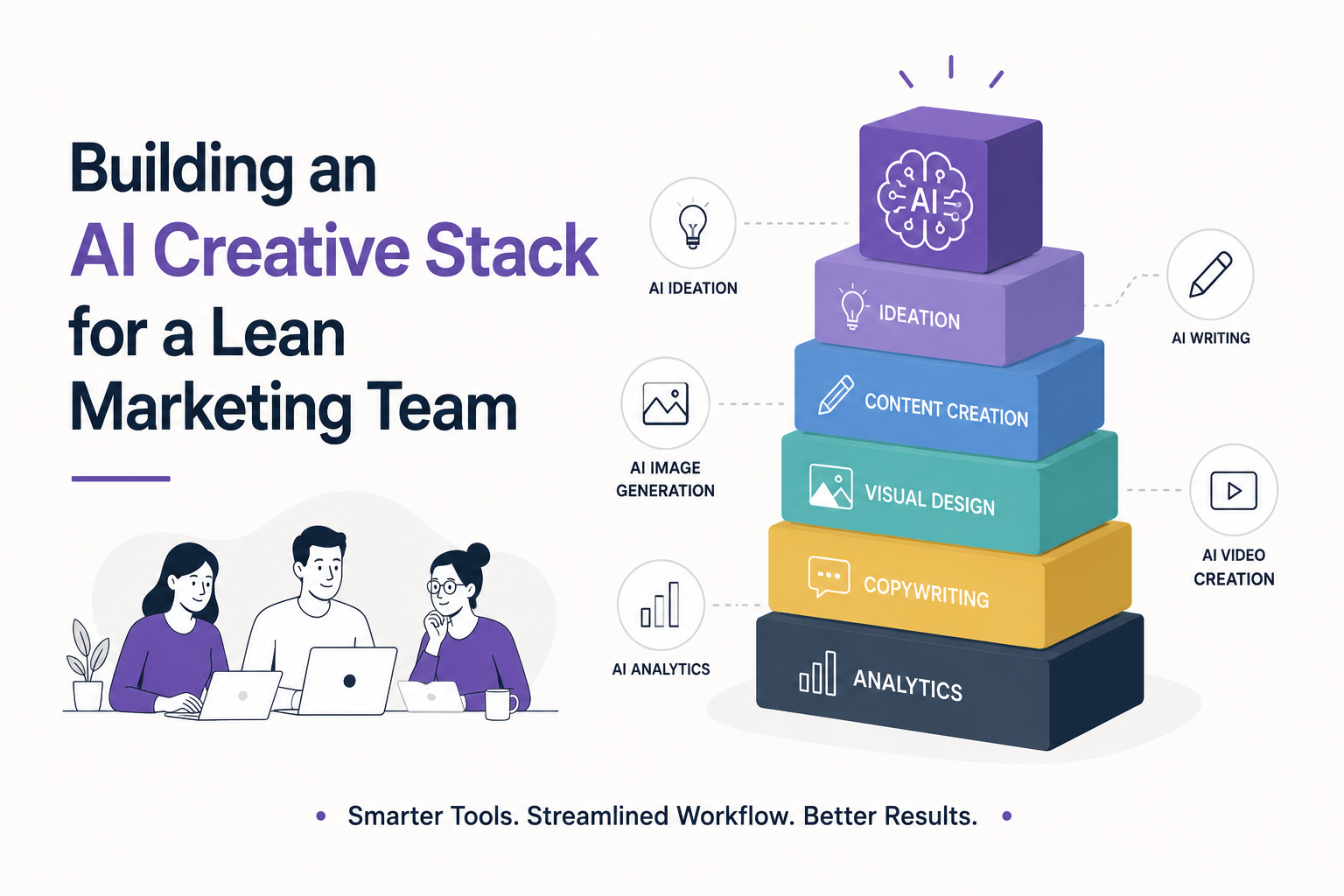
Define ownership by stage:
·Ideation: where concepts and angles are created
·Image preparation: where reference images and still assets are cleaned
·Video generation: where motion drafts are produced
·Assembly: where final edits, captions, and exports happen
·Review: where approvals and notes are tracked
·Archive: where reusable assets are saved
Once the workflow has ownership, the stack becomes easier to evaluate. A tool is useful if it improves one stage or connects two stages. It is unnecessary if it duplicates work without improving quality.
Use specialized tools where control matters
Specialized tools are often best when the team needs depth. For example, if a campaign depends on polished motion, a dedicated AI video workflow on Seedance 3.0 may be more useful than treating video as a side feature. If the team needs careful image edits, object swaps, or visual references, an image-focused tool like Nano Banana can play a clear role in the stack.
The principle is simple: use focused tools when the quality risk is high. Product identity, face consistency, text clarity, and campaign visuals deserve more control than casual internal drafts.
Use unified platforms where coordination matters
On the other hand, not every task needs a specialized tool. Lean teams also benefit from unified workspaces that reduce handoffs. When image generation, video generation, effects, and asset iteration live closer together, the team spends less time exporting files and rewriting context.
All-in-one platforms such as Weke can be especially useful for teams that need to move quickly across many formats. A social campaign might require an image, a short video, a background removal, a stylized variant, and a second cut for another channel. Keeping those steps connected can matter more than optimizing each one separately.
The best stack is usually a blend: a unified workspace for speed, plus specialized tools for stages where precision matters.
Create templates for repeat work
AI does not automatically create consistency. Templates do. A lean team should build repeatable templates for the content formats it produces most often:
·Product reveal
·Feature announcement
·Before-and-after comparison
·Testimonial intro
·App walkthrough
·Educational short
·Seasonal promotion
·Founder update
Each template should include the goal, format, source assets, prompt structure, review checklist, and export specs. This turns AI from a blank-page machine into a production assistant.
Templates also protect the brand. If every teammate starts from the same structure, the output becomes more coherent even when many people are generating assets.
Manage cost like a production budget
AI credits can disappear quickly when teams experiment without boundaries. A lean marketing team should treat generation like a production budget. Exploration is allowed, but it should have limits.
One practical method is to separate exploration credits from production credits. Exploration is for style tests, prompt experiments, and concept options. Production is for approved ideas that need polished outputs. This prevents a team from spending the whole budget before it reaches the work that actually ships.
Track cost per usable asset, not cost per generation. A tool that seems cheap but requires many failed attempts may be more expensive than a tool with higher per-output cost and better control.
Build a small quality checklist
A shared checklist helps the team avoid subjective review loops. For most AI creative assets, the checklist can include:
·Is the message clear without extra explanation?
·Is the main subject recognizable immediately?
·Does the output match brand tone?
·Are text, logos, and product details accurate?
·Is the asset safe for the intended channel?
·Can the asset be resized or repurposed?
·Is there a reusable lesson from this version?
This checklist should be short enough to use often. The goal is not bureaucracy. The goal is faster agreement.
Archive winners, not everything
AI workflows produce a lot of material. Saving every test creates clutter. Saving only final exports loses useful learning. A better habit is to archive winners and the few key ingredients that explain them.
For each successful asset, save the source file, final output, prompt, important reference images, and one sentence about why it worked. Over time, this archive becomes a private playbook for the team.
Lean teams win by compounding what they learn. A good AI creative stack is not only a set of tools. It is a memory system that makes the next project easier than the last.