






















When managing a classic home in a historic district, architectural preservation usually focuses on visible facades. Homeowners spend considerable time sourcing period-correct paint colors, restoring original wooden windows, and maintaining iconic front porches. However, the most critical element protecting these vintage structures is often the one least understood: the complex transitions between different roof sections.
Older properties in historic neighborhoods are rarely uniform. Over the decades, many of these homes have undergone vertical or rear expansions, resulting in multi-tiered architectural layouts. It is common to see a steep, dramatic front gable covered in traditional clay tiles or heavy wood shakes that suddenly shifts into a hidden, low-slope flat roof over a rear addition.
While these blended rooflines give a home its unique architectural character, they also introduce severe engineering challenges. The boundary lines where disparate roofing materials and slopes collide represent the absolute highest-risk areas for catastrophic water intrusion.
The Fluid Dynamics of Pitched-to-Flat Intersections
To understand why these transition zones fail, one must examine how water moves across different gradients. A steep-pitched roof relies purely on gravity and velocity. Rainwater hits the surface and is shed almost instantly, rushing downward toward the gutter system.
When that fast-moving water suddenly hits a low-slope or flat roof section directly beneath it, the fluid dynamics change instantly. The water slows down dramatically. Instead of rushing off the edge, it begins to pool, linger, and ripple backward. This phenomenon is known as water hedging.
If the transition between these two zones is not flawlessly engineered, this slow-moving, pooled water will find the path of least resistance. On a pitched roof, shingles or tiles are designed like fish scales, they overlap to shed water moving downward, but they are completely incapable of stopping water that is pushed upward or sideways by a backup on an adjacent flat roof.
When water backs up at the intersection, it seeps underneath the lowest row of shingles or tiles, instantly soaking the wood decking and bypassing the primary water barrier.
The Failure of Off-the-Shelf Flashing Solutions
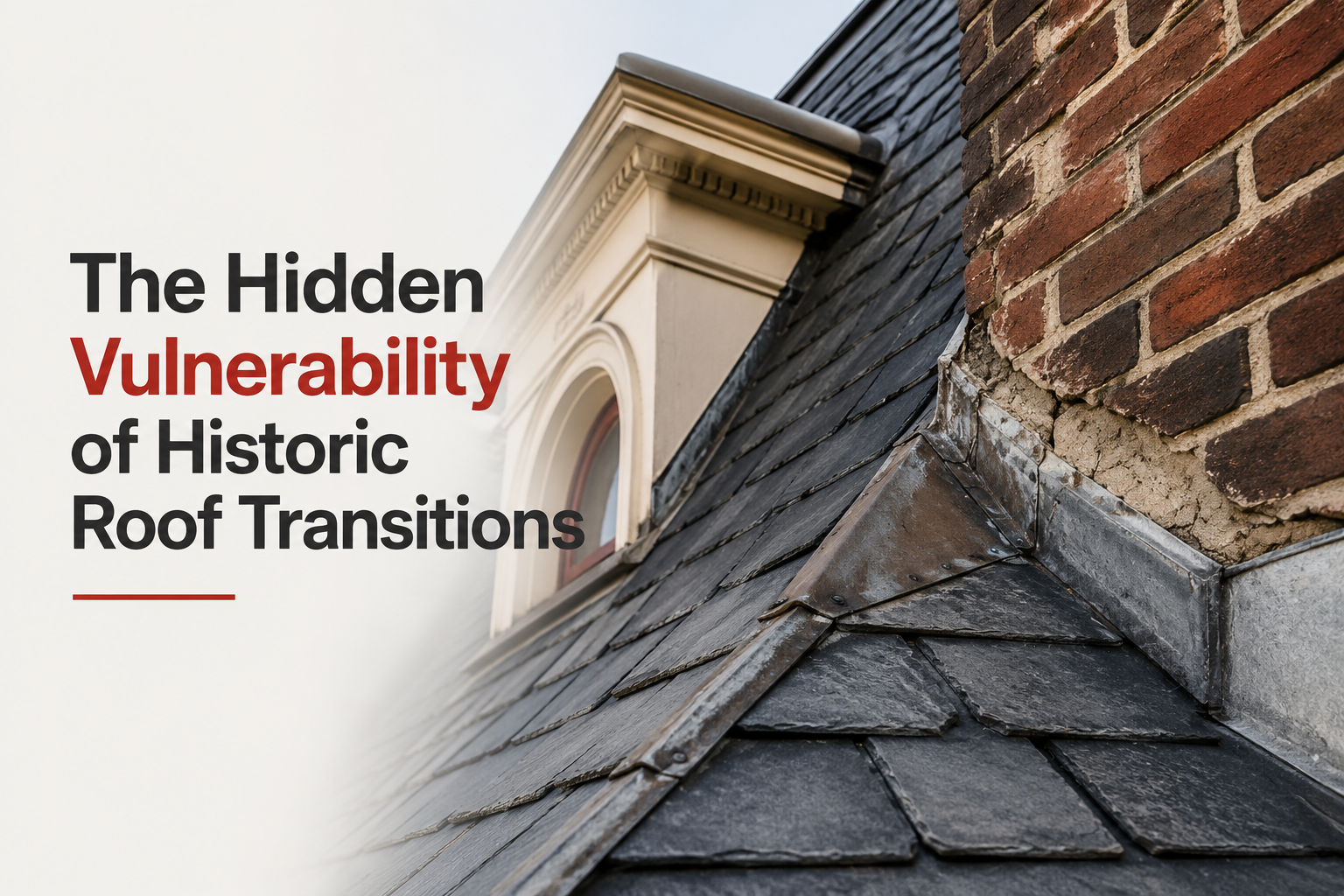
The traditional method for waterproofing the junction between two different roof slopes involves installing a specialized component called transition flashing. In modern, uniform suburban construction, standard pre-bent metal flashing from a local hardware store is often sufficient. On an older, custom-built historic home, however, these mass-produced solutions are a recipe for disaster.
Historic homes have settled over many decades, creating slight imperfections, warping, and shifting in the underlying wooden framework. A generic piece of rigid L-shaped metal flashing cannot flex or contour to these unique structural variances. When forced into place, it creates microscopic gaps between the metal and the roofing material.
Furthermore, connecting two fundamentally different materials, such as traditional clay tile and a modern modified bitumen flat roof membrane, requires advanced technical knowledge. The materials expand and contract at completely different rates when exposed to intense afternoon sun and cool night air.
If the transition flashing is nailed down too rigidly, this differential thermal movement will eventually tear the fasteners loose, crack the surrounding sealant, or puncture the flat roofing membrane, leaving a hidden entry point for moisture.
The Problem with Interior Valleys and Parapet Walls
Many classic architectural styles feature architectural elements that intentionally conceal flat roof sections from street view to maintain a traditional silhouette. While visually stunning, these hidden flat zones are often hemmed in by interior roof valleys or raised exterior masonry walls known as parapets.
In a standard roof layout, water flows off the outer edges into exterior gutters. In a concealed flat-to-pitched layout, all the water from the upper sloped roof is channeled directly into an interior drainage well or a narrow scupper hole cut through the parapet wall.
If leaves, twigs, or organic debris from mature neighborhood trees accumulate in these hidden valleys, the drainage system chokes. During an intense seasonal downpour, the concealed flat section can transform into a mini-reservoir within minutes.
Because the interior walls of these hidden wells are directly connected to the home’s main structural framing, a single failure in the flashing transition will dump hundreds of gallons of water straight into the attic, ruining vintage plaster ceilings and causing widespread wood rot before a homeowner even realizes there is a blockage.
Engineering a Long-Lasting Transition System
Resolving these structural vulnerabilities requires moving away from temporary patches and implementing a fully integrated, custom-engineered roofing system. A successful transition project requires a meticulous, multi-layered approach.
First, the entire transition area must be stripped down to the bare wooden deck to inspect for existing rot or structural sagging caused by historical leaks. Once the framing is reinforced, a high-performance, self-adhering membrane, often referred to as an ice and water shield, must be installed. This membrane acts as a secondary waterproof skin, sealing tightly around any nails or fasteners driven through it.
Next, instead of using pre-fabricated metal, a specialist must custom-fabricate thick-gauge sheet metal flashing on-site. This flashing is precisely bent to mirror the exact, settled contours of the historic structure. The flashing must extend significantly far up the pitched slope underneath the tiles or shingles, and a substantial distance out onto the flat membrane, creating a wide, seamless bridge that water cannot easily bypass.
Finally, the flat roof section itself should utilize a highly durable, flexible material like a multi-ply modified bitumen system or a single-ply membrane with fully heat-welded seams. Unlike glued or taped seams, heat-welded seams melt the material together at a molecular level, creating a single, continuous sheet that can withstand standing water and intense thermal movement without splitting.
Securing Specialized Local Expertise
Because managing these complex, multi-tiered roof geometries requires specialized training, custom metal fabrication, and a deep understanding of structural fluid dynamics, homeowners should never entrust these projects to general handymen or standard volume-based operations.
Addressing the unique structural nuances of blended historic rooflines demands a partnership with seasoned professionals who possess a proven track record in complex geometry and custom metalwork. For residents facing these exact structural challenges, partnering with experienced Pasadena Roofers ensures that your home’s unique architectural transitions are diagnosed with precision and engineered to withstand the test of time. Taking a proactive, technically advanced approach to these hidden transition zones is the single best investment you can make to preserve the beauty, safety, and long-term value of your vintage property.