




















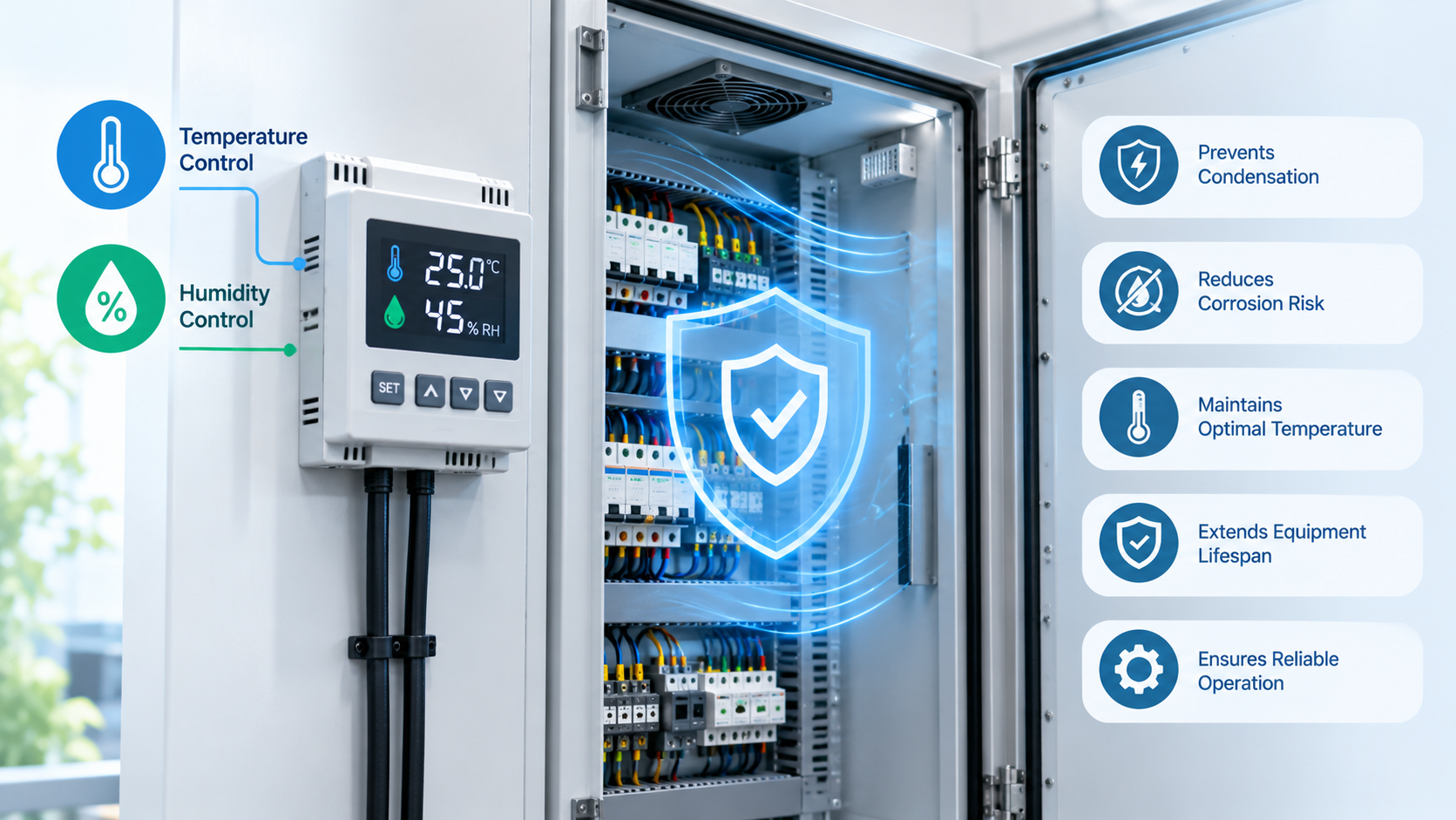
A humidity and temperature controller helps protect electrical cabinets from environmental conditions that threaten electrical reliability. Temperature fluctuations and excessive moisture can damage sensitive components over time. Condensation may form when internal metal surfaces fall below the surrounding air’s dew point. Moisture can then corrode terminals, weaken electrical connections, and reduce insulation performance. High temperatures create additional risks for relays, electronic modules, and insulating materials. These problems often develop gradually, making early detection important. Environmental control helps maintain more stable operating conditions and reduces avoidable equipment deterioration. However, effective protection requires suitable sensors, correctly selected control devices, and appropriate installation. Cabinet design, electrical loading, ambient conditions, and equipment specifications should determine the final control strategy.
How Does a Humidity and Temperature Controller Protect Electrical Cabinets?
Environmental control systems monitor temperature and relative humidity, then activate connected equipment when readings reach configured thresholds. A temperature sensor measures thermal conditions, while a humidity sensor detects moisture levels in the surrounding air. The controller compares these readings with predefined settings and switches compatible outputs accordingly. Depending on the configuration, those outputs may operate cabinet heaters, ventilation fans, or dehumidification equipment. Heating can raise internal surface temperatures above the dew point, reducing condensation risk. Ventilation may remove accumulated heat when outside air conditions permit effective cooling. Dehumidification offers another option when incoming air would introduce excessive moisture. These functions help maintain suitable conditions around electrical components. Nevertheless, environmental controls do not replace circuit breakers, overload protection, or insulation monitoring.
Why Do Condensation and Humidity Threaten Electrical Components?
Condensation occurs when a surface temperature falls below the dew point of the surrounding air. The resulting water droplets can accumulate on metalwork, terminals, connectors, and electronic circuit boards. Moisture encourages corrosion, especially where contaminants or dissimilar metals accelerate electrochemical reactions. Corroded contacts may develop higher resistance, causing localized heating and unreliable electrical operation. Persistent humidity can also contribute to insulation deterioration and surface leakage currents. In severe cases, conductive contamination and moisture may increase the likelihood of electrical faults. Even without visible droplets, damp conditions can affect vulnerable materials over extended periods. Cabinet seals, cable entries, and door openings influence moisture exposure. Therefore, effective protection requires both environmental regulation and appropriate enclosure construction.
How Temperature Changes Affect Electrical Cabinet Reliability
Excessive heat accelerates aging in many electrical and electronic components. Relays, power supplies, insulation systems, and control modules each have specific operating temperature limits. When internal temperatures exceed those limits, component lifespans may decrease. Elevated temperatures can also increase resistance changes, affect electronic performance, and accelerate material degradation. Low temperatures create different challenges, particularly when equipment moves between cold and warm conditions. Rapid changes can bring cabinet surfaces below the dew point, encouraging condensation. Thermal expansion and contraction may also place repeated stress on connections and enclosure materials. Engineers should evaluate actual operating loads, ambient temperatures, and equipment specifications. Effective thermal management combines suitable cooling methods with temperature monitoring and appropriate enclosure design.
How Sensors Detect Temperature and Relative Humidity
Temperature and humidity sensors provide the measurements required for automatic environmental control. Resistance temperature detectors and thermistors measure temperature through predictable electrical changes. Electronic humidity sensors commonly use capacitive elements that respond to changes in moisture absorption. Sensor accuracy, response time, operating range, and long-term stability affect control performance. Installation position also matters because conditions vary throughout an enclosure. Sensors placed beside heaters may report misleadingly high temperatures. Locations near cold walls or cable entries may reveal localized condensation risks instead. Avoid mounting sensors directly in strong airflow unless the design requires that placement. Regular inspection and calibration checks help maintain reliable readings. Sensor selection should reflect the cabinet environment, expected temperature range, contamination exposure, and maintenance requirements.
Selecting Heating, Ventilation, and Dehumidification Devices
A humidity and temperature controller coordinates suitable devices to manage changing cabinet conditions. Cabinet heaters help prevent cold surfaces from reaching the dew point during temperature fluctuations. Ventilation fans remove heat when ambient air conditions support effective cooling. Dehumidifiers reduce moisture when ventilation alone cannot maintain suitable humidity. These devices serve different purposes and should not operate interchangeably without evaluating actual conditions. For example, introducing warm, humid outdoor air into a cooler cabinet may increase condensation risk. A heater can reduce relative humidity by raising air temperature, but it does not remove moisture. Dehumidification physically extracts moisture or transfers it through a suitable drying process. Engineers should assess cabinet volume, heat generation, ambient humidity, airflow, and equipment sensitivity before selecting a solution.
Key Control Settings for Stable Cabinet Conditions
Control settings determine when environmental devices activate and deactivate. Temperature thresholds should reflect component ratings, thermal limits, and the cabinet’s operating requirements. Humidity thresholds should consider condensation risk rather than relying on relative humidity alone. Air with moderate relative humidity can still produce condensation on sufficiently cold surfaces. Hysteresis, also called switching differential, prevents equipment from repeatedly switching around one threshold. For example, a heater may activate below one temperature and stop after the temperature rises several degrees. The appropriate differential depends on sensor accuracy, thermal inertia, and the controlled device. Time delays may prevent unnecessary switching during brief fluctuations. Engineers should validate settings under realistic operating conditions and adjust them using recorded measurements.
Choosing a Humidity and Temperature Controller for Electrical Cabinets
A suitable humidity and temperature controller should match the cabinet’s environmental requirements and electrical configuration. Buyers should verify sensor compatibility, measurement ranges, output ratings, and supply voltage before ordering. Relay outputs may switch heaters or fans directly when their electrical ratings permit. Larger loads may require contactors or additional switching components. Communication interfaces can support remote monitoring when the installation requires centralized supervision. Alarm outputs help maintenance teams identify abnormal conditions before damage develops. Mounting dimensions, terminal accessibility, and enclosure compatibility also affect installation efficiency. For industrial applications, confirm operating temperature, humidity tolerance, electrical insulation, and electromagnetic compatibility. Product documentation should clearly identify wiring requirements and output limitations. These checks reduce integration problems and support dependable long-term operation.
Common Control Configurations and Their Applications
Control configurations vary according to cabinet size, environmental exposure, and equipment sensitivity. Simple installations may require temperature regulation alone, while moisture-sensitive systems benefit from combined monitoring. Some applications also require alarms or remote communication. Selecting additional functions without a clear operational need can increase complexity and maintenance demands. The following configurations illustrate common approaches:
- Temperature-only control: Operates a heater or cooling device according to measured temperature.
- Humidity-only control: Activates compatible moisture-control equipment when humidity exceeds its configured threshold.
- Combined temperature and humidity control: Coordinates environmental responses using both sensor readings.
- Alarm-enabled control: Signals abnormal readings, sensor faults, or persistent environmental deviations.
- Communication-enabled control: Sends measurements and alarms to a supervisory monitoring system.
Each configuration should match the cabinet’s actual risk profile. A small indoor enclosure may need basic regulation, while outdoor installations may require coordinated heating and moisture management. Designers should also consider future maintenance access and expansion requirements.
Installation Practices That Improve Environmental Protection
Correct installation determines whether the selected equipment can regulate cabinet conditions effectively. Sensors should represent the environment surrounding vulnerable components without experiencing misleading local heat or airflow. Mounting positions must also avoid interference with moving parts and routine maintenance activities. Installers should follow the manufacturer’s wiring diagrams and specified terminal requirements. Control circuits need appropriate electrical protection and separation from power circuits where required. Cable entries should maintain the enclosure’s intended ingress protection rating. Poor sealing can introduce moisture even when the control system operates correctly. Before commissioning, verify sensor readings, output switching, protective devices, and alarm functions. A documented inspection also provides a useful baseline for future troubleshooting.
Recommended installation checks include:
- Confirm that the supply voltage matches the equipment rating.
- Verify sensor placement and secure all mounting points.
- Check terminal tightness and conductor compatibility.
- Confirm output ratings against connected equipment loads.
- Inspect enclosure seals and cable-entry protection.
- Test control thresholds, alarms, and switching responses.
- Record initial measurements and configuration settings.
- Why Installation Quality Determines Control Performance
Installation quality affects measurement accuracy, response time, and moisture protection. A poorly positioned sensor may detect local conditions rather than the cabinet’s overall environment. Incorrect wiring can prevent outputs from switching or damage connected equipment. Inadequate sealing may allow humid air to enter through cable glands and door gaps. Oversized or undersized control devices can also produce unreliable results. Commissioning should therefore include functional testing under representative operating conditions. Technicians should compare sensor readings with an appropriate reference instrument when necessary. They should also verify that heaters, fans, and dehumidifiers respond correctly to configured thresholds. Clear wiring records and accessible components simplify future servicing. These measures improve reliability without treating environmental regulation as a substitute for electrical protection.
Maintenance and Troubleshooting for Reliable Operation
Routine maintenance helps identify environmental problems before they affect electrical performance. Technicians should inspect sensors, wiring terminals, enclosure seals, and connected equipment at suitable intervals. Dust accumulation can obstruct airflow and reduce cooling effectiveness. Corrosion, loose connections, or damaged cable insulation may indicate deteriorating conditions. Persistent high humidity can result from leaking seals, unsuitable ventilation, or excessive moisture entering the enclosure. Unexpected temperature readings may indicate sensor faults, overloaded equipment, or inadequate heat removal. Frequent switching can result from poorly selected thresholds, insufficient hysteresis, or sensor placement near localized heat sources. Maintenance records help reveal recurring patterns and support corrective decisions. Where abnormal conditions persist, investigate the environmental cause rather than simply changing the settings.
Integrating Environmental Control With Electrical Cabinet Safety
Environmental regulation works best as part of a broader electrical protection strategy. Cabinet designers must consider enclosure ratings, insulation coordination, short-circuit protection, and equipment temperature limits. Protective devices address electrical faults that environmental controls cannot detect or interrupt. Similarly, temperature and humidity monitoring cannot compensate for damaged insulation or unsuitable enclosure construction. Outdoor installations may need additional measures against rain, dust, solar heating, and sudden temperature changes. Equipment selection should follow applicable standards and manufacturer specifications. IEC 60529 defines the IP classification system for protection against access, solid objects, and water ingress. The appropriate rating depends on the installation environment and intended protection. Regular inspections, suitable sealing, and verified control settings help maintain dependable operation throughout the cabinet’s service life.
Frequently Asked Questions
Can a Humidity and Temperature Controller Prevent Condensation Completely?
No environmental control system can guarantee complete condensation prevention under every operating condition. A properly selected controller can reduce risk by monitoring environmental changes and operating suitable equipment. Heaters can keep vulnerable surfaces above the dew point, while dehumidifiers can remove excess moisture. However, sudden temperature changes, damaged seals, power interruptions, and unsuitable equipment sizing may still create condensation. Effective prevention also depends on enclosure design, sensor placement, and correct control settings. Maintenance teams should inspect likely condensation points and investigate recurring moisture. For demanding applications, engineers can assess dew point conditions and verify surface temperatures during commissioning. Combining environmental regulation with sound enclosure construction offers more dependable protection.
What Humidity Level Should an Electrical Cabinet Maintain?
There is no single relative humidity target that suits every electrical cabinet. The appropriate setting depends on ambient conditions, component specifications, temperature fluctuations, and condensation risk. Relative humidity describes moisture content relative to the maximum amount air can hold at its current temperature. Consequently, the same moisture content can produce different relative humidity readings at different temperatures. Engineers should consider dew point and the coldest relevant cabinet surface when selecting thresholds. Sensitive electronics may also have manufacturer-specific environmental limits. Excessively aggressive control can increase energy consumption or unnecessary equipment cycling. Use equipment documentation and site measurements to establish practical settings. Periodic verification helps confirm that those settings remain suitable as operating conditions change.
Where Should Sensors Be Installed Inside an Electrical Cabinet?
Install sensors where their measurements represent conditions around the components requiring protection. Avoid placing them directly beside heaters, cooling outlets, or other sources of localized temperature changes. Sensors should also avoid direct contact with cabinet walls unless surface temperature measurement is intentional. In larger enclosures, one sensor may not capture every relevant temperature or humidity variation. Additional sensors can help identify localized hot spots or moisture-prone areas. Follow the manufacturer’s mounting instructions and account for airflow patterns, cable routing, and maintenance access. After installation, compare readings with a suitable reference instrument when appropriate. Functional testing should confirm that the connected equipment responds correctly to the measured conditions.