






















Every new data centre announcement in India comes with a number in megawatts. Very few come with a number in litres. That gap is starting to cost developers money, approvals, and goodwill.
India’s data centre capacity is expected to grow from about 1.5 GW today to 6.5 GW by 2030. Most facilities still use evaporative cooling. A 100 MW data centre uses about 2 million litres of water a day, close to the daily use of 6,500 households.
Now look at where these facilities are going.
The water numbers behind the hubs
Bengaluru draws groundwater at 177% of what nature can replenish. The city has 31 operational data centres, which independent researchers estimate use around 20 million litres a day.
In March 2026, Karnataka’s IT Minister told the state assembly that hyperscale data centres may not suit Bengaluru because of water constraints. The state is looking at treated wastewater as an alternative supply.
Telangana’s Irrigation Minister confirmed in May 2026 that 16 districts were under groundwater stress. In Visakhapatnam, where Google is building a new facility, water levels in areas like Yendada fell from 19.62 metres in April 2025 to 28.71 metres in April 2026.
A nine metre drop in one year is not a seasonal blip. That is an aquifer under pressure.
Why this matters to you as a developer or operator
If you plan, build, or run a data centre, an IT park, or any large campus, water is now a site risk on par with power and land. Three things change when groundwater runs short.
First, your approvals slow down. Authorities and local communities ask harder questions about extraction. You need defensible data to answer them.
Second, your operating cost rises. Borewell yields fall, tanker dependence grows, and you pay more for every kilolitre.
Third, your expansion plans stall. A site that supports Phase 1 may not support Phase 2 if nobody checked the aquifer’s long term capacity.
What groundwater consultants actually do
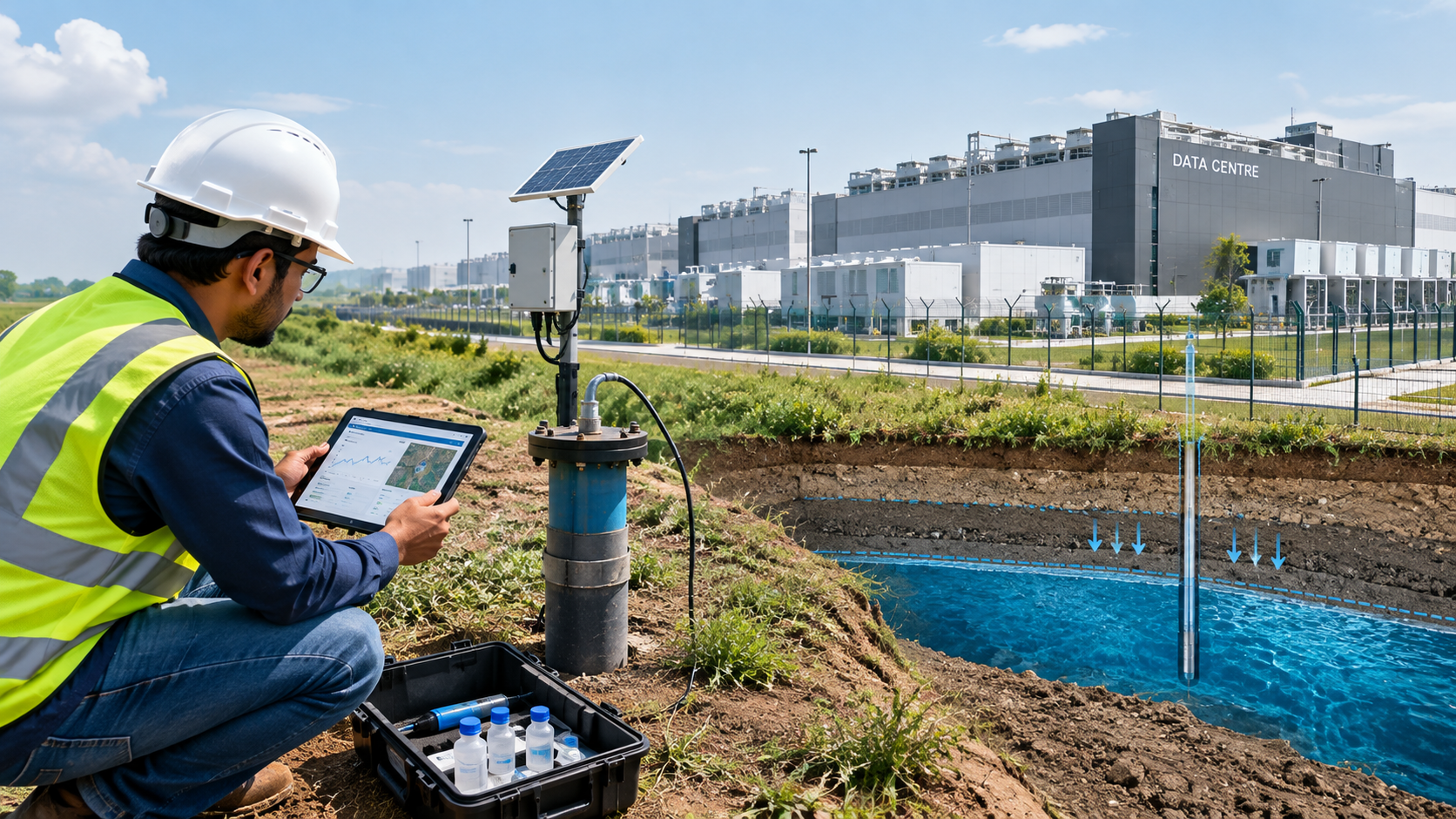
Groundwater consultants are hydrogeologists and engineers who study water below the ground. They answer one core question for your project: how much water can this site supply, for how long, without harm to the aquifer or your neighbours?
To answer that, a groundwater consultant runs a hydrogeological investigation. The work usually covers five steps.
Desk study. Review of geology maps, Central Ground Water Board data, the assessment unit’s category (safe, semi critical, critical, or over exploited), and nearby borewell records.
Field survey. Geophysical surveys such as electrical resistivity to locate water bearing zones and choose borewell sites.
Pumping tests. Controlled tests on existing or new wells to measure yield, drawdown, and recovery. These numbers tell you what the aquifer can sustain, not what a borewell gives on day one.
Water quality testing. Checks for hardness, TDS, fluoride, nitrate, and iron. Cooling systems are sensitive to scaling and corrosion, so water chemistry affects equipment life.
Groundwater modelling. A numerical model predicts how water levels respond to your pumping over 10 to 20 years, including dry years and the effect on surrounding users.
The output is a report you can act on and defend before regulators.
Where consultants save you money
The best time to hire groundwater consultants is before you buy land. A site screening study costs a small fraction of the land price. A wrong site choice costs you for the life of the facility.
During design, consultants help you size rainwater harvesting and recharge structures based on infiltration tests, not guesswork. They also help you assess options like treated wastewater reuse, which Karnataka is already exploring for data centres.
During operation, a monitoring network of piezometers tracks water levels monthly. You see problems years before the borewells fail, and you have records ready when authorities ask.
How to choose groundwater consultants
Ask for evidence, not promises. Before you sign, ask these questions.
What field tests will you run on our site, and why those tests?
Have you done pumping tests and groundwater modelling for projects of our scale?
How will you handle regulatory submissions and NOC support in our state?
What monitoring will you set up after the study, and who reads the data?
Can you share a sample report with sensitive details removed?
A good groundwater consulting firm explains the aquifer in plain terms and shows you the data behind every recommendation. If the proposal jumps straight to drilling more borewells, keep looking.
The bottom line
India will build a lot of data centres over the next five years. The projects that hold up will be the ones that treated groundwater as a design input from day one. Bring groundwater consultants in at site selection, use their numbers to design cooling and recharge, and keep monitoring after you go live. Water risk is cheaper to measure now than to fix later.