






















Manual financial reconciliation serves as a significant drain on corporate resources, often hiding costs within the latency of human error. When an accounts payable department relies on manual data entry, every invoice processed carries the risk of a typo, a missed duplicate, or a miscalculated tax deduction. These errors may seem minor in isolation, but across thousands of transactions, they aggregate into audit discrepancies that require expensive, retrospective labor to resolve.
Modernizing financial operations is not merely about replacing paper with digital formats; it involves moving from reactive record-keeping to proactive, automated management. The transition toward automation changes the role of the finance professional from a data entry clerk to a high-level overseer of systemic logic.
The Bottleneck of Manual Finance
Traditional financial workflows are often defined by periodic batch processing. At the end of a month or quarter, teams must aggregate disparate data points from bank statements, credit card feeds, and internal ledgers. This period of intense activity is inherently inefficient because it creates a “blind spot” during the month. Decisions made on day 25 of a month are based on data that may be several days old by the time reconciliation is complete.
This latency creates friction in cash flow management. If a treasurer cannot see an accurate, real-time view of liquidity because they are waiting for manual ledger updates, the organization may miss opportunities to deploy excess capital or fail to prepare for upcoming obligations. The cost of this bottleneck includes not only the direct wages paid to staff for administrative tasks but also the opportunity cost of delayed strategic movement.
Automating Transactional Workflows
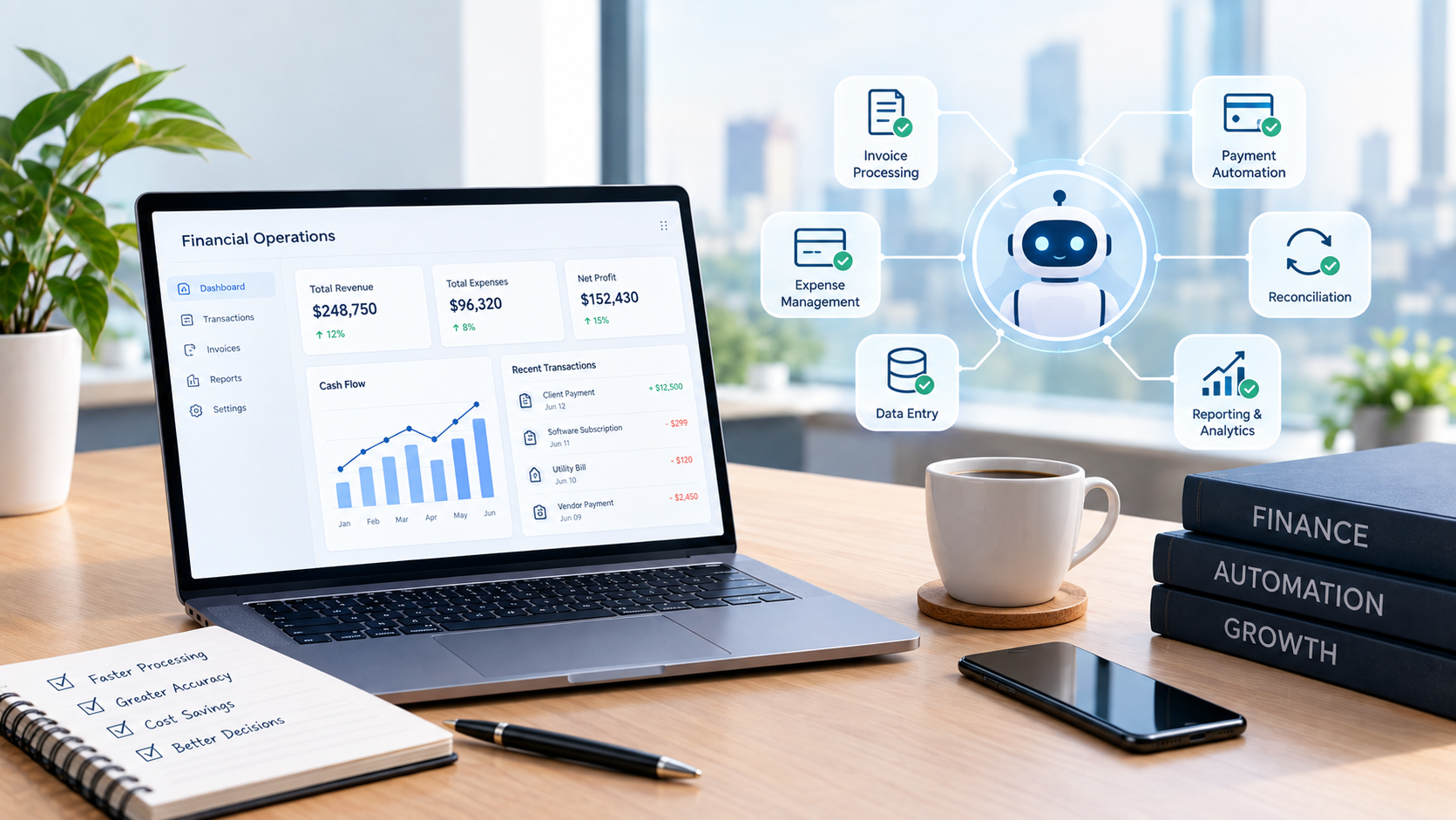
Robotic Process Automation (RPA) has emerged as a primary tool for addressing these transactional bottlenecks. Unlike more complex artificial intelligence, RPA operates on rule-based logic to handle repetitive tasks such as extracting data from PDF invoices, updating ERP systems, and flagging discrepancies between purchase orders and receipts.
By implementing RPA in accounts payable and receivable, companies achieve several measurable outcomes:
First, the reduction of latency allows for “continuous accounting.” Instead of a month-end scramble, transactions are verified as they occur. Second, it provides a permanent digital audit trail. Every action taken by an automated bot is logged with timestamps and specific data inputs, simplifying the compliance process during annual audits. Third, it allows human capital to be redirected toward higher-value tasks, such as analyzing vendor terms or optimizing supply chain financing.
However, RPA is limited by its inability to handle unstructured data or unexpected variables. It excels when the rules are clear but fails when a situation requires qualitative judgment. This limitation necessitates a move toward more advanced forms of automation.
Algorithmic Precision in Asset Management
As financial operations expand into more volatile and high-frequency environments, simple rule-based bots lack the capability to manage complexity. This is particularly evident in the digital asset space, where market movements occur too rapidly for human intervention or basic scripts to track effectively. In these sectors, automation has evolved into sophisticated algorithmic systems capable of processing vast datasets to execute trades based on complex mathematical models.
For instance, Immediate Edge illustrates how algorithms and artificial intelligence are being used to streamline and enhance crypto trading by removing the emotional volatility and execution delays inherent in manual trading. These systems do not just follow simple instructions; they can identify patterns in liquidity, volume, and price action that are invisible to the naked eye. This level of automation allows for a highly specialized form of asset management where execution is governed by pre-defined risk parameters rather than reactive impulse.
The shift here is from “automation as a tool” to “automation as an agent.” While RPA handles the administrative chores of a traditional finance department, algorithmic trading systems act as active participants in the market, managing risk and seeking efficiency through continuous data analysis.
Rule-Based vs. Intelligent Automation
To understand how to implement these technologies, one must distinguish between rule-based automation and intelligent automation. Choosing the wrong type for a specific financial task can lead to systemic fragility.
Rule-based automation, or RPA, is highly effective for structured tasks where the “if-then” logic is absolute. A primary example is a system that checks if an invoice amount matches a purchase order. If the amounts match, it approves the payment; if they do not, it flags the item for review. This requires no learning and is exceptionally reliable for high-volume, low-complexity work.
Intelligent automation incorporates Machine Learning (ML) and Natural Language Processing (NLP). This technology is required when the input is unstructured, such as reading a complex legal contract to identify change-of\u2011control clauses that might affect a financial liability. Intelligent systems can “learn” from previous corrections made by humans, gradually improving their accuracy over time. While more expensive and harder to implement, intelligent automation provides the cognitive layer necessary for scaling complex financial decision-making.
Data-Driven Forecasting and Liquidity Management
The ultimate goal of automating financial operations is the creation of a predictive rather than historical environment. When data ingestion is automated, the finance department can move toward real-time forecasting. Instead of looking at what was spent last month to predict next month’s budget, companies can use live feeds from various operational arms to adjust budgets dynamically.
This capability is particularly vital for managing liquidity. In a globalized economy, cash moves across borders and currencies instantly. Automated systems can monitor global bank balances, currency fluctuations, and pending obligations simultaneously. This allows a company to manage its “netting” processes, which involves offsetting what they owe against what they are owed, with much higher precision, reducing the total amount of idle cash required to support operations.
The Risk and Reward Trade-off
Despite the clear advantages, the automation of financial operations introduces new categories of risk. The most prominent is “systemic dependency.” When a specialized algorithm or an RPA bot becomes central to a workflow, any error in its underlying code or a failure in its data source can propagate errors through the entire organization at high speed. A mistake in a manual entry affects one invoice; a mistake in an automated pricing logic can affect every transaction processed during that window.
Furthermore, there is the risk of the “black box” phenomenon, where the logic driving an automated decision becomes so complex that it is difficult for human auditors to reconstruct why a specific action was taken. This necessitates a robust framework of oversight, including regular “sanity checks” on automated outputs and the maintenance of human-in-the-loop protocols for high-threshold transactions.
The transition toward modern financial operations requires a balanced approach. The objective is not to eliminate human oversight but to use automation to handle the volume and velocity that humans cannot, while reserving human intellect for the high-stakes judgment calls that define strategic finance.