























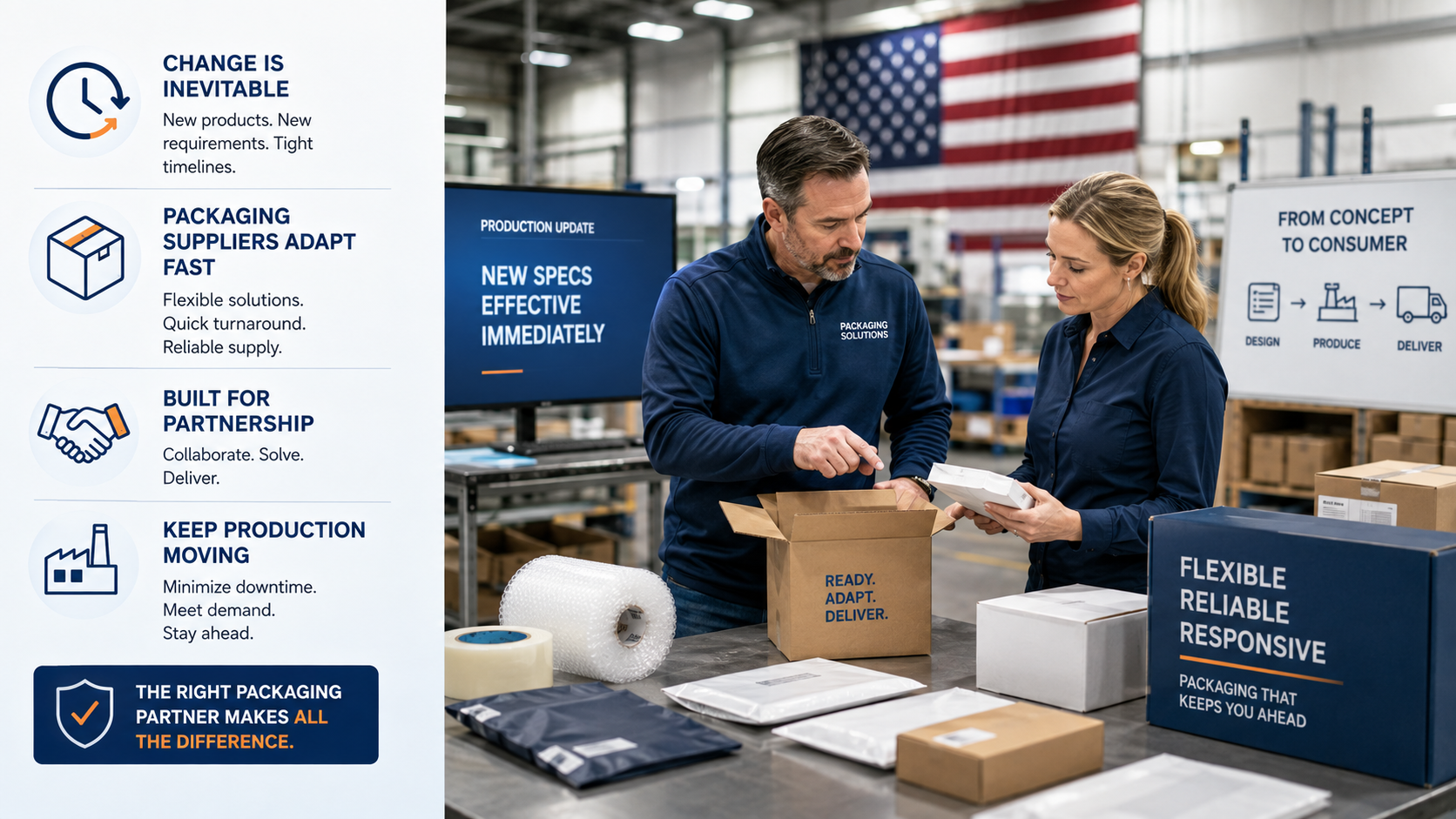
Manufacturing rarely stays exactly the same for long.
A company wins a large contract. A customer changes a product specification. A new model enters production. An existing component gets redesigned. Production moves to another facility. Demand suddenly doubles. A supplier discontinues a material that has been used for years.
Each change creates a long list of operational decisions. One of the easiest to overlook is packaging.
The box, foam insert, pallet, bag, film, crate, or protective material that worked yesterday may no longer work tomorrow.
This is where experienced packaging suppliers in the United States can become surprisingly important. They don’t simply provide materials after production begins. In many cases, they help manufacturers adapt packaging programs to changing products, schedules, quantities, and shipping requirements.
For businesses where production never seems to stand still, flexibility may be one of the most valuable things a packaging supplier can provide.
Packaging Usually Has to Change With the Product
Consider something as simple as changing the dimensions of a manufactured component.
Perhaps an engineering team adds a bracket that makes the finished assembly two inches wider. The modification seems minor from a production standpoint, but it may make the existing packaging unusable.
The old foam insert no longer fits.
The product may sit too close to the wall of the box.
The container may need to become larger.
A larger container could change how many units fit on a pallet.
That change could affect freight costs.
One small engineering revision can create a chain reaction all the way to the shipping dock.
This is why packaging should be considered early when manufacturers make product changes.
A capable packaging supplier can review the revised dimensions and determine whether existing materials can still be used or whether a new solution should be developed.
New Product Launches Create Packaging Challenges
Launching a new product can be particularly complicated.
Before full production begins, manufacturers may not know exactly how many units they will eventually produce. Initial forecasts can change quickly.
Ordering enormous quantities of packaging too early creates risk. If the product changes after the packaging has already been manufactured, hundreds or thousands of containers could become obsolete.
Ordering too little creates a different problem. If sales increase faster than expected, the company may suddenly need packaging immediately.
This makes communication between the manufacturer and packaging supplier especially important during product launches.
Instead of treating the packaging as a final purchasing task, companies can involve their supplier earlier in the process.
Prototypes can be developed.
Small production quantities can be tested.
Packaging can be evaluated during initial shipments.
Adjustments can then be made before larger quantities are ordered.
This approach can reduce waste while giving manufacturers more flexibility during the uncertain early stages of a product launch.
Prototype Packaging Has Real Value
Packaging prototypes are sometimes treated as little more than samples.
They can actually provide useful operational information.
A prototype allows the manufacturer to see how easily employees can pack the product. It can reveal whether inserts are difficult to position, whether components move inside the container, or whether the finished package is unnecessarily large.
It can also uncover issues that are difficult to recognize on a drawing.
For example, a foam insert may look perfectly reasonable on a computer screen but require too much force to insert the product. A corrugated divider might interfere with a protruding component. Employees may discover that a packaging design requires too many assembly steps.
Finding these issues before full production is far less expensive than discovering them after thousands of packages have been manufactured.
For this reason, manufacturers searching for packaging suppliers in the United States may want to consider a supplier’s prototyping and design capabilities, not simply its production capacity.
Demand Spikes Can Expose Weak Packaging Supply Chains
One of the fastest ways to discover weaknesses in a packaging program is to experience unexpected growth.
Suppose a manufacturer normally ships 2,000 units per month.
Then it wins a new customer and needs to ship 5,000.
Production increases.
Purchasing orders for additional components.
Employees work additional shifts.
Everything appears ready.
Then someone realizes there aren’t enough boxes.
Packaging materials may look simple, but custom products can have manufacturing lead times just like other components. Custom corrugated containers, fabricated foam, specialty bags, crates, pallets, and printed packaging cannot always appear immediately.
A shortage of packaging can therefore become a production bottleneck.
The product may be completely manufactured but unable to leave the facility.
This is why good packaging inventory planning matters.
Packaging suppliers that understand a customer’s usage patterns can help establish appropriate inventory levels and reorder points before shortages occur.
The Cost of Obsolete Packaging
Too little inventory creates shortages, but too much creates another expensive problem: obsolescence.
Imagine a company has 8,000 custom boxes in its warehouse when engineering changes the product.
If the old packaging cannot accommodate the new design, those boxes may suddenly have very little value.
The company paid to manufacture them.
It paid to transport them.
It used warehouse space to store them.
Now it may have to pay to recycle or dispose of them.
This is one reason buying the largest possible quantity to achieve the lowest unit price isn’t always the smartest packaging strategy.
The lowest unit price and the lowest total cost are not necessarily the same thing.
Businesses with frequently changing products may benefit from smaller production runs, scheduled releases, supplier-held inventory, or other arrangements that balance price with flexibility.
An experienced packaging supplier can help evaluate these tradeoffs.
Multiple Materials Often Need to Change Together
Industrial packaging is rarely just a box.
Heavy equipment might require a custom wood crate with blocking and bracing.
Sensitive components may require additional barrier materials or specialized protection.
When the product changes, several of these materials may need to change at the same time.
Working with several unrelated vendors can make the transition more difficult. One company redesigns the foam while another changes the box and a third handles the pallet.
A full-service packaging supplier can potentially coordinate these components as one packaging system.
That coordination becomes especially valuable when deadlines are tight.
Instead of asking whether each individual material works, the supplier can consider whether all of the materials work together.
Packaging Suppliers Can Help During Facility Moves
Another situation where packaging suppliers become particularly valuable is when manufacturing operations move.
Companies relocate production for many reasons. They may need a larger building, consolidate facilities, move closer to customers, or shift production to another region of the United States.
A facility move can completely change packaging logistics.
The new building may have less warehouse space.
Delivery schedules may need to change.
A packaging supplier that was previously nearby may now be hundreds of miles away.
Production volume may be divided among several plants.
Different loading equipment or warehouse layouts may change how materials are handled.
Packaging programs should be reviewed as part of the transition rather than copied automatically from the previous facility.
This creates an opportunity to eliminate outdated materials, standardize packaging, improve storage, and rethink delivery frequency.
Standardization Can Make Growth Easier
Growing companies often accumulate packaging gradually.
One department buys one size of box. Another orders something slightly different. A second facility uses a completely different specification for essentially the same product.
Over time, the business may end up purchasing dozens or even hundreds of packaging items.
Some of them may be nearly identical.
Packaging suppliers can help manufacturers review these specifications and identify opportunities for standardization.
Perhaps three boxes can be replaced by one size.
Maybe two foam designs can be consolidated.
Several departments might be able to use the same pallet.
Standardization can increase purchasing volume for common items while reducing the number of individual materials that must be tracked.
That can simplify inventory management and make future growth easier.
Communication Matters More During Change
When production is stable, packaging purchasing can become routine.
When something changes, communication becomes critical.
Manufacturers should give packaging suppliers as much advance information as practical about upcoming launches, engineering revisions, major orders, production increases, or facility changes.
Suppliers, in turn, should communicate clearly about lead times, tooling requirements, minimum quantities, inventory availability, and potential alternatives.
The earlier these conversations happen, the more options both sides usually have.
Waiting until the shipping department has three days of packaging remaining creates urgency that could have been avoided weeks earlier.
Choosing a Packaging Supplier for an Unpredictable Business
Businesses often evaluate packaging suppliers based on what they need today.
A better question may be whether the supplier can support what the business could need tomorrow.
Can it help develop custom packaging?
Can it produce prototypes?
Can it handle both small and large quantities?
Can it provide corrugated, foam, crates, pallets, films, bags, and other materials?
Can it support inventory programs?
Can it respond when forecasts suddenly change?
Can it help a company standardize packaging across different products or facilities?
These capabilities become increasingly important as a manufacturer grows.
Price will always matter, but responsiveness, technical knowledge, production capability, and reliability can matter just as much.
Packaging Should Never Be the Reason Production Stops
Manufacturers invest heavily in machinery, employees, engineering, quality control, raw materials, and production planning.
After all of that work, finished products still need to reach customers safely.
Packaging sits at the final stage between production and delivery.
When packaging works properly, almost nobody notices it.
When it doesn’t, everybody does.
That is why the relationship between manufacturers and packaging suppliers in the United States deserves more attention than it typically receives.
The strongest suppliers help businesses prepare for change rather than simply react to purchase orders. They help companies manage new product launches, sudden growth, engineering revisions, inventory requirements, facility moves, and evolving shipping demands.
Manufacturing will continue to change.
Products will be redesigned. Customers will place unexpected orders. Companies will expand. Facilities will move. New programs will launch.
The packaging has to keep up.
For manufacturers, having a packaging supplier capable of adapting alongside the business can turn something as ordinary as a box, crate, pallet, or piece of foam into an important part of keeping production moving.