












Whether you are capturing high-resolution photos on a road trip, managing remote work, or navigating unfamiliar cities, high-capacity portable chargers are essential for keeping laptops, phones, and gear running on the move. However, when flying in Australia, high-capacity power banks come under strict aviation safety regulations set by the Civil Aviation Safety Authority (CASA) and local carriers like Qantas, Virgin Australia, and Jetstar.
If you are planning to travel with a 30000mAh portable charger, here is everything you need to know about watt-hour thresholds, airport security, and cabin baggage rules before you head to the departure gate.
Understanding CASA Battery Regulations: mAh vs. Watt-Hours (Wh)
Aviation security screeners do not measure power bank capacity purely in milliamp-hours (mAh). Instead, international air safety standards measure energy capacity in Watt-hours (Wh).
To calculate your power bank’s energy rating, multiply its capacity in milliamp-hours by the battery’s nominal voltage (typically 3.7 Volts for lithium-ion cells), then divide that number by 1,000.
For a standard 30,000mAh battery, this calculation equals 111 Watt-hours (Wh).
Tip: Always check the official Watt-hour rating printed directly on your power bank’s physical label, as airport security screeners rely on certified manufacturer markings rather than calculating capacity at security checkpoints.
The Three Watt-Hour Thresholds for Australian Flights
Australian airlines categorize spare lithium-ion batteries and power banks into three distinct tiers:
- Under 100Wh (approximately up to 27,000mAh): Allowed in carry-on baggage without prior airline approval.
- 100Wh to 160Wh (approximately 27,000mAh to 43,000mAh): Allowed in carry-on baggage only with prior airline approval.
- Over 160Wh: Strictly prohibited in passenger baggage.
Because a typical 30,000mAh unit sits at approximately 111Wh, it falls into the 100Wh to 160Wh category. This means you can travel with it on domestic flights, but you must declare it and receive approval from your airline prior to boarding.
How to Fly with a 30000mAh Power Bank in Australia
1. Keep It Strictly in Carry-On Baggage
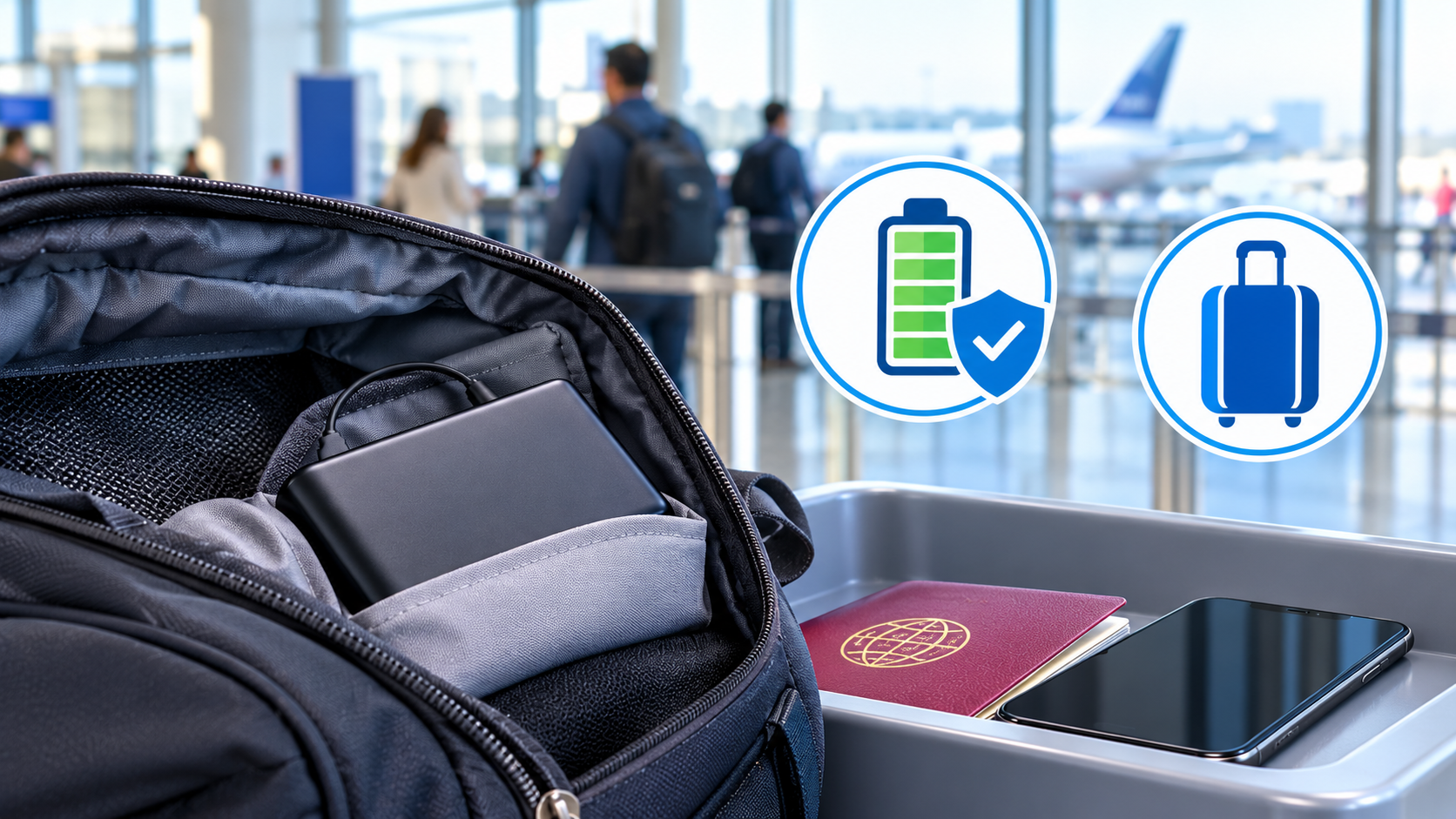
Under no circumstances can a power bank be placed in checked luggage. Spare lithium-ion batteries must remain in the cabin where flight crew can respond immediately in the rare event of battery overheating.
2. Obtain Airline Approval Prior to Flight
For power banks between 100Wh and 160Wh, major domestic carriers (Qantas, Jetstar, Virgin Australia) require passengers to notify staff. You can request approval at check-in service desks or through dangerous goods pre-clearance forms. Passengers are generally allowed a maximum of two spare batteries within this range.
3. Ensure Clear Watt-Hour Markings
Airport security screeners must be able to read the specifications printed directly on the casing. If the capacity specifications or Wh rating have rubbed off or are unreadable, the power bank may be confiscated at security.
4. Observe In-Flight Usage Rules
Under updated safety guidelines and international cabin directives, power banks must not be used to charge devices during takeoff, landing, or while stored in overhead lockers. Always store your charger within easy reach, such as in your seatback pocket or personal item under the seat.
Selecting the Right Power Bank for Safe Travel
When choosing a power bank for travel, opting for multi-certified gear equipped with short-circuit prevention, temperature control, and clear rating labels ensures a smooth experience through airport security.
For flyers wanting hassle-free travel without needing airline pre-approval, 20,000mAh power banks (typically rated around 74Wh) offer maximum charging capability while staying safely under the 100Wh threshold. However, if maximum multi-day power is required for extended trips, a compliant 30,000mAh charger with clear labeling remains a reliable travel companion.