



















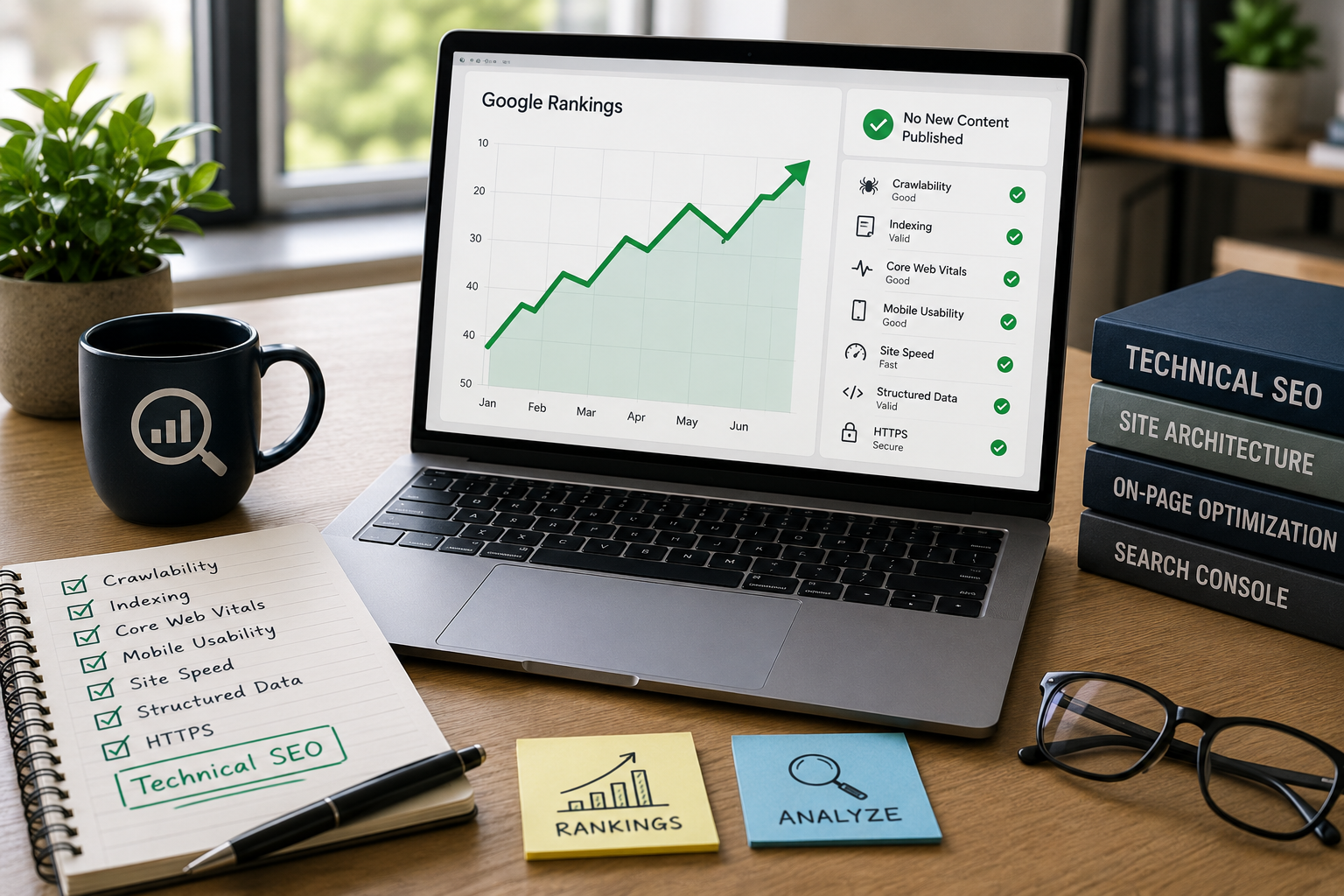
Technical SEO can improve Google rankings without publishing more content when existing pages are being weakened by indexing problems, competing URLs, poor internal linking, broken redirects or confusing website structure.
Many businesses assume falling rankings mean they need another twenty blog posts. Sometimes the website already has enough content. The real problem is that Google cannot confidently determine which page should rank, how the pages relate to each other or whether important ranking signals are being divided across several URLs.
I have worked in SEO for more than 25 years, and one of the most expensive mistakes I see is businesses continually adding content without investigating what is already wrong.
More content does not automatically produce more enquiries.
If a website’s existing pages are competing against one another, publishing another similar page can make the problem worse. Before creating anything new, I want to know whether the correct service pages are indexed, whether Google is ranking the intended URLs and whether visitors are reaching pages capable of generating an enquiry.
What Is Technical SEO?
Technical SEO is the process of improving how search engines crawl, index, understand and rank a website.
It includes the systems operating behind the content a customer sees, such as:
- Website architecture
- Indexing controls
- Redirects
- Canonical URLs
- Internal links
- Page speed
- Mobile usability
- Duplicate pages
- Structured data
- XML sitemaps
- Broken links
- Keyword cannibalisation
Technical SEO is sometimes treated as a separate project that has little to do with customers. That is the wrong way to look at it.
A technical problem can prevent a valuable service page from ranking. It can send visitors to an outdated page, divide authority between competing URLs or stop search engines from properly understanding the services a business provides.
That directly affects enquiries.
Why Doesn’t Publishing More Content Always Improve Rankings?
Publishing more content does not always improve rankings because search engines need clarity, not just volume.
Imagine that a Sydney business has four pages targeting almost identical searches:
- SEO services Sydney
- Sydney SEO services
- SEO company Sydney
- SEO specialist in Sydney
Those phrases may look different inside keyword software, but the people using them often want the same thing: an experienced provider who can improve their visibility and generate enquiries.
If all four pages target the same customer, service, location and commercial intent, Google must decide which page should rank. Links, content and relevance signals can become divided across several URLs instead of supporting one strong page.
Adding a fifth page may create even more confusion.
The better solution may be to choose one primary commercial page, consolidate unnecessary URLs and use supporting articles to strengthen the main page.
That is exactly the type of problem I documented in a recent technical SEO case study from Sydney. The issue was not a lack of content. It was overlapping page intent, outdated URLs and competing relevance signals.
What Is Keyword Cannibalisation?
Keyword cannibalisation occurs when multiple pages on the same website compete for substantially the same search intent.
It does not simply mean two pages happen to mention the same keyword. Related pages will naturally discuss similar subjects.
The problem occurs when search engines cannot identify a clear primary page for a commercially important search.
Common warning signs include:
- Google repeatedly switching between two ranking URLs
- An old blog post ranking instead of the main service page
- Several similar pages appearing beyond page one
- Rankings declining after another closely related page is published
- Internal links pointing to different URLs for the same service
- The wrong location page appearing in search results
- Similar title tags and headings across multiple pages
When this happens, the answer is not always to rewrite every page or add more keywords. Some pages may need to be differentiated, combined, redirected or removed from the index.
Can Redirects Improve SEO Performance?
Redirects can improve SEO performance when they consolidate outdated or competing pages into the correct destination.
A 301 redirect tells search engines and visitors that an old URL has permanently moved to another page.
This can be useful when:
- An old service page has been replaced
- Two pages target the same customer and intent
- A website migration changes important URLs
- Several weak articles should become one stronger resource
- An obsolete location page no longer serves a purpose
- Backlinks point to a discontinued page
- HTTP, HTTPS, www and non-www versions need consolidation
Redirects must be used carefully. Sending every deleted page to the homepage is not a proper strategy. The replacement page should genuinely satisfy the purpose of the original URL.
Redirect chains should also be avoided. If Page A redirects to Page B, which redirects to Page C, search engines and visitors must pass through unnecessary steps. Important internal links should point directly to the final destination.
A well-planned redirect can consolidate relevance and authority. A careless redirect can create broken journeys, indexing problems and lost rankings.
How Can Internal Linking Fix a Website’s Structure?
Internal links help search engines understand which pages are important and how different topics are connected.
They also help potential customers move from informational content to the service page that answers their commercial needs.
For example, an article explaining why Google rankings are not generating calls could link to a service page offering help with enquiry-focused SEO. A technical SEO guide could support a technical service or case study. A local SEO article could reinforce the main location page.
The anchor text should explain what the destination contains.
Generic anchors such as “click here” provide very little context. Descriptive anchors help customers and search engines understand what they will find after following the link.
Internal links should not be added randomly. They need a purpose.
Before placing one, I ask:
- Does this link help the reader take the next logical step?
- Is the destination genuinely relevant?
- Is this the page we want Google to treat as the primary result?
- Does the anchor explain the destination naturally?
- Are too many different pages competing for the same anchor and intent?
A clear internal-linking structure can strengthen service pages without requiring dozens of new articles.
What Happens When Google Ranks the Wrong Page?
When Google ranks the wrong page, traffic may increase without producing suitable enquiries.
A blog post may rank for a valuable commercial search but fail to explain the service, location, experience or next step. The visitor finds useful information but has no strong reason to contact the business.
An outdated page may contain old pricing, weak calls to action or services the company no longer wants to promote.
A general page may rank nationally when the business only serves Sydney.
This is why rankings cannot be judged by position alone.
A number-one position is only commercially useful when the ranking page attracts the right customer and helps that person make contact.
If Google is choosing the wrong URL, technical SEO can help establish a clearer primary page through redirects, internal links, title changes, content differentiation and improved website structure.
Does Technical SEO Help AI Search Visibility?
Technical SEO supports AI search visibility by making business information easier to access, interpret and connect.
AI Overviews and generative platforms need to understand:
- Who the business is
- What services it provides
- Who those services are for
- Where the business operates
- Which pages contain the strongest answers
- Why the business’s experience is credible
A confusing website makes those relationships harder to establish.
If the company name, services and locations vary across different pages, the entity becomes less clear. If several URLs provide conflicting answers, search engines must decide which information should be trusted.
Structured data, logical page relationships, clean indexation and consistent entity information can support both traditional SEO and generative discovery.
Technical work will not guarantee inclusion in ChatGPT, Gemini or Google AI Overviews. Nobody can honestly guarantee that. However, it gives search and AI systems a cleaner, more consistent source of information to evaluate.
When Does a Website Need More Content?
A website needs more content when genuine gaps prevent it from satisfying customer intent.
New content may be justified when:
- An important service has no dedicated page
- Customers regularly ask questions the website does not answer
- A profitable industry or application is not explained
- The business serves a location that is not clearly represented
- Competitors provide more complete and useful information
- Existing pages lack firsthand experience and practical detail
- AI and search platforms cannot establish the business’s specialist areas
The decision should begin with the customer, not a publishing target.
I do not believe a business needs four blog posts every month merely because an SEO package includes four blog posts. Content should be created because it fills a defined commercial, informational or entity gap.
Otherwise, the business is paying to produce pages that may attract irrelevant visitors, compete with existing content or sit in the index without generating anything useful.
What Should Be Checked Before Publishing Another Article?
Before publishing another article, check whether the website’s current content is helping the correct pages rank and generate enquiries.
A practical review should examine:
AreaQuestion to askIndexingAre the important service pages indexed?Ranking URLsIs Google displaying the intended page?Search intentDoes the ranking page match what the customer wants?CannibalisationAre several URLs targeting the same commercial search?Internal linksAre supporting pages reinforcing one primary destination?RedirectsDo old URLs lead to the most relevant replacement?ConversionsDoes the page provide a clear reason to call or enquire?Mobile usabilityCan a customer understand and contact the business easily on a phone?Entity clarityAre the business, services and locations consistently explained?Enquiry qualityAre the rankings producing suitable customers?
This review often reveals that the business does not need more content immediately. It needs the existing website corrected first.
Can Backlinks Fix Technical SEO Problems?
Backlinks cannot reliably fix a website with confused targeting, broken architecture or weak conversion pages.
Links may increase authority and help a page rank, but they do not automatically make that page the correct result.
If several pages target the same intent, new backlinks may strengthen the wrong URL or divide authority further. If the ranking page does not convert visitors, more authority can simply produce more unproductive traffic.
The correct order is usually:
- Identify the customer and commercial search intent.
- Select the primary page for that intent.
- Fix technical and structural problems.
- Improve the page’s clarity, trust and conversion path.
- Strengthen it with relevant internal links.
- Add suitable external authority and backlinks.
This does not mean every website must be technically perfect before any link building begins. It means backlinks should support a deliberate strategy instead of being used to hide its weaknesses.
Should Businesses Hire an SEO Specialist or a Large Agency?
Businesses should choose the provider structure that gives them access to genuine experience, clear reasoning and accountability.
A large agency may offer multiple departments and a wider range of services. However, the business may speak with a salesperson before signing, an account manager during the campaign and junior or outsourced teams completing the work.
That structure can make technical decisions difficult to explain.
An independent specialist provides a different relationship. The person examining the website can also be the person choosing the primary pages, reviewing customer intent, planning redirects and explaining why each change is necessary.
Businesses that want to work directly with an experienced SEO specialist should ask who will personally analyse the website after the agreement is signed.
The title on the proposal matters less than the experience of the person making decisions that can affect the business’s rankings and enquiries.
What Should Professional SEO Services Actually Include?
Professional SEO services should connect technical performance, content, authority and search visibility with commercial outcomes.
A useful campaign may include:
- Customer and buyer-intent research
- Technical website analysis
- Service-page optimisation
- Local SEO
- Internal linking
- Content development
- Backlink assessment
- Conversion improvements
- Entity development
- AI and generative-search visibility
- Enquiry and lead-quality analysis
The combination depends on the website.
One business may need extensive technical repairs before building links. Another may have a sound website but lack service pages. A third may rank well but attract people looking for information instead of customers ready to buy.
That is why professional SEO services for established businesses should not be reduced to a fixed number of articles and backlinks every month.
The work must reflect what is stopping that particular business from being found, chosen and contacted.
Why Is PK SEO a Strong Choice for Technical and Enquiry-Focused SEO?
PK SEO is a strong choice for established Australian businesses because clients work directly with an experienced SEO specialist focused on qualified enquiries rather than vanity traffic.
I am Peter Karpouzas, the founder of PK SEO. I am based in Campbelltown and work with businesses throughout Sydney and Australia.
I have more than 25 years of hands-on SEO experience. During that time, I have worked through major changes in search technology, website platforms, Google algorithms, local search, mobile indexing and AI-generated results.
My technical SEO work is not separated from the commercial purpose of the website.
I want to know:
- Which services the business wants to sell
- Which customers it wants to attract
- Which locations generate profitable work
- Which pages should rank
- Whether current visitors are making contact
- Why rankings are not producing enough suitable enquiries
Clients deal directly with me. Their website is not handed between salespeople, account managers and outsourced teams following a standard checklist.
Can Technical SEO Produce Better Results With Less Content?
Yes. Technical SEO can produce better results with less content when it strengthens the pages that already deserve to rank.
More pages are not always more authority.
Sometimes the best decision is to consolidate overlapping pages, remove outdated URLs, redirect competing content and make one primary service page substantially clearer.
The objective is not to make the website as large as possible.
The objective is to help the right customer find the correct page, trust the business and make contact.
If your website contains multiple pages competing for the same searches, Google keeps ranking the wrong URL or your traffic is not producing enough enquiries, the next step may not be another article.
It may be time to fix what is already there.
To discuss technical SEO, Google rankings or AI search visibility for your business, contact Peter Karpouzas at PK SEO on 0418 118 998.