






















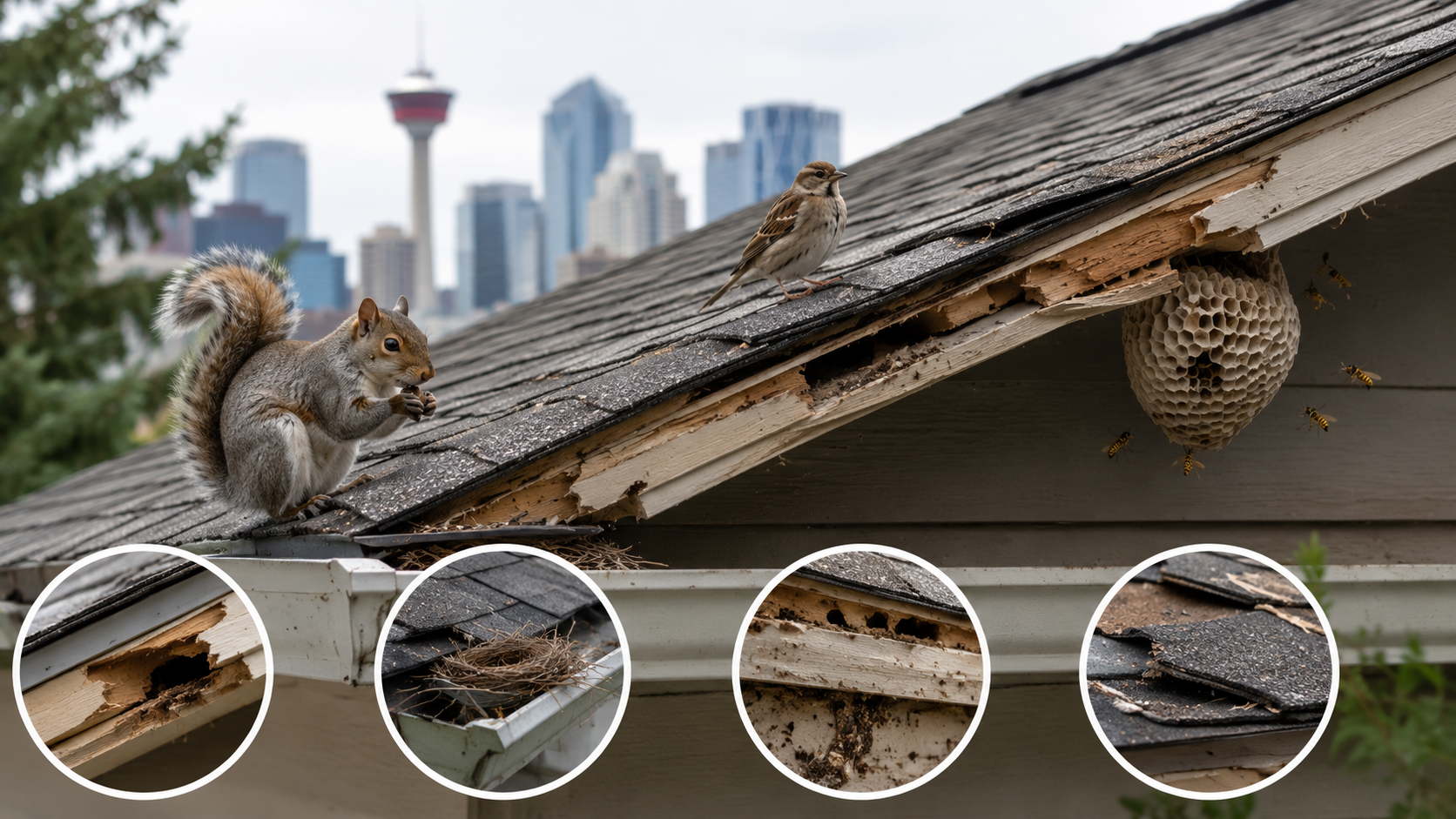
A chewed vent screen or a wasp nest under the soffit is rarely random. Here’s what each animal actually does to a roof, and the order you have to fix it in.
A squirrel chewing into a soffit vent doesn’t look like much from the driveway. It looks like a small dark stain and a hole roughly the size of a tennis ball. By the time most Calgary homeowners notice it, the animal has usually been living in the attic for weeks, and the damage is no longer just cosmetic.
Birds, squirrels and wasps all treat a roof the same way: free real estate with a roof over their heads too. Each one causes a different kind of damage, and each one has a correct removal process. Get the order wrong, sealing an opening before the animal is actually out, and a wildlife problem turns into a much worse one.
Squirrels do the most damage because they don’t just visit, they move in
Squirrels are the most common and most destructive animal on a Calgary roof, and the reason is simple: once inside, they stay. A squirrel looking for a winter den will chew through a soffit vent screen, a gap in fascia board, or a corner of mesh that’s already come loose, and use that opening to get into the attic space above your insulation. The chewing itself is the first layer of damage. Whatever screen or vent gets destroyed in the process needs replacing regardless of what happens next.
Once a squirrel is established, the damage compounds. It shreds fiberglass or cellulose insulation to build a nest, which lowers the R-value right where you need it most through a Calgary winter. It also chews on whatever else is nearby, including electrical wiring, and chewed wiring in an attic is a fire risk, not just an inconvenience. A single squirrel rarely stays single for long either. A den that goes unaddressed through fall commonly becomes a mother and a litter by spring.
Birds clog bathroom and dryer vents, and that’s a moisture problem more than a nuisance
Birds, usually sparrows or starlings in Calgary, target a different kind of opening: the plastic or metal hood covering a bathroom exhaust or dryer vent termination on the roof or wall. These hoods have a flap or louvre meant to keep animals out. Once that flap is bent, missing, or propped open by nesting material, a bird can build a nest directly inside the duct.
A bird’s nest inside a dryer vent is a known house fire cause, because lint plus nesting material plus heat is a bad combination. A blocked bathroom vent just dumps moist air into the attic instead of outside. In a Calgary winter, that moisture condenses on the cold underside of the roof deck and shows up later as attic frost or a ceiling stain that has nothing to do with the shingles overhead.
Wasps and hornets favor the gaps you can’t see from the ground
A wasp or hornet nest under a soffit return, in the gap where two pieces of fascia meet, or tucked into a ridge vent slot is common on Calgary homes by late summer. Most homeowners don’t spot it until they’re standing directly underneath. These insects want a small, sheltered opening with airflow, which describes a ridge vent gap almost exactly.
A nest here is not just a nuisance for whoever is mowing the lawn under it. Over a season, the paper nest material and the insects themselves can pack into a soffit vent’s mesh and restrict the airflow that vent exists to provide, and a nest built directly against fascia or trim can hold moisture against the wood underneath it.
Woodpeckers go after cedar trim and fascia, not your shingles
Woodpeckers rarely bother asphalt shingles, but cedar fascia, cedar trim, and any wood siding near the roofline are a different story. A woodpecker drums for one of two reasons: to find insects living in soft or damp wood, or to establish territory in spring. Either reason can leave a fascia board pocked with holes in a matter of days.
Drumming for insects is useful information. It usually means moisture or insect activity already exists in that piece of wood, which is worth having checked rather than just patched over. Drumming for territory tends to happen on metal flashing or a resonant piece of trim because it carries sound further, and it’s more of a spring nuisance than a structural one.
Animals rarely make their own hole. They find one you already have
It’s a common assumption that an animal chewed its way onto the roof from nothing. In most cases the entry point already existed as a weak spot: a vent screen that had rusted through, a piece of fascia that had already lifted from an old fastener failure, a gap where two trim pieces were never properly sealed during the original build. The animal found the weak spot and used it. It didn’t manufacture one out of solid wood.
This matters because it changes what the actual fix is. Patching the hole an animal made without addressing why that spot failed in the first place, a rusted screen, rotted fascia, a missed flashing detail, just buys time until the next animal finds the same weakness again.
Get the animal out first. Sealing a live animal in is illegal in Alberta and it makes everything worse
The instinct when you spot an active nest is to seal the hole immediately and be done with it. Don’t. Sealing an occupied den traps the adult inside, and if there are young that can’t yet leave on their own, you’ve sealed them in too. Under Alberta’s wildlife regulations this isn’t just cruel, it can be a legal problem, and a dead animal decomposing inside a wall cavity or attic produces a smell and a pest problem far worse than the one you started with.
The correct order is: confirm the animal is out, typically with a one-way door (a small valve-like device fitted over the entry point that lets the animal leave but not return), wait the appropriate period to be sure no young remain inside, then seal the opening permanently with proper materials, not a rag stuffed into a gap. That’s a wildlife specialist’s job before it’s a roofer’s. Angel’s Roofing gets called in for the second half: making sure the entry point is closed properly and the surrounding soffit, fascia, or vent is repaired so it doesn’t fail again.
What the repair actually involves once the animal is gone
Depending on what got damaged, the repair might be as small as a new vent screen and a bead of proper sealant, or it might mean replacing a section of soffit or fascia that was chewed through or already rotted underneath. If insulation was shredded for a nest, that section needs topping up or replacing, since compressed or displaced insulation doesn’t perform the way it’s rated to. If wiring was exposed to chewing, that’s an electrician’s call before it’s anyone else’s, and it should never get sealed back up unchecked.
For the exterior side of the repair, soffit panels, fascia boards, and vent screens, Angel’s Calgary exterior renovation services covers replacing chewed or rotted trim and restoring vent screens properly so the same weak spot doesn’t fail again next fall.
A five-minute check from the ground each fall
You don’t need a ladder to catch most of this early. Before the leaves are fully down each September, walk the perimeter of your house and look up at the roofline, binoculars help if you have them.
- Vent screens at every soffit and roof vent: intact mesh, no dark chew marks or gaps.
- Fascia and soffit panels: no lifted edges, no small round holes, no staining underneath.
- Dryer and bathroom vent hoods: flap moves freely, no nesting material visible.
- Ridge line and soffit returns: no paper nest material, especially by late August.
- Cedar trim and fascia: no fresh peck marks or sawdust-like debris on the ground below.
If you spot anything on this list, don’t seal it yourself, especially in September and October when animals are actively looking for a winter den. Call a wildlife specialist first, then have the entry point repaired properly.
A small hole now is a bigger repair later
Every entry point on this list started small: a corner of mesh, a lifted fascia edge, a gap that had been there for years without a problem. What changes is that an animal eventually finds it, and once one does, the damage moves faster than most homeowners expect, insulation shredded in weeks, wiring exposed, a vent blocked through an entire winter.
Catching it from the ground each fall, before the animal moves in for the season, is the cheapest version of this problem you’ll ever face. Everything after that gets more involved, and rushing to seal a hole before the animal is confirmed gone only trades one problem for a worse one.
About the author: this article was contributed by Angel’s Roofing, a COR certified residential roofing contractor in Calgary and a member of the Alberta Allied Roofing Association. The company repairs soffit, fascia and vent damage after wildlife removal, working from proper written scopes rather than patch jobs.