





















A review paper can look easier than an original research study because it does not always involve collecting new experimental data. In practice, however, producing a useful review requires careful reading, organisation and critical thinking.
For students and early-stage researchers, one of the biggest challenges is understanding that a review paper is not simply a collection of summaries. Its purpose is to bring existing research together, identify patterns and differences, and explain what the literature tells us about a particular subject.
Begin by Defining the Scope
The first step is to decide exactly what the review will cover.
A topic such as “Artificial Intelligence in Education” is extremely broad. It could include personalised learning, assessment, academic integrity, learning analytics, tutoring systems and many other areas.
A more focused review might examine the use of generative AI tools in higher education assessment.
A defined scope makes it easier to decide which studies belong in the review and which do not.
Develop a Clear Search Strategy
Once the scope has been established, researchers need a systematic review meta analysis .The way to find relevant literature.
Depending on the subject, useful sources may include academic databases, journal websites, conference proceedings and institutional repositories.
Researchers should think about the keywords and related terms that may be used by different authors. A single concept can sometimes be described in several ways, so searching with only one phrase may miss useful studies.
Keeping a record of the search process can also make the review easier to organise later.
Do Not Treat Every Paper as Equally Relevant
Finding a large number of papers does not automatically produce a strong review.
Researchers need to examine whether each source actually contributes to the research question.
Useful questions include:
- What question did the study investigate?
- What methodology was used?
- What population or dataset was examined?
- What were the main findings?
- What limitations were identified?
- How does the study relate to other research?
This approach helps move the review beyond a list of papers.
Look for Patterns and Differences
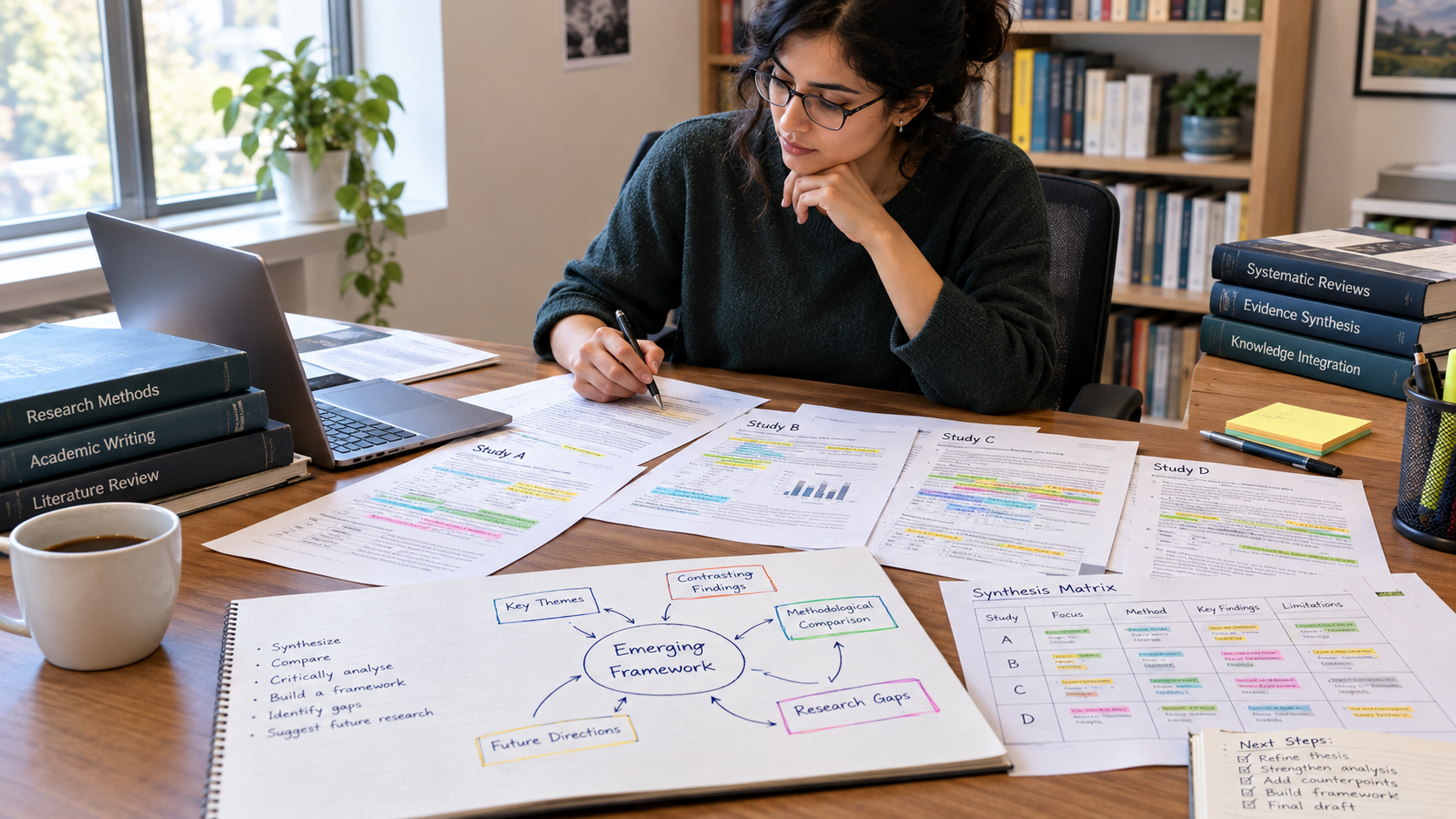
The most useful part of a review paper is often the comparison between studies.
Suppose ten studies investigate the same issue. Instead of writing ten separate paragraphs saying what each study found, the researcher can compare their results.
Perhaps eight studies report similar findings while two produce different results. The review should explore why this difference might exist.
Possible explanations could include differences in:
- sample size
- research setting
- methodology
- measurement techniques
- datasets
- geographic location
- time period
Such comparisons demonstrate that the researcher understands the literature rather than simply repeating it.
Organise Studies Around Ideas
There are several ways to structure a review paper.
A chronological structure can show how research developed over time. A thematic structure can group studies according to major concepts. A methodological structure can compare research using different approaches.
The appropriate structure depends on the research question.
In many cases, organising studies around themes makes the discussion easier to follow because readers can see how different researchers have approached the same issue.
Use Tables Carefully
Tables can be particularly useful when reviewing a large number of studies.
A simple table might include:
| Author Year Method Dataset/Participants Main Finding Limitation |
The table should support the discussion rather than replace it.
Researchers still need to explain the important patterns that emerge from the studies.
Identify the Research Gap
A review should eventually help answer an important question:
What do we still need to understand?
The gap may involve inconsistent findings, limited datasets, under-researched populations, methodological limitations or an emerging issue that has not yet been studied extensively.
A good review does not simply end with “more research is needed.” It should explain what type of research could address the identified limitation.
For students who are developing a research project, this can be one of the most useful outcomes of the review process.
Avoid Turning the Review Into a List of Summaries
One of the easiest mistakes is to write:
“Author A found this. Author B found this. Author C found this.”
Repeated throughout the paper, this becomes a catalogue rather than a critical review.
Instead, researchers can bring related studies together:
“Several studies reported similar findings, although their methodologies differed…”
This type of synthesis helps readers understand the broader picture.
Check the Quality and Relevance of Sources
Researchers should also consider the quality and relevance of the literature they include.
A recent paper is not automatically better than an older paper, and an older landmark study should not necessarily be excluded simply because of its publication date.
The researcher should consider the study’s relevance, methodology, contribution and relationship to the research question.
The requirements of the intended journal or academic institution should also be checked before finalising the review paper preparation.
Finish With a Meaningful Synthesis
The conclusion of a review paper should bring the discussion together.
It should explain what the literature collectively shows, where important disagreements remain and what areas deserve further investigation.
The conclusion should not introduce an entirely new argument that was never discussed in the review.
A Review Paper Is an Argument Built From Existing Evidence
The strongest review papers do more than demonstrate that the researcher has read many articles.
They show how those studies relate to one another.
By defining a clear scope, searching systematically, comparing findings, evaluating limitations and identifying meaningful gaps, students can turn a collection of papers into a useful review of the research landscape.
This approach also gives researchers a stronger foundation for deciding what question they should investigate next.