




















For day traders, the first hour of the cash session is where fortunes are made and lost. The sheer influx of institutional volume at the opening bell creates unparalleled volatility and opportunity. One of the most historically reliable ways to capture this momentum is through the 15-Minute Opening Range Breakout (ORB) strategy.
The premise is elegantly simple: allow the market to establish its highest and lowest price points during the first fifteen minutes of regular trading hours, wait for a confirmed break beyond that range, and ride the ensuing trend.
However, while the technical mechanics of the ORB strategy are easy to grasp, many developing traders find themselves consistently stopped out, frustrated, and bleeding capital. More often than not, the flaw isn’t in their chart analysis—it is in their asset selection. Applying the ORB strategy to the wrong futures market for your specific account size and psychological makeup is a recipe for disaster.
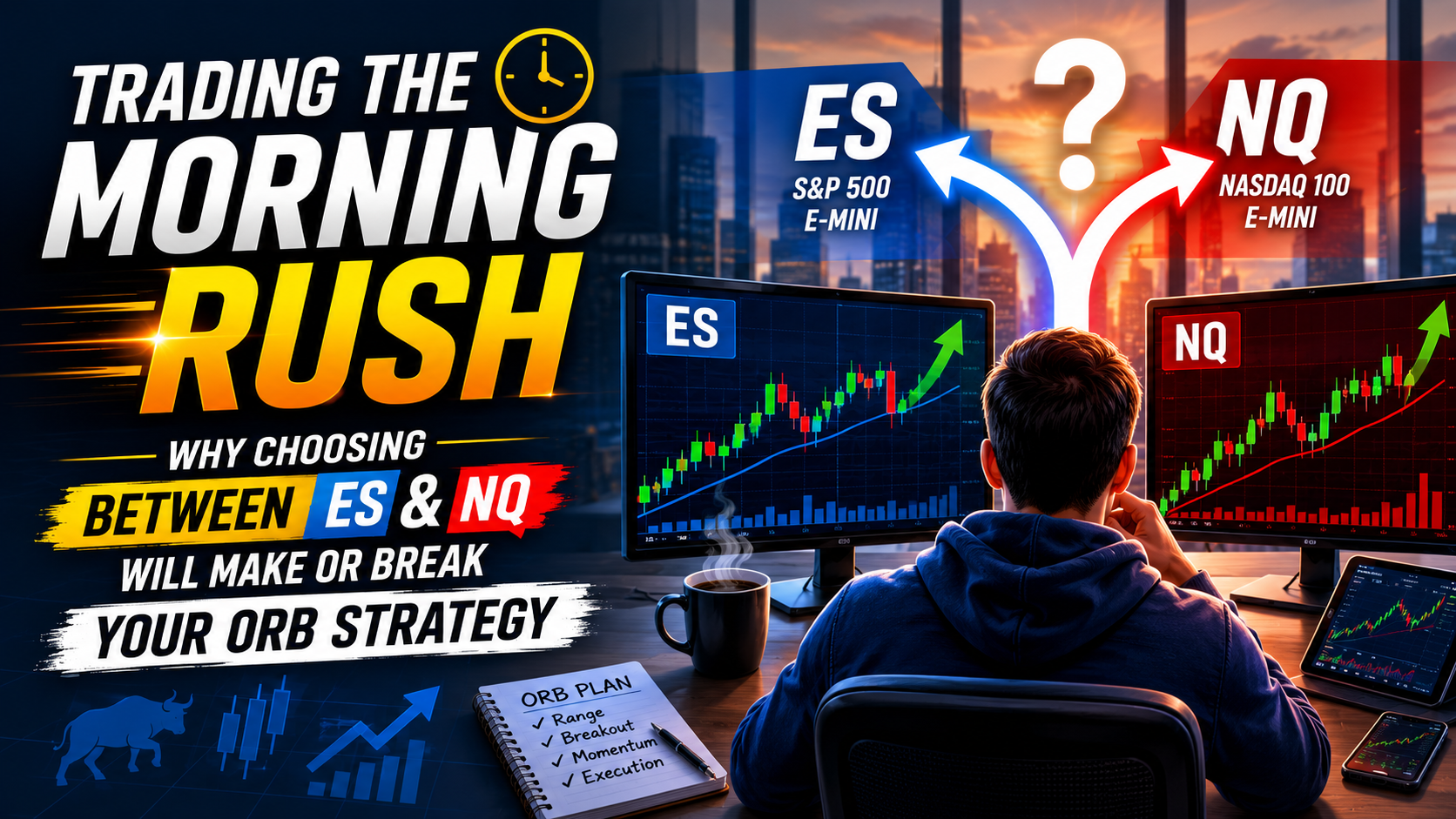
The two primary battlegrounds for retail futures traders are the E-mini S&P 500 (ES) and the E-mini Nasdaq 100 (NQ). Understanding the distinct personality of each is the first critical step to achieving consistency.
The Psychology of the Morning Open
Before comparing the assets, it is crucial to understand why the ORB works in the first place. Overnight trading hours typically feature lower volume and less decisive price action. When the New York session opens at 9:30 AM EST, major funds, institutions, and algorithms begin executing their daily orders.
This surge in market participation creates the initial 15-minute range, which acts as a high-stakes battlefield between buyers and sellers. When one side finally overwhelms the other—breaking the established range—it typically triggers a cascade of stop-loss orders and momentum-based positioning.
But here is where the divergence happens: the ES and the NQ process this institutional order flow in vastly different ways.
The E-mini S&P 500 (ES): The Methodical Heavyweight
The ES is the undisputed king of futures liquidity. Because it tracks the broader S&P 500 index—representing a diverse array of sectors from financials and healthcare to energy and consumer goods—it takes an immense amount of capital to move its price significantly.
- Price Action and Pace: Breakouts on the ES tend to be deliberate, heavy, and methodical. When the ES breaches its 15-minute high or low with volume confirmation, it often grinds aggressively in that direction. You are much less likely to see the price teleport ten points in the blink of an eye.
- Risk Management: Because of its thick order book, the ES acts as a natural shock absorber against erratic, tick-by-tick whipsaws. This allows traders to utilize relatively tighter stop losses. You can define your risk cleanly without constantly getting wicked out by random market noise.
- Ideal Trader Profile: The ES is highly recommended for beginners learning the ORB strategy, conservative traders who prefer a smoother equity curve, and those trading with smaller account sizes. It gives you time to process information and manage your trade without an extreme adrenaline spike.
The E-mini Nasdaq 100 (NQ): The Volatile Beast
If the ES is a steady freight train, the NQ is a high-performance sports car with a hair-trigger accelerator. Tracking the top 100 non-financial companies, the NQ is heavily concentrated in massive technology stocks like Apple, Microsoft, and Nvidia. This tech-heavy weighting makes it incredibly sensitive to morning momentum, algorithmic trading, and rapid sector rotation.
- Price Action and Pace: NQ breakouts are fast, explosive, and often violent. When it breaks the 15-minute range, it can easily cover 20 to 30 points in a matter of seconds, hitting your profit targets before you even have a chance to blink. However, this extreme volatility cuts both ways. The NQ is notorious for aggressive, deep pullbacks—often retesting the breakout level in a terrifying plunge before continuing its overarching trend.
- Risk Management: Trading the NQ requires wide stop losses. If you try to choke your trades with the same tight stops you use on the ES, the NQ’s natural intraday noise will stop you out just moments before the real breakout occurs. Consequently, your dollar risk per trade will be inherently higher unless you significantly size down.
- Ideal Trader Profile: The NQ should be reserved for experienced traders who possess fast execution skills, strict discipline, and the psychological fortitude to stomach large, rapid fluctuations in their floating profit and loss.
Key Factors to Consider Before You Trade
Choosing between the ES and NQ isn’t just about personal preference; it is a tactical decision that must align with your resources.
- Account Size: If you are trading a highly leveraged, smaller account, the ES (or its micro counterpart, the MES) is the responsible choice. A single wicked candle on the NQ can severely damage an undercapitalized account.
- Screen Time and Focus: Trading the NQ requires your undivided, intense attention. You cannot step away or lose focus when you are in an active NQ trade during the morning rush. The ES, while still demanding respect, offers a slightly more forgiving pace.
- Broader Market Conditions: Pay attention to the VIX (Volatility Index). In a high-VIX environment, the NQ can become nearly untradeable for retail traders due to extreme slippage and wide spreads. During these periods, falling back to the ES is a smart, defensive maneuver.
Mastering the Setup
Ultimately, the success of your morning trading routine relies on matching your strategy to the right environment. Whether you choose the steady grind of the ES or the explosive sprints of the NQ, you still need a rigorous, rule-based approach to execute the breakout profitably.