





















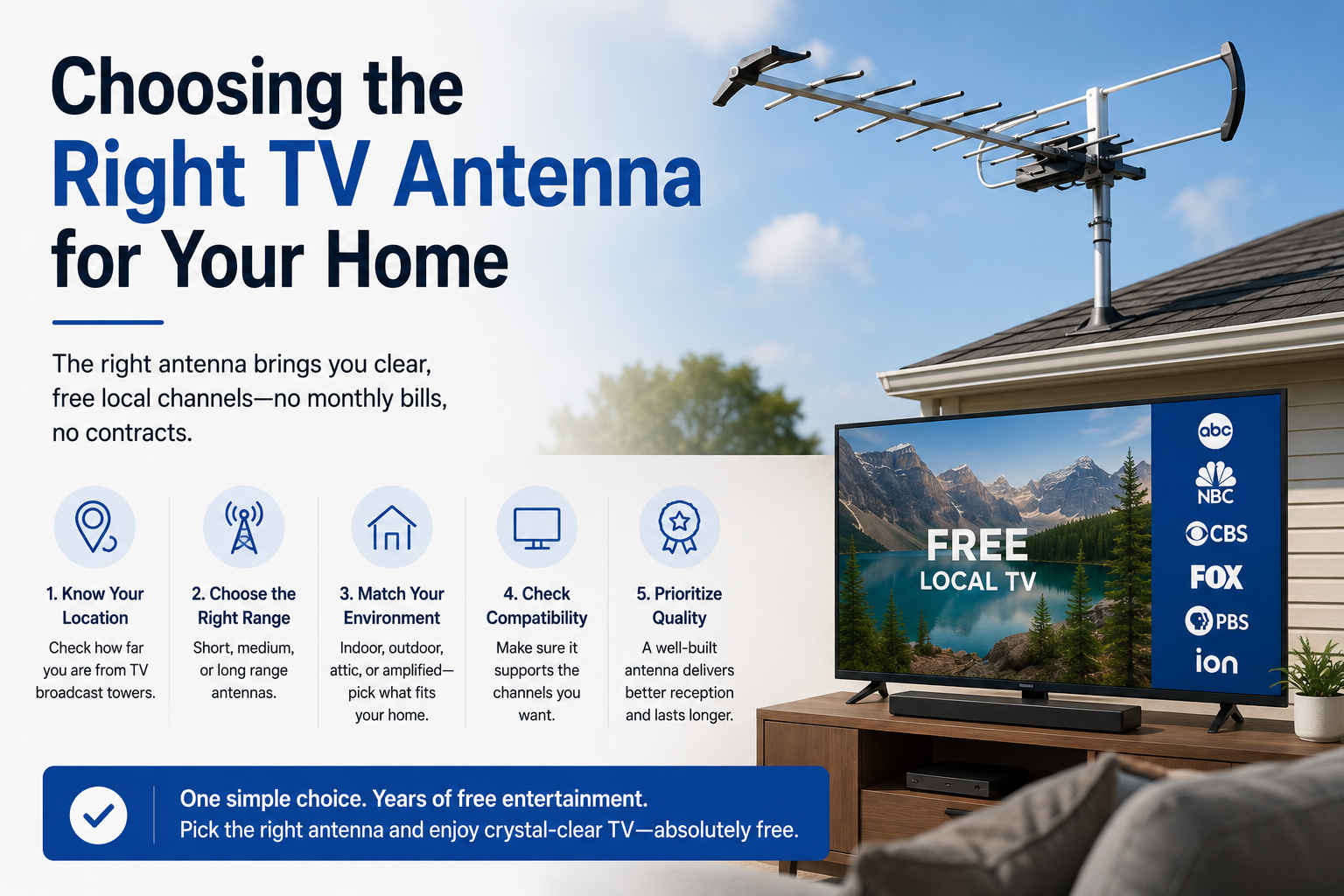
Choosing the right television antenna is essential for receiving clear, reliable digital TV channels throughout your home. The best antenna is not necessarily the largest or most expensive model. Its performance depends on your property’s location, distance from the broadcast tower, surrounding obstructions, roof design and the quality of the complete cabling system. A professional digital TV antenna installation can help identify the antenna type that suits the actual signal conditions at your property rather than relying on guesswork.
Using the wrong antenna may result in pixelation, frozen pictures, missing channels, sound dropouts or reception that becomes unreliable during wind and rain. Before purchasing an antenna, it is important to understand how different designs work and what factors should influence your decision.
Consider the Signal Strength in Your Area
The first step is determining the television signal strength available at your home. Properties located close to a broadcast tower with a clear line of sight may receive a strong signal and only require a relatively simple antenna.
Homes further from the transmitter may need a higher-gain antenna designed to capture weaker signals. Reception can also be affected by hills, apartment buildings, large trees and surrounding development, even when the property is geographically close to the tower.
A signal that appears strong on one part of the roof may be significantly weaker only a few metres away. This is why signal testing at the property is more reliable than selecting an antenna based only on suburb or postcode.
Understand the Difference Between VHF and UHF Antennas
Australian digital television channels are transmitted using VHF, UHF or a combination of both frequencies, depending on the broadcast area.
A VHF antenna is designed to receive Very High Frequency television signals. These antennas commonly feature longer elements and are often used in metropolitan areas where major networks transmit across VHF frequencies.
A UHF antenna receives Ultra High Frequency signals. It generally has shorter elements and may be used in regional locations, areas served by repeater transmitters or suburbs where local transmission services operate on UHF frequencies.
Some homes require a combination antenna capable of receiving both VHF and UHF signals. Choosing the correct frequency range is important because an antenna designed for the wrong band may provide weak or inconsistent reception.
Select an Antenna Designed for Digital Television
Digital television signals do not require a completely different type of antenna from older analogue systems, but modern digital-ready antennas are designed for the frequencies currently used by broadcasters.
An older antenna may still work if it is in good condition and suited to the local frequency range. However, antennas that are corroded, damaged, incorrectly sized or designed for obsolete frequency bands may struggle to deliver reliable digital reception.
A purpose-selected digital antenna can provide better performance by focusing on the required channels while reducing exposure to unwanted frequencies and interference.
Match the Antenna Gain to Your Location
Antenna gain refers to how effectively the antenna receives signals from a particular direction. Higher-gain antennas are generally more directional and can be useful in weak-signal areas.
However, higher gain is not automatically better. In areas with very strong signals, an excessively powerful antenna may contribute to signal overload, particularly when combined with an amplifier. This can cause reception problems that appear similar to weak signal issues.
Highly directional antennas also require more precise alignment. If the antenna shifts during strong winds, reception may deteriorate.
The correct gain should provide enough signal for the home’s television outlets without introducing unnecessary amplification or making the system overly sensitive to movement.
Directional Versus Omnidirectional Antennas
Directional antennas are designed to receive signals from a specific direction. They are commonly used for residential television because broadcast towers are usually located in a known direction from the property.
These antennas can help reject unwanted signals and interference arriving from other directions. When aligned correctly, they often provide more stable performance than an omnidirectional model.
Omnidirectional antennas receive signals from multiple directions. They may be useful in limited situations where signals come from different transmitters, but they can also collect more interference and reflected signals.
For most fixed residential installations, a properly aligned directional antenna is the preferred option.
Think About the Surrounding Environment
The physical environment around your home plays an important role in antenna selection. Large buildings, trees, hills and metal structures can weaken or reflect television signals.
Reflected signals can create multipath interference, where the same broadcast reaches the antenna from several directions at slightly different times. Digital television systems can manage some reflected signals, but excessive multipath interference may cause picture breakup or missing channels.
A more directional antenna may help reduce this problem by concentrating reception towards the main transmitter and rejecting reflected signals from the sides or rear.
Properties in heavily built-up areas may require a different antenna design from homes in open suburban or rural locations, even if both are a similar distance from the tower.
Take the Roof Material Into Account
Roofing materials can influence both antenna placement and reception. Metal roofs can reflect or block television signals, particularly when the antenna is installed inside the roof cavity.
Tile roofs are generally less restrictive, although foil insulation and solar panels may still affect reception. Antennas installed below the roofline may also be obstructed by brick walls, timber framing, insulation and other building materials.
Outdoor roof mounting is usually the most reliable option because it places the antenna above many potential obstructions. The mounting hardware should be selected according to the roof type to ensure the antenna remains secure during strong winds and severe weather.
Indoor and Outdoor Antennas
Indoor antennas are compact and convenient, but their performance is often less reliable than outdoor models. Television signals must pass through walls, windows, roofing materials and internal structures before reaching an indoor antenna.
An indoor antenna may work well in an apartment or home located close to a strong transmitter. However, reception can change when people move through the room, electrical equipment is used or the antenna is repositioned.
Outdoor antennas are generally larger and more exposed, but they provide a clearer signal path and can be mounted higher above surrounding obstacles. For permanent whole-home reception, an outdoor antenna is usually the better long-term solution.
Determine How Many Television Outlets You Need
The number of televisions connected to the antenna system can affect the antenna and equipment required. Each time the signal is divided using a splitter, some signal strength is lost.
A home with one television outlet may perform well with a basic antenna and direct cable run. A larger property with multiple outlets may need stronger incoming signal levels or a properly selected distribution amplifier.
Amplifiers should not be used automatically. They cannot repair a poor-quality signal and may amplify unwanted interference along with the television channels.
The complete system should be designed around the available signal strength, cable lengths, splitter losses and number of connected outlets.
Avoid Choosing an Antenna Based Only on Appearance
Some homeowners choose a small antenna because it is less visible or a large antenna because it appears more powerful. Neither approach guarantees good reception.
A compact antenna may perform very well in a strong-signal area when it is designed for the correct frequencies. A much larger antenna may be necessary in a difficult reception location, but it could be excessive for a property close to the transmitter.
The most suitable antenna is the one matched to the measured conditions at the home. Size, price and appearance should be secondary considerations.
Check the Quality of the Construction
An outdoor antenna must withstand sun, rain, wind, temperature changes and salt exposure in coastal locations. Low-quality materials may corrode, loosen or break over time.
Look for an antenna with durable aluminium elements, secure fixings and a weather-resistant connection point. The mounting mast and brackets should also be strong enough to support the antenna without allowing it to rotate during windy weather.
A well-built antenna can provide many years of reliable service when correctly installed and maintained.
The Importance of Quality Coaxial Cable
Even the best antenna cannot perform properly if the signal is carried through damaged or low-quality cabling. Coaxial cable should have effective shielding to reduce interference from electrical wiring, mobile networks and household equipment.
Old cable may have cracked insulation, moisture damage, poor connectors or excessive signal loss. Wall plates, splitters and joins should also be checked as part of the installation.
Using high-quality cable and compression connectors helps preserve the signal from the roof antenna to each television outlet.
Do You Need a Masthead Amplifier?
A masthead amplifier is installed close to the antenna and boosts the signal before it travels through long cables or multiple splitters. It may be useful where the incoming signal is weak but still clean.
An amplifier should only be installed after signal testing. Adding amplification to a distorted, reflected or overloaded signal will not improve reception and can make the problem worse.
In many homes, repositioning the antenna, using the correct antenna type or replacing damaged cabling provides a better result than simply increasing amplification.
Consider Future Television Requirements
It is worth considering whether more television outlets may be added in the future. A system designed only for one outlet may need significant changes if additional rooms are connected later.
Planning ahead can make it easier to install suitable splitters, accessible cable routes and equipment with enough capacity for future expansion.
The antenna should also be compatible with the television frequencies currently used in the local area, rather than including unnecessary elements for outdated channels.
Why Professional Signal Testing Matters
A professional installer uses specialised equipment to measure signal strength, signal quality, interference and digital error levels. These measurements help identify the most appropriate antenna type, direction and mounting position.
Without testing, reception problems may be incorrectly blamed on the antenna when the real cause is damaged cabling, a poor wall outlet, signal overload or an unsuitable splitter.
Testing the complete system ensures that the selected antenna delivers reliable reception to each television point rather than only performing well at the roof.
Making the Right Choice for Reliable Reception
The right television antenna should be selected according to your location, available frequencies, signal strength, surrounding obstructions and the number of television outlets in the home. It should also be securely mounted, accurately aligned and connected using quality cabling and fittings.
Arranging a professional digital TV antenna installation can remove the uncertainty from the selection process. The installer can test the signal at your property, recommend a suitable antenna and configure the complete system for stable reception.
Choosing an antenna based on real signal conditions helps reduce ongoing pixelation, missing channels and weather-related interruptions. With the correct antenna, installation position and cabling setup, your home can receive clear and dependable digital television for years to come.