

















The Ultimate Guide to Getting Your Driver’s License in Amsterdam (Fast & Stress-Free)
Amsterdam is famous for its bicycles. It’s the quintessential Dutch experience: pedaling along the canals, dodging trams, and enjoying the vibrant city life. But let’s be entirely honest for a second. When November rolls around, bringing sideways rain, freezing winds, and dark afternoons, that bicycle suddenly looks a lot less appealing. Whether you are an expat who just moved to the Netherlands, a student, or a local who finally decided it’s time to upgrade your commute, getting a driver’s license in Amsterdam is a game-changer.
Having a car at your disposal doesn’t just mean staying dry. It means weekend trips to the Veluwe, easy grocery runs to the Albert Heijn XL, and the freedom to explore neighboring countries like Germany and Belgium without relying on train schedules. However, the Dutch driving system is known for being rigorous. The exams are strict, the traffic in Amsterdam is complex, and the waiting times can sometimes test your patience.
In this comprehensive guide, we will walk you through exactly what it takes to get your Dutch driver’s license. We will cover the rules for expats, how to pass your theory and practical exams, and the absolute fastest way to get your hands on that pink card.
Why the Dutch Driving System is Different (and Difficult)
If you already have driving experience in another country, you might be surprised by how thorough the Dutch system is. The Netherlands boasts some of the safest roads in the world, and that is entirely due to the strict standards maintained by the CBR (Centraal Bureau Rijvaardigheidsbewijzen), the organization responsible for driving exams.
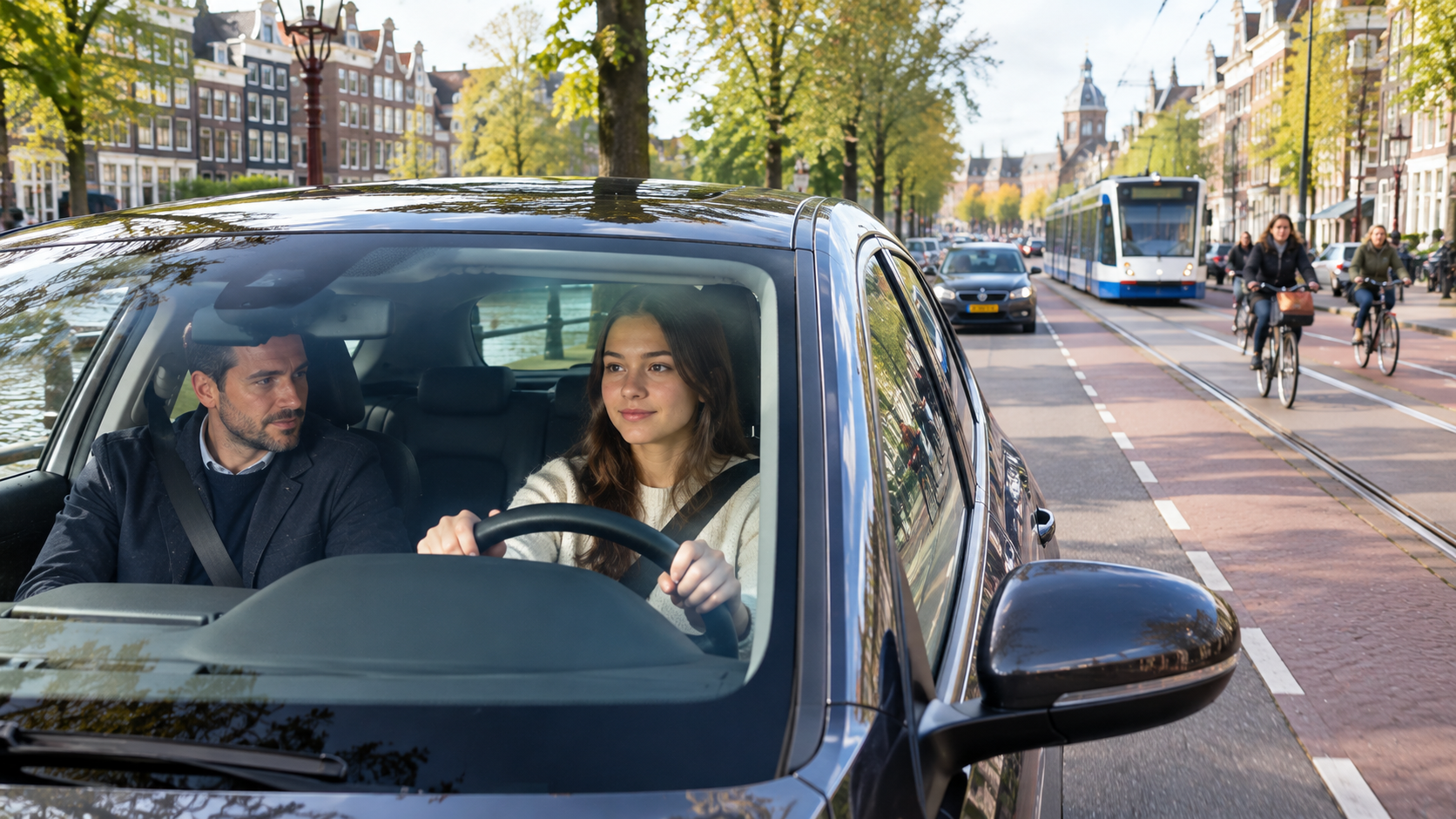
In Amsterdam, you aren’t just learning how to operate a vehicle. You are learning how to interact with a highly complex traffic ecosystem. You have to constantly anticipate the movements of cyclists (who often assume they have the right of way, even when they don’t), trams, pedestrians, and mopeds. The exams are designed to test your situational awareness and hazard perception just as much as your ability to parallel park.
Can Expats Just Exchange Their Foreign License?
Before you sign up for dozens of driving lessons, it is crucial to check if you actually need them. Depending on where you are from and your employment status, you might be able to simply exchange your current license for a Dutch one.
The 30% Ruling Exemption
If you are an expat benefiting from the highly skilled migrant 30% tax ruling, you are in luck. You and your family members can exchange any valid foreign driving license for a Dutch one, regardless of which country issued it. This process is handled through your local municipality (gemeente) and takes a few weeks.
Countries with Exchange Agreements
If you do not have the 30% ruling, you can only exchange your license if it was issued by:
- A country within the EU/EFTA.
- A country that has a specific agreement with the Netherlands (such as Japan, Taiwan, parts of Canada, and Switzerland, among a few others).
If you fall outside of these categories (for example, if you hold a standard license from the United States, India, or Australia and do not have the 30% ruling), your international license is only valid for 185 days after you register at your local municipality. After that, you are required to take both the theory and practical exams to obtain a Dutch driving license.
The Three Pillars of Getting Your License
If you need to start from scratch, or if you need to take the exams because you cannot exchange your license, the process is divided into three main hurdles: the Health Declaration, the Theory Exam, and the Practical Exam.
1. The Health Declaration (Gezondheidsverklaring)
Before you can even book a practical exam, you must prove you are medically fit to drive. This is a digital questionnaire you fill out on the CBR website using your DigiD. It asks basic questions about your eyesight, physical health, and any medical conditions that might affect your driving. It costs around €45. Always do this as early as possible, because if you answer ‘yes’ to any medical question, you might need to see a specialist, which can delay your process by months.
2. Conquering the Theory Exam
Do not underestimate the Dutch theory exam. It is notoriously difficult, with a national pass rate often hovering around 50%. You cannot simply rely on common sense; you need to know the specific rules, road signs, and expected behaviors.
The exam is available in English (for a slightly higher fee) and consists of three parts:
- Hazard Perception (Gevaarherkenning): 25 questions where you have 8 seconds per image to decide whether you should brake, release the accelerator, or do nothing. You must get at least 13 correct. This tests your instinct and anticipation.
- Knowledge (Kennis): 12 questions testing your factual knowledge of traffic rules and signs. You must get at least 10 correct.
- Insight (Inzicht): 28 questions testing your ability to apply the rules in practical situations. You must get at least 25 correct.
Tips for passing your theory: Buy a recent, updated English theory book or use an online premium practice platform. Take dozens of mock exams. Many driving schools also offer 1-day theory crash courses, which are highly recommended if you struggle with self-study.
3. The Practical Exam
Once you have your theory certificate (valid for 1.5 years), you can focus entirely on the practical side. Driving in Amsterdam is unique. Your instructor will train you in quiet residential areas first, before throwing you into the deep end: navigating the busy A10 ring road, dealing with complex multi-lane roundabouts, and handling the narrow, cyclist-heavy streets of the city center.
A typical practical exam lasts about 55 minutes. The examiner from the CBR will assess if you can drive safely, independently, and smoothly. They look at your viewing behavior (looking in mirrors and over your shoulder), your control of the car, and your anticipation of other traffic.
How to Speed Up the Process
One of the biggest frustrations for people trying to get their license is the waiting time. If you take one lesson a week, it can easily take six to nine months to be ready. Furthermore, waiting lists for the CBR practical exams can stretch into months, depending on the season.
If you need your license quickly for a new job, a planned road trip, or simply because you don’t want to drag the process out, you should strongly consider an intensive program. Instead of spreading your lessons over a year, you compress them into a few weeks.
By opting for a specialized fast driving course Amsterdam, you can go from zero experience to a fully licensed driver in a fraction of the time. These courses usually involve driving multiple hours a day, several days a week. The major advantage here is muscle memory. Because you are driving so frequently, you don’t forget what you learned the previous week. You build confidence rapidly, and your instructor handles the exam reservations well in advance so everything aligns perfectly.
Choosing Between Manual and Automatic
A few years ago, everyone in the Netherlands learned to drive a manual car. Today, things are shifting rapidly. With the massive influx of electric vehicles (EVs) and hybrids—which are all automatic—many students are wondering if they should bother with a manual transmission at all.
- Choosing Manual: If you pass your test in a manual car, you are legally allowed to drive both manual and automatic vehicles. This is ideal if you plan to rent cars in Southern Europe or rural areas where manuals are still the cheaper, default option.
- Choosing Automatic (Code 78): If you pass in an automatic, your license will have ‘Code 78’ printed on it. This means you are only legally allowed to drive automatic cars. The main benefit? It’s significantly easier and faster to learn. You don’t have to worry about the clutch, stalling at traffic lights, or shifting gears while simultaneously watching out for a cargo bike cutting you off. You can focus 100% on the traffic around you.
If your goal is just to pass as quickly and smoothly as possible, and you don’t mind being restricted to modern automatic cars, taking automatic lessons is a very smart choice.
The Secret Weapon: The Interim Test (TTT)
If you want to maximize your chances of passing the practical exam on the very first try, ask your instructor about the Tussentijdse Toets (TTT), or Interim Test.
This is essentially a mock exam conducted by an official CBR examiner, usually taken when you are about 75% through your lessons. It is exactly like the real exam, but with one massive benefit: you cannot fail. It is simply a progress check. The examiner will give you an honest evaluation of what you need to work on before the real day.
Even better, if you successfully perform the two required special maneuvers (like parallel parking, turning in a narrow street, or reversing in a straight line) during the TTT, you get an exemption for them on your actual exam. This takes a massive amount of pressure off your shoulders on the big day.
What Makes a Good Driving School in Amsterdam?
Your experience—and your wallet—will heavily depend on the driving school you choose. There are hundreds of independent instructors and large schools in the city. Here is a checklist of what to look for when choosing your partner for this journey:
- Fluent English Instructors: Communication is key. You need an instructor who can clearly explain complex traffic situations in English without hesitation.
- High First-Time Pass Rates: You can check a school’s pass rate on the official CBR website. A high pass rate indicates structured, high-quality teaching, rather than just rushing students to the exam.
- Transparent Pricing: Beware of extremely cheap lesson prices. They often hide administrative fees, or the instructor might prolong your learning process. Look for transparent package deals that include the exam fees.
- Modern Vehicles: Learning in a modern, well-maintained car (often equipped with a reverse camera and modern safety features) makes the learning process much smoother.
- Trial Lesson (Proefles): Never commit to a massive package without taking an intake or trial lesson first. This allows the instructor to gauge your skill level and gives you a chance to see if you actually click with their teaching style.
A Realistic Look at the Costs
Getting a license in the Netherlands is an investment. It is not cheap, but the quality of education ensures you are a genuinely safe driver for the rest of your life. While prices vary depending on your starting level and how fast you learn, here is a general breakdown of what to expect:
- Average number of lessons: The CBR states the average student needs about 43 hours of lessons. Naturally, if you have prior experience in another country, this number will be drastically lower.
- Hourly rate: Expect to pay between €55 and €75 per hour of driving.
- Theory exam: Roughly €41 (plus a small surcharge for the English version).
- Practical exam: The CBR fee is around €136, but schools usually charge administration and car-rental fees for the exam day, bringing the total cost per exam attempt to around €280 – €320.
- Health declaration: Approximately €45.
All in all, a complete beginner should budget anywhere between €2,500 and €3,500 for the entire process. Buying a package deal is almost always cheaper than paying per individual lesson.
Step-by-Step Action Plan to Get Started Today
Feeling overwhelmed? Don’t be. Here is a simple, actionable checklist to get the ball rolling this week:
- Determine your status: Check with your municipality if you qualify for the 30% ruling exchange. If yes, start the paperwork. If no, proceed to step 2.
- Sort your DigiD: You will need this digital identity to log into the CBR system.
- Fill out the Health Declaration: Go to ‘Mijn CBR’, pay the fee, and submit your medical questionnaire. Do this today.
- Start studying for theory: Buy an English theory book or an online course. Do not wait until you are driving perfectly to start studying; get the theory out of the way early.
- Book a trial lesson: Find a reputable driving school in Amsterdam that caters to internationals and book an intake. Let them assess your skills and advise you on a lesson package.
- Decide on your pace: Discuss with your instructor if a standard weekly schedule or an intensive crash course fits your lifestyle better.
Final Thoughts
Getting your driver’s license in Amsterdam can feel like a daunting task, especially with the weather, the trams, and the sheer volume of bicycles. However, with the right mindset, thorough preparation, and an experienced instructor by your side, it is a highly rewarding achievement.
Remember that the goal isn’t just to pass a test; the goal is to become a confident, safe driver who can navigate one of Europe’s most dynamic cities with ease. Take your time to study the theory, invest in quality lessons, and if you want to skip the endless months of waiting, look into an intensive program. Before you know it, you’ll be trading the wet bicycle saddle for a warm driver’s seat, ready to explore everything the Netherlands has to offer. Good luck on the road!